Black Carbon as a ShortLived Climate Pollutant and Cryosphere Risk
Source:Indian Express ↗
ఇది ఎందుకు ముఖ్యం
Black carbon represents a vital topic under environmental degradation and climate change, frequently appearing in UPSC Prelims and Mains regarding short-lived climate pollutants, cryosphere dynamics, and air pollution.
సారాంశం
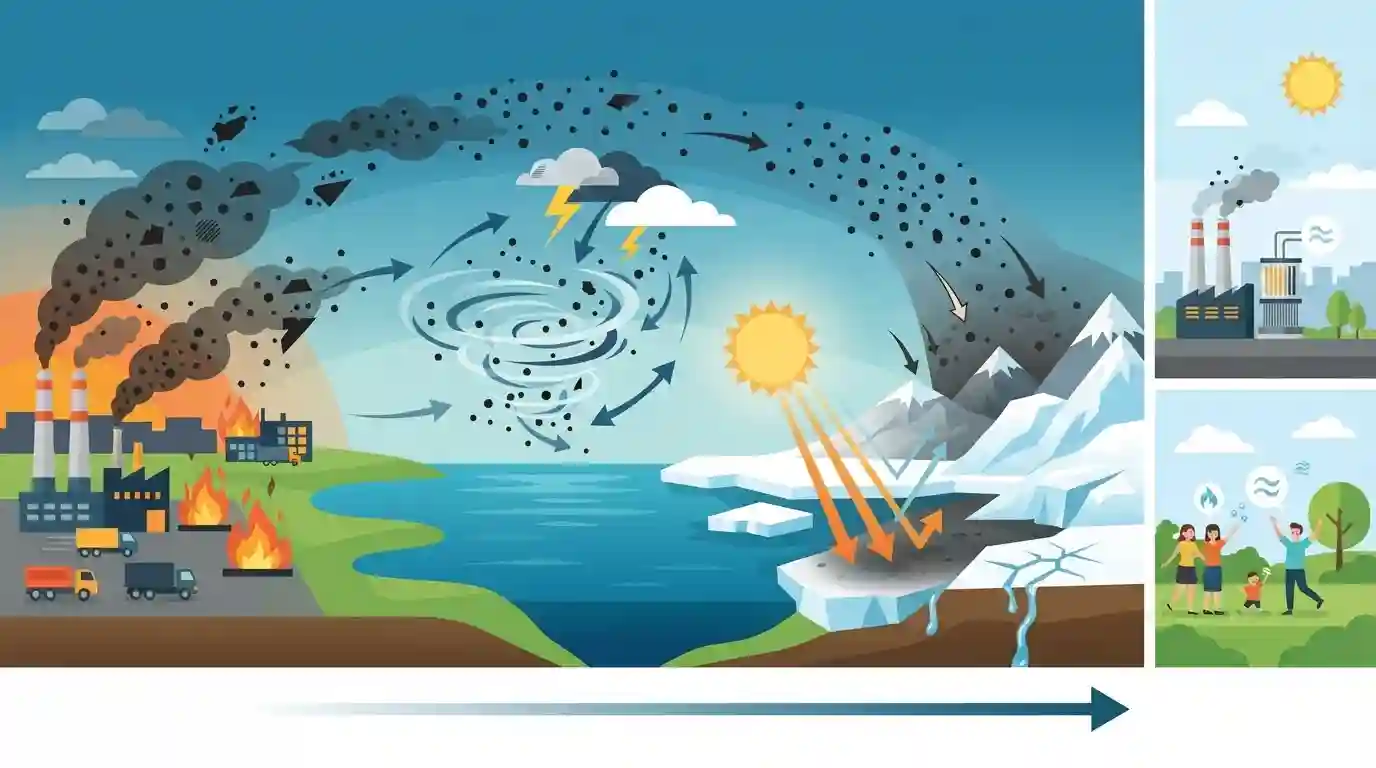
The article highlights black carbon as a critical short-lived climate pollutant (SLCP) that significantly impacts global warming, regional weather patterns, and cryosphere health. Because of its strong light-absorbing properties and role in reducing snow and ice albedo, mitigating black carbon offers immediate co-benefits for climate action and public health.
ముఖ్య అంశాలు
- Black carbon is a short-lived climate pollutant (SLCP) formed through the incomplete combustion of fossil fuels, biofuels, and biomass.
- It has a strong warming impact on the atmosphere by absorbing sunlight and reducing surface albedo when deposited on snow and ice, accelerating glacier melt.
- Unlike carbon dioxide, which remains in the atmosphere for centuries, black carbon persists for only a few days to weeks, making mitigation an effective strategy for near-term climate relief.
- Key sources include residential solid fuel burning, open biomass burning, diesel engines, and industrial emissions.
ముఖ్యమైన పదాలు
Black Carbon

A potent climate-warming particulate formed by incomplete combustion, having a short atmospheric lifespan and accelerating cryosphere melting when deposited on snow and ice.
UPSC context
GS Paper III (Environment and Ecology) — tests understanding of climate change drivers, air pollution, and cryosphere degradation.
Short-Lived Climate Pollutants (SLCPs)
Pollutants such as black carbon, methane, and tropospheric ozone that remain in the atmosphere for a relatively short time but exert high warming impacts.
UPSC context
GS Paper III (Environment and Ecology) — important for climate mitigation strategies and fast-action global policies.
Albedo Effect
The fraction of solar radiation reflected by a surface, which decreases significantly when dark pollutants like black carbon settle on snowfields and glaciers.
UPSC context
GS Paper I (Geography) and GS Paper III (Environment) — tests physical geography concepts and feedback loops in global warming.
UNFCCC
An international environmental treaty adopted at the 1992 Rio Earth Summit to stabilize atmospheric greenhouse gas concentrations and coordinate global climate action.
UPSC context
GS Paper III (Environment and Ecology) — core international governance framework tested frequently in Prelims and Mains.
ప్రిలిమ్స్ ఉచ్చు
Black carbon is a long-lived greenhouse gas that accumulates in the stratosphere over centuries.
Aspirants often confuse black carbon as a greenhouse gas with a long atmospheric lifetime, whereas it is actually a particulate aerosol that persists for only days to weeks.
అనుసంధానమైన స్థిర భావనలు
What are Short-Lived Climate Pollutants (SLCPs) and their key atmospheric characteristics?
- Atmospheric Lifetime: Short lifespan lasting from a few days to a few decades in the atmosphere, unlike CO2 which persists for centuries.
- Key Constituents: Includes black carbon, methane, tropospheric ozone, and hydrofluorocarbons (HFCs) with potent warming impacts.
- Climate Co-benefits: Targeting SLCPs provides immediate near-term cooling and slows down the rate of near-term climate change.
అంతర-అంశ నమూనాలు
Black Carbon & PM2.5 Health Linkages
Black carbon emissions intersect with air quality standards (PM2.5) and international commitments under the Climate Change convention, testing India's balance between development and net-zero goals.

Black carbon vs CO2 atmospheric lifetimes and albedo impact frequently feature in elimination-based UPSC statements.
అనుసంధాన PYQలు · 2
అనుసంధాన PYQలు · 2
- 2024PrelimsGS1
One of the following regions has the world's largest tropical peatland, which holds about three years worth of global carbon emissions from fossil fuels; and the possible destruction of which can exert detrimental effect on the global climate. Which one of the following denotes that region?
- 2026PrelimsGS1
Consider the following statements with reference to India's response to climate change : I. India's Long-Term Low Emission Development Strategy (LT-LEDS) is a crucial tool for achieving net-zero emissions by 2070. II. India's 4th Biennial Update Report (BUR-4) submitted in December, 2024 recorded around 8% decrease in Greenhouse gas emissions in 2020 over 2019. III. Climate-resilient development necessarily depends on quick and short-term achievement of emission reduction targets. Which of the following relationships among the above statements is/are correct ? 1. Statement I is empirically supported by statement II. 2. Statement III contradicts the approach implicit in statement I. 3. Statement I and statement III together establish the premise of long-term sustainability. Select the answer using the code given below :
