AI and Digital Public Infrastructure Transform Indian Agriculture
Source:Indian Express ↗
Why It Matters
The integration of AI and Digital Public Infrastructure (DPI) in agriculture is a core focus area for government policy aimed at doubling farmers' income and climate resilience, making it highly probable for GS3 questions on e-technology in agriculture.
Summary
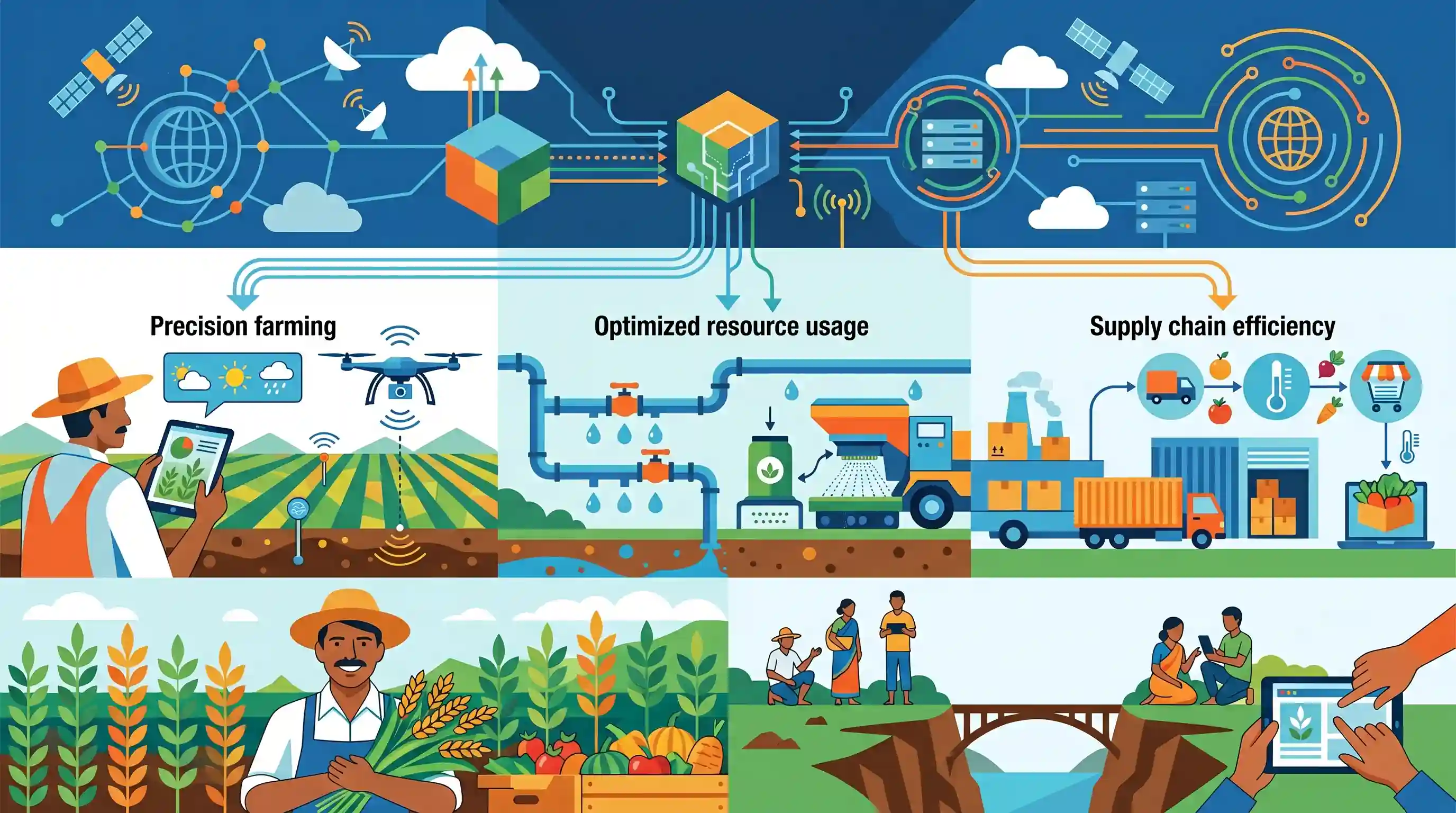
The article explores the ongoing digital transformation of Indian agriculture, highlighting the role of artificial intelligence and digital public infrastructure (DPI) in aiding farmers. It focuses on the Bharat-VISTAAR initiative alongside the broader Digital Agriculture Mission (including AgriStack and Krishi-DSS) as tools to provide precision farming advisories, optimize resource usage, and improve supply chain efficiency. While these e-technologies hold the potential to drastically improve agricultural productivity and resilience, successful implementation requires bridging the rural digital divide and enhancing digital literacy among smallholder farmers.
Key Points
- AI and digital technologies like drones, IoT sensors, and satellite analytics are modernizing Indian agriculture through precision farming and data-driven yield prediction.
- Initiatives like Bharat-VISTAAR serve as AI-powered agricultural extension systems to deliver tailored, real-time advisories directly to farmers.
- The Digital Agriculture Mission, underpinned by digital public infrastructure like AgriStack and Krishi-DSS, aims to streamline farmer registries, crop surveys, and support delivery.
- These technological interventions aim to solve systemic issues like resource inefficiency, fragmented supply chains, and climate vulnerabilities.
- Structural challenges remain, including the rural digital divide, low digital literacy among small and marginal farmers, and concerns over agricultural data privacy.
Important Terms
Digital Agriculture Mission

An umbrella scheme approved to establish Digital Public Infrastructure for agriculture, focusing on data-driven solutions like AgriStack and Krishi-DSS to modernize the sector and improve service delivery.
UPSC context
GS III: Technology Missions; crucial for understanding India's strategy to digitize farm services and improve policy efficiency.
AgriStack
A Digital Public Infrastructure (DPI) comprising foundational registries—Farmer ID, Geo-referenced Village Maps, and Crop Sown Registry—to enable targeted service delivery, credit access, and insurance.
UPSC context
GS III: E-technology in aid of farmers; relevant for questions on digital identity and precision agriculture.
Bharat-VISTAAR
An AI-powered, multilingual conversational platform that provides personalized agricultural advisories through voice and text, integrating scientific research from ICAR and real-time weather and market data.
UPSC context
GS III: E-technology; highlights the role of Generative AI in bridging the rural information gap and digital divide.
Krishi-DSS
A comprehensive geospatial system that integrates satellite imagery, weather, soil, and water data to provide real-time alerts and support evidence-based agricultural decision-making and yield estimation.
UPSC context
GS III: Science & Tech; tests knowledge of remote sensing applications in disaster management and crop insurance.
National Agriculture Market (e-NAM)
A pan-India electronic trading portal that networks existing APMC mandis to create a unified national market, facilitating transparent price discovery and direct online payments to farmers.
UPSC context
GS III: Agricultural Marketing; central to discussions on market reforms and achieving "One Nation, One Market."
Indian Council of Agricultural Research (ICAR)
The apex autonomous body under the Ministry of Agriculture responsible for coordinating, guiding, and managing agricultural research, education, and extension services across India.
UPSC context
GS III: Major crops/cropping patterns; fundamental institution for scientific advancement and technology extension in Indian agriculture.
Prelims Trap
AgriStack's Farmer and Crop Registries are centrally populated and maintained by the Union Government.
Land records and agricultural data fall under State purview. While the Union provides the digital architecture (AgriStack), foundational registries are actually maintained by respective State governments.
Static Concepts Connected
What are the foundational layers of India's Digital Public Infrastructure (DPI)?
- Identity layer: Uses Aadhaar to provide unique biometric identification for residents, forming the base of the stack.
- Payments layer: Enabled by UPI for interoperable, real-time, and cashless financial transactions across platforms.
- Data layer: Uses DEPA (Data Empowerment and Protection Architecture) for secure, user-consent-based sharing of personal data.
What is the traditional role of Agricultural Extension in India?
- Tech Transfer: Facilitating lab-to-land initiatives by transferring scientific research and modern farming practices directly to fields.
- Capacity Building: Training farmers on resource optimization, new crop varieties, and modern machinery adoption.
- Advisory Services: Providing timely pest management, weather, and market information, which is now being upgraded via AI.
Cross-Topic Patterns
Space tech in crop monitoring
Krishi-DSS bridges space tech and agriculture by using ISRO satellite data alongside groundwater metrics for real-time crop acreage mapping and drought monitoring.
Federalism in digital governance
AgriStack demonstrates cooperative federalism; the Union provides the digital federated architecture, while States execute ground-level data collection to populate local land and farmer registries.

Expect a multi-statement Prelims question testing the specific ministries and state vs. central roles in AgriStack and Krishi-DSS.
Linked PYQs · 2
Linked PYQs · 2
- 2023MainsGS3
How does e-Technology help farmers in production and marketing of agricultural produce? Explain it.
- 2017PrelimsGS1
What is/are the advantage/advantages of implementing the 'National Agriculture Market' scheme? 1. It is a pan-India electronic trading portal for agricultural commodities. 2. It provides the farmers access to nationwide market, with prices commensurate with the quality of their produce. Select the correct answer using the code given below:
