RBI Cyber Security Measures and the Restricted Bank In Domain
Source:Indian Express ↗
Why It Matters
UPSC tests the understanding of institutional measures to combat cyber threats. The '.bank.in' domain is a critical regulatory and technological tool by the RBI to secure the digital banking ecosystem, making it relevant for GS3 Cyber Security and Economy sections.
Summary
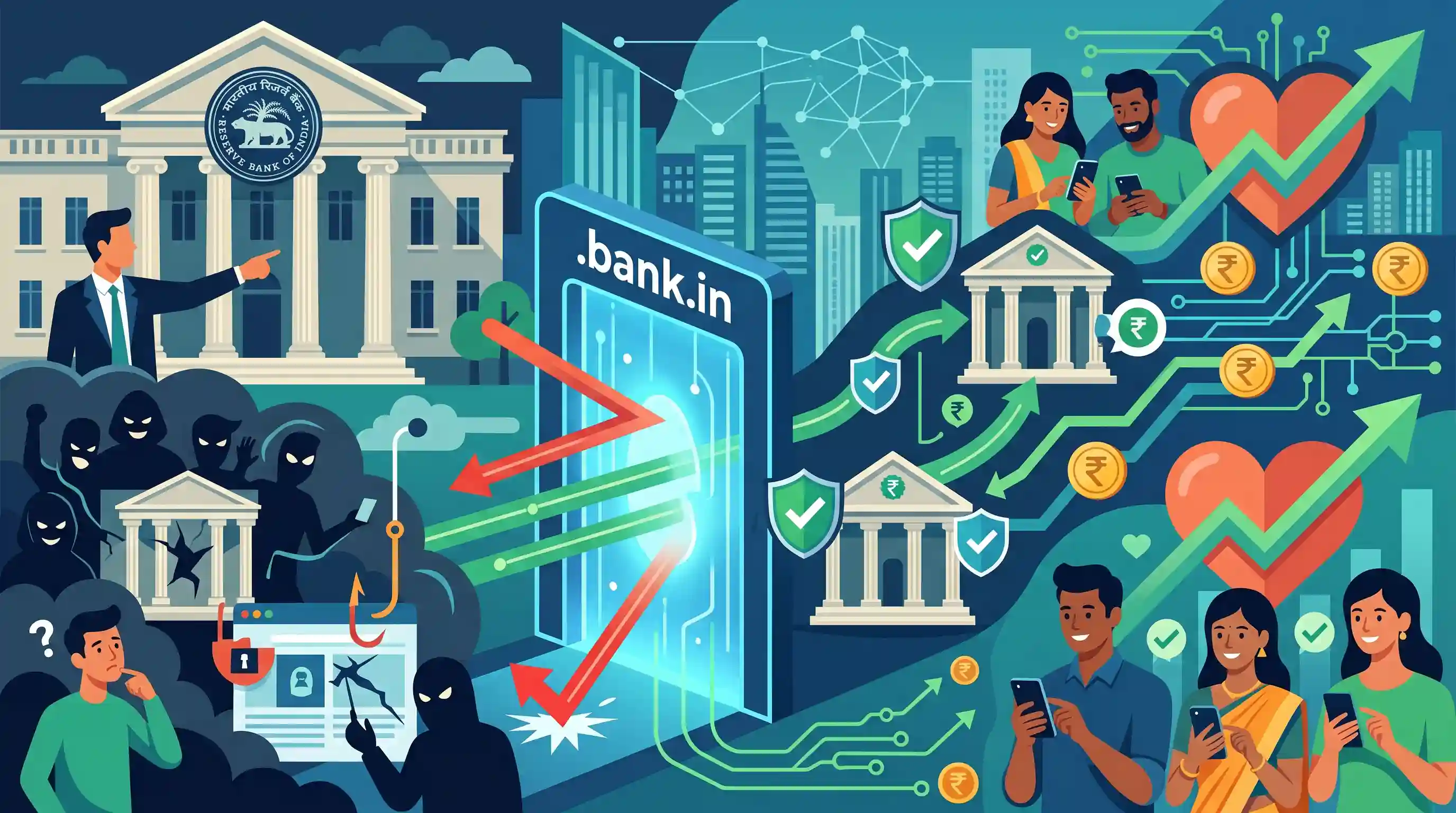
To bolster cybersecurity and protect consumers from digital fraud, the Reserve Bank of India (RBI) supports the use of the restricted '.bank.in' domain for Indian banks. Managed under the '.in' registry by NIXI, this domain is exclusively available to RBI-licensed banking entities. By migrating to '.bank.in', banks can effectively mitigate phishing and domain spoofing attacks, as it prevents malicious actors from creating fake banking websites. This initiative strengthens the cyber resilience of India's financial sector and enhances customer trust in the rapidly growing digital payments ecosystem.
Key Points
- The '.bank.in' is a restricted third-level domain name under India's '.in' country-code top-level domain (ccTLD), specifically reserved for banking institutions.
- Only entities licensed and recognized by the Reserve Bank of India (RBI) are eligible to register and operate websites using the '.bank.in' domain.
- The primary objective is to enhance cybersecurity by preventing domain spoofing, phishing attacks, and the creation of fake banking websites that trick customers.
- It creates a verifiable and trusted digital environment, reinforcing customer confidence in digital banking and online payments.
- The '.in' registry, including restricted domains, is managed by the National Internet Exchange of India (NIXI).
Important Terms
Reserve Bank of India (RBI)

India's central bank, established in 1935, responsible for regulating the banking system, managing monetary policy, and maintaining financial stability.
UPSC context
GS Paper III: Indian Economy; tests knowledge of banking regulation and financial stability.
National Internet Exchange of India (NIXI)
A not-for-profit company under MeitY that manages the '.in' registry and internet exchanges, facilitating domestic routing of internet traffic to reduce latency.
UPSC context
GS Paper III: IT & Security; relevant for digital infrastructure and internet governance.
.bank.in domain
A restricted, exclusive domain extension for RBI-licensed banks designed to prevent fraud by ensuring only verified financial institutions can operate under this web identity.
UPSC context
GS Paper III: Cyber Security; tests measures to protect digital payment ecosystems from fraud.
Phishing and Domain Spoofing
Phishing uses deceptive messages to steal data; Domain Spoofing is a technical impersonation of a legitimate website to trick users into trusting a fraudulent source.
UPSC context
GS Paper III: Internal Security; fundamental cyber threats impacting the financial sector.
Cyber Resilience
The capacity of an entity to withstand, recover from, and adapt to cyberattacks while maintaining essential operations and protecting consumer trust.
UPSC context
GS Paper III: Internal Security; core objective of national cybersecurity strategies and infrastructure protection.
Institute for Development and Research in Banking Technology (IDRBT)
An RBI-funded autonomous research institute that acts as the exclusive registrar for the '.bank.in' domain and supports banking technology development.
UPSC context
GS Paper III: Economy/S&T; subsidiary body supporting technical banking standards.
Prelims Trap
"The National Internet Exchange of India (NIXI) is a statutory body under the IT Act."
NIXI is actually a not-for-profit organization registered under Section 8 of the Companies Act, not a statutory body created by an Act of Parliament.
Static Concepts Connected
What is the mandate and organizational structure of NIXI?
- Section 8 Company: Established in 2003 as a not-for-profit company under Section 8 of the Companies Act to facilitate routing of domestic internet traffic.
- .IN Registry: Operates the INRegistry, managing India's country-code top-level domain (.in) and restricted third-level domains like .gov.in and .bank.in.
- IP Allocation: Acts as the National Internet Registry (NIR) to allocate and manage IPv4 and IPv6 addresses in India via IRINN.
How do Domain Spoofing and Phishing differ in cyber-attacks?
- Domain Spoofing: A technique where attackers forge a website's URL (e.g., using look-alike domains) to deceive users into believing they are interacting with a legitimate entity.
- Phishing: A broader social engineering attack using deceptive communications (emails, SMS) to trick victims into revealing sensitive financial or personal data.
Cross-Topic Patterns
Financial Cyber Resilience & CERT-Fin
RBI's .bank.in mandate aligns with broader financial cyber resilience, echoing the proposed CERT-Fin for the financial sector and IDRBT's mandate to secure India's digital payment architecture.
Data Sovereignty via ccTLDs
Securing critical sectors under India's own country-code top-level domain (.in) reduces reliance on foreign global registries, a key facet of India's ongoing digital sovereignty push.

Expect a 2026 prelims statement pairing NIXI's non-statutory (Section 8) status with IDRBT's exclusive role in RBI-regulated tech.
Linked PYQs · 4
Linked PYQs · 4
- 2020MainsGS3
Discuss different types of cyber crimes and measures required to be taken to fight the menace.
- 2022MainsGS3
What are the different elements of cyber security ? Keeping in view the challenges in cyber security, examine the extent to which India has successfully developed a comprehensive National Cyber Security Strategy.
- 2017MainsGS3
Discuss the potential threats of Cyber attack and the security framework to prevent it.
- 2018PrelimsGS1
With reference to digital payments, consider the following statements: 1. BHIM app allows the user to transfer money to anyone with a UPI-enabled bank account. 2. While a chip-pin debit card has four factors of authentication, BHIM app has only two factors of authentication. Which of the statements given above is/are correct?
