Sixteenth Finance Commission constitutional mandate and devolution
Source:Indian Express ↗
Why It Matters
The Finance Commission is a foundational pillar of India's federal structure. Its recommendations directly dictate state budgets, local governance funding, and macroeconomic stability, making it a highly recurring topic in both Prelims and Mains.
Summary
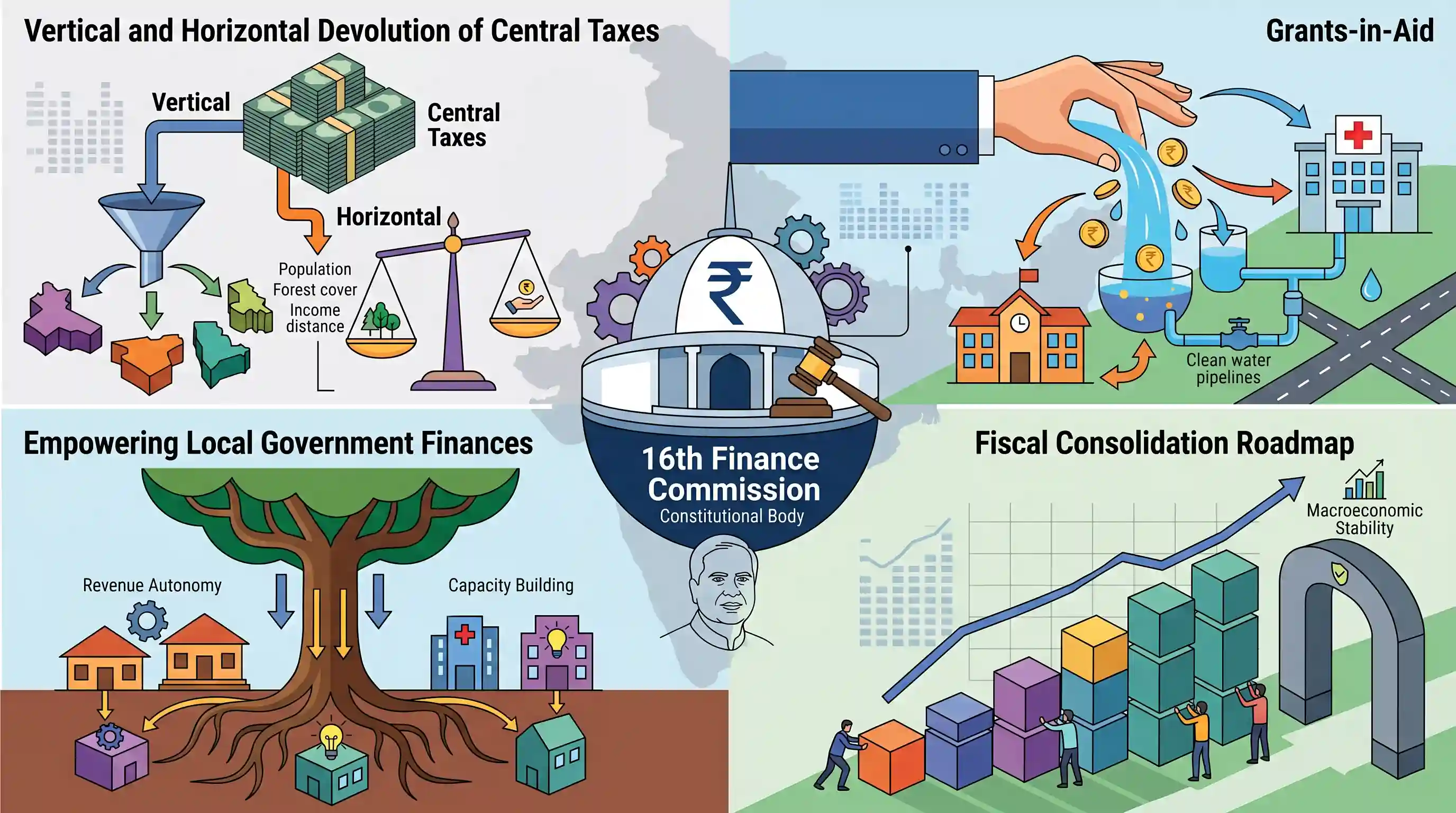
The article serves as a comprehensive study guide on the 16th Finance Commission, breaking down its Constitutional mandate, composition, and key areas of focus for UPSC aspirants. Headed by Dr. Arvind Panagariya, the Commission is responsible for deciding the vertical and horizontal devolution of central taxes, ensuring equitable resource distribution among states. It evaluates grants-in-aid, strategies to empower local government finances, and outlines a fiscal consolidation roadmap to maintain macroeconomic stability. Understanding the Commission's criteria and recommendations is essential for analyzing India's evolving fiscal federalism and Centre-State financial relations.
Key Points
- The 16th Finance Commission, established under Article 280 of the Constitution and chaired by Dr. Arvind Panagariya, plays a pivotal role in shaping Centre-State financial relations.
- Its core mandate includes recommending the vertical devolution (the share of central taxes allocated to states) and the horizontal devolution (the formula determining each state's individual share).
- Key factors in the devolution formula typically include income distance, population, area, forest ecology, and demographic performance.
- The Commission also outlines principles for grants-in-aid to states from the Consolidated Fund of India and measures to augment state consolidated funds to supplement resources for local bodies.
- Fiscal consolidation and maintaining sustainable debt-to-GDP ratios for both the Union and States are critical aspects of the Commission's evaluations.
Important Terms
Article 280 of the Indian Constitution

A constitutional provision empowering the President to constitute a Finance Commission every five years to recommend the distribution of tax revenues between the Union and the States.
UPSC context
GS Paper II (Constitutional Bodies); tests knowledge of the institutional framework governing Centre-State financial relations.
16th Finance Commission
The constitutional body chaired by Dr. Arvind Panagariya, tasked with determining the tax-sharing formula and fiscal roadmap between the Centre and States for 2026–2031.
UPSC context
Current Affairs; vital for questions on recent developments in India's fiscal architecture and federalism.
Vertical Devolution
The percentage-based allocation of the Union’s divisible tax pool to all State governments collectively, addressing the vertical fiscal imbalance in the federal structure.
UPSC context
GS Paper III (Economy); essential for understanding resource mobilization and the core mechanics of tax sharing.
Horizontal Devolution
The formula-based distribution of the States' collective tax share among individual States, using specific criteria like population, forest cover, and income distance.
UPSC context
GS Paper III (Economy); tests the ability to analyze regional equity and inter-state resource distribution criteria.
Fiscal Federalism
The system of financial relations and division of taxing and spending powers between different levels of government (Union, State, and Local).
UPSC context
GS Paper II (Governance); a recurring conceptual pillar for questions on cooperative federalism and decentralization.
Fiscal Responsibility and Budget Management (FRBM) Act
Legislation enacted in 2003 to institutionalize financial discipline, reduce fiscal deficits, and ensure long-term macroeconomic stability through rule-based targets.
UPSC context
GS Paper III (Budgeting); critical for discussing fiscal consolidation, debt sustainability, and government accountability.
Prelims Trap
"The Finance Commission distributes all Central tax revenues, including cesses and surcharges, among the states."
Cesses and surcharges levied by the Union are explicitly excluded from the divisible tax pool under Article 270. They remain entirely with the Centre.
Static Concepts Connected
What is the constitutional status and composition of the Finance Commission?
- Constitutional Body: Established under Article 280 of the Constitution, making it a constitutional, quasi-judicial, and advisory body.
- Composition: Consists of a Chairman and four other members appointed by the President of India.
- Qualifications: The Constitution authorizes Parliament to determine the qualifications of members and the manner of their selection (Finance Commission Act, 1951).
What is the difference between Statutory and Discretionary Grants to states?
- Statutory Grants: Under Article 275; given on Finance Commission's recommendation to states needing assistance, charged on the Consolidated Fund of India.
- Discretionary Grants: Under Article 282; both Centre and states can make grants for public purposes. These fall outside the Finance Commission's purview.
Cross-Topic Patterns
Southern States & Demographic Performance
The tension between population control success (Southern states) and devolution criteria connects Finance Commission debates directly to the upcoming delimitation freeze and demographic dividend topics.
73rd/74th Amendments & State FCs
The Union FC relies on State Finance Commissions to augment local body resources, linking macro fiscal federalism directly to 73rd/74th Amendment implementation and Panchayati Raj empowerment.

Expect a mixed-statement Prelims question testing 16th FC's horizontal devolution criteria weights against the 15th FC's formula.
Linked PYQs · 5
Linked PYQs · 5
- 2025PrelimsGS1
Which of the following statements with regard to recommendations of the 15th Finance Commission of India are correct? I. It has recommended grants of ₹ 4,800 crores from the year 2022-23 to the year 2025-26 for incentivizing States to enhance educational outcomes. II. 45% of the net proceeds of Union taxes are to be shared with States. III. ₹ 45,000 crores are to be kept as performance-based incentive for all States for carrying out agricultural reforms. IV. It reintroduced tax effort criteria to reward fiscal performance. Select the correct answer using the code given below.
- 2023PrelimsGS1
Consider the following: 1. Demographic performance 2. Forest and ecology 3. Governance reforms 4. Stable government 5. Tax and fiscal efforts For the horizontal tax devolution, the Fifteenth Finance Commission used how many of the above as criteria other than population area and income distance?
- 2025MainsGS2
Examine the evolving pattern of Centre-State financial relations in the context of planned development in India. How far have the recent reforms impacted the fiscal federalism in India?
- 2018MainsGS2
How is the Finance Commission of India constituted? What do you know about the terms of reference of the recently constituted Finance Commission? Discuss.
- 2021MainsGS2
How have the recommendations of the 14th Finance Commission of India enabled the States to improve their fiscal position?
