Sixteenth Finance Commission Recommendations on Fiscal Federalism
Source:Indian Express ↗
Why It Matters
The Finance Commission is a cornerstone of India's fiscal federalism. Questions regarding its composition, the criteria used for horizontal tax devolution (e.g., population vs demographic performance), and its impact on Centre-State relations appear repeatedly in both UPSC Prelims and Mains (GS2 and GS3).
Summary
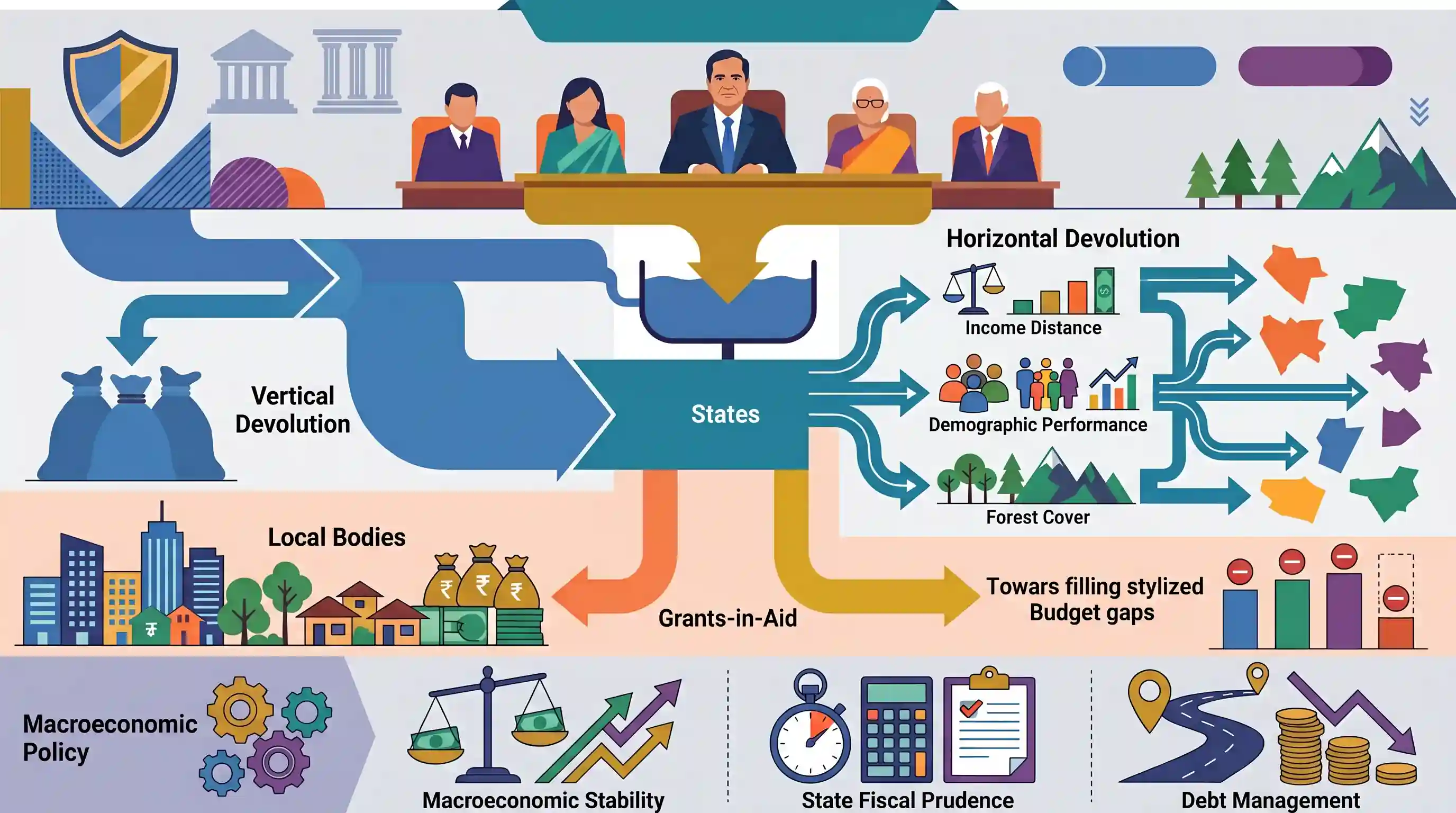
The article outlines the key highlights of the 16th Finance Commission's report, focusing on its recommendations for Centre-State financial relations. Constituted under Article 280 and chaired by Arvind Panagariya, the Commission determines the blueprint for fiscal federalism in India for the 2026-2031 period. Key areas of focus include vertical devolution (the states' aggregate share in central taxes), horizontal devolution (the formula determining each state's individual share using criteria like income distance, demographic performance, and forest cover), and various grants-in-aid to support local bodies and bridge revenue deficits. It also emphasizes state fiscal prudence, macroeconomic stability, and debt management roadmaps in line with federal mandates.
Key Points
- The 16th Finance Commission, chaired by Arvind Panagariya, recommends the tax-sharing formula between the Centre and States for the period 2026-27 to 2030-31.
- Vertical Devolution determines the overall percentage of the central divisible pool of taxes to be shared with the states (historically maintained around 41% under the 15th FC).
- Horizontal Devolution involves distributing this share among individual states based on criteria like income distance, population, area, forest & ecology, demographic performance, and tax effort.
- Grants-in-aid under Article 275 include revenue deficit grants, sector-specific grants, and performance-based incentives for local bodies to strengthen grassroots governance.
- Fiscal consolidation roadmaps and state-level fiscal performance parameters are closely monitored to maintain macroeconomic stability and debt sustainability.
Important Terms
Article 280 of the Constitution

A constitutional provision empowering the President to constitute a Finance Commission every five years to recommend the distribution of tax proceeds between the Union and States.
UPSC context
GS Paper-II (Constitutional Bodies) and GS-III; tests understanding of fiscal governance and Centre-State relations.
16th Finance Commission
Chaired by Arvind Panagariya, this body recommends the fiscal roadmap for 2026–2031, retaining a 41% vertical devolution and introducing "GDP contribution" as a horizontal criterion.
UPSC context
GS-III (Economy) and Current Affairs; tests latest fiscal policy shifts and performance-linked federal transfers.
Vertical Devolution
The allocation of the "divisible pool" of central taxes between the Union government and all state governments collectively. The 16th Commission maintained this at 41%.
UPSC context
GS-III (Budgeting); tests knowledge of the aggregate resource transfer mechanism from Centre to States.
Horizontal Devolution
A formula-based distribution of the states' collective tax share among individual states using criteria like income distance, population, and forest cover to ensure regional equity.
UPSC context
GS-III (Economy); tests how the government balances regional equity with performance incentives.
Fiscal Responsibility and Budget Management (FRBM) Act
A 2003 Act designed to institutionalize fiscal discipline, reduce India's fiscal deficit, and ensure long-term macroeconomic stability through rule-based spending and debt management.
UPSC context
GS-III (Economy); essential for questions on deficit financing, debt sustainability, and fiscal consolidation.
Fiscal Federalism
The system of sharing financial powers and resources between central and regional governments, managed in India primarily through the Finance Commission's recommendations.
UPSC context
GS-II (Federalism) and GS-III; tests the structural and operational aspects of India's financial system.
Prelims Trap
The 16th Finance Commission's vertical devolution formula applies to all central revenues including cesses and surcharges.
Under Article 270, cesses and surcharges levied by the Centre are entirely excluded from the divisible pool. States only get a share of net central taxes.
Static Concepts Connected
What constitutes the Divisible Pool of taxes under the Constitution?
- Included Taxes: Most central taxes and duties, such as Income Tax, Corporation Tax, and CGST, are shared between the Centre and States.
- Key Exclusions: Cesses, surcharges (Article 271), cost of tax collection, and IGST components allocated to the Centre are strictly kept out of the divisible pool.
- Article 270: Governs the distribution of these net tax proceeds between the Union and the States based on Finance Commission recommendations.
How do Article 275 and Article 282 grants differ?
- Article 275 (Statutory): Statutory grants (e.g., revenue deficit grants) recommended by the Finance Commission and charged on the Consolidated Fund of India to states in need.
- Article 282 (Discretionary): Discretionary grants made by the Union or States for public purposes, previously used extensively by the Planning Commission outside the FC's purview.
Cross-Topic Patterns
Delimitation and Demographic Weights
The 16th FC's balancing of demographic performance with population criteria heavily informs the ongoing North-South debate regarding the upcoming 2026 Lok Sabha delimitation freeze expiry.
Rising Cesses vs Effective Devolution
While vertical devolution remains around 41%, the Centre's increasing reliance on non-shareable cesses and surcharges shrinks the effective divisible pool, triggering state protests over fiscal federalism.

Expect a multi-statement Prelims question comparing 15th and 16th FC horizontal criteria, specifically weights for demographic performance.
Linked PYQs · 5
Linked PYQs · 5
- 2025MainsGS2
Examine the evolving pattern of Centre-State financial relations in the context of planned development in India. How far have the recent reforms impacted the fiscal federalism in India?
- 2024MainsGS2
What changes has the Union Government recently introduced in the domain of Centre-State relations ? Suggest measures to be adopted to build the trust between the Centre and the States and for strengthening federalism.
- 2025MainsGS3
Explain how the Fiscal Health Index (FHI) can be used as a tool for assessing the fiscal performance of states in India. In what way would it encourage the states to adopt prudent and sustainable fiscal policies?
- 2023PrelimsGS1
Consider the following: 1. Demographic performance 2. Forest and ecology 3. Governance reforms 4. Stable government 5. Tax and fiscal efforts For the horizontal tax devolution, the Fifteenth Finance Commission used how many of the above as criteria other than population area and income distance?
- 2025PrelimsGS1
Which of the following statements with regard to recommendations of the 15th Finance Commission of India are correct? I. It has recommended grants of ₹ 4,800 crores from the year 2022-23 to the year 2025-26 for incentivizing States to enhance educational outcomes. II. 45% of the net proceeds of Union taxes are to be shared with States. III. ₹ 45,000 crores are to be kept as performance-based incentive for all States for carrying out agricultural reforms. IV. It reintroduced tax effort criteria to reward fiscal performance. Select the correct answer using the code given below.
