Constitutional Articles Targeted by Three Proposed Parliamentary Bills
Source:Indian Express ↗
Why It Matters
Questions frequently focus on the mechanisms of constitutional amendments, legislative processes, and specific articles affected by statutory bills in Parliament.
Summary
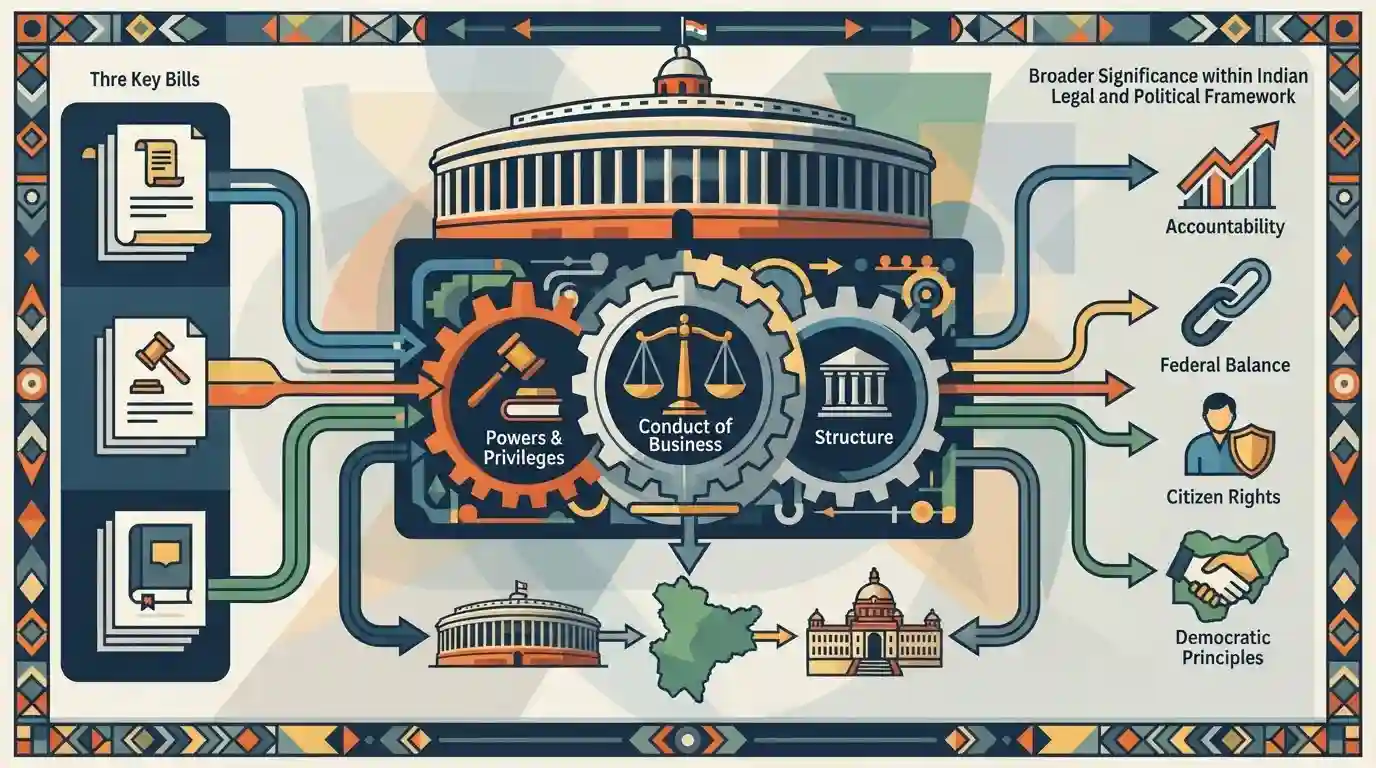
The article details the constitutional and legislative provisions proposed to be amended by three key bills introduced in Parliament, highlighting the specific articles affected and their broader significance within the Indian legal and political framework.
Key Points
- The article details the constitutional articles and statutory provisions affected by three major proposed bills in the Indian Parliament.
- Understanding legislative amendments helps aspirants map the dynamic changes in Indian polity and constitutional law.
- A comprehensive look at legislative procedures and constitutional articles under amendment enhances conceptual clarity for UPSC civil services preparation.
Important Terms
Parliament of India

The supreme legislative body of India, comprising the President, Lok Sabha, and Rajya Sabha, responsible for law-making, executive accountability, and constitutional amendments under Part V of the Constitution.
UPSC context
UPSC GS Paper II: Structure, organization, and functioning of the Parliament and State legislatures.
Lok Sabha
The directly elected lower house of India's bicameral Parliament, holding exclusive powers over Money Bills and executive accountability under Article 75.
UPSC context
UPSC GS Paper II: Conduct of business, powers, and privileges of Parliament and its houses.
Rajya Sabha
The upper house of India's bicameral Parliament representing the states and union territories, possessing special legislative powers under Articles 249 and 312.
UPSC context
UPSC GS Paper II: Federal structure, bicameralism, and the special powers of the Council of States.
Prelims Trap
All major legislative bills introduced in Parliament mandatorily require the prior recommendation of the President of India for their introduction.
Aspirants often confuse the requirement of prior presidential recommendation for Money Bills or state reorganization bills with Constitutional Amendment Bills, which do not require prior presidential recommendation.
Static Concepts Connected
What are the key procedural requirements and majorities required for amending the Constitution under Article 368?
- Special Majority:: Most constitutional provisions require a special majority, i.e., a majority of the total membership and a 2/3rd majority of members present and voting.
- State Ratification:: Certain provisions affecting federal structures additionally require ratification by the legislatures of at least half of the states by a simple majority.
- No Joint Sitting:: Unlike ordinary bills, there is no provision for a joint sitting of both Houses if there is a deadlock over a constitutional amendment bill.
Cross-Topic Patterns
Constitutional Amendments vs Ordinary Legislative Process
Constitutional amendment bills are frequently tested alongside ordinary and money bills to check aspirants' understanding of legislative mechanics and presidential recommendations.

Expect statement-based prelims questions on Article 368 amendment procedures versus ordinary statutory amendments.
Linked PYQs · 2
Linked PYQs · 2
- 2024PrelimsGS1
As per Article 368 of the Constitution of India, the Parliament may amend any provision of the Constitution by way of : 1. Addition 2. Variation 3. Repeal Select the correct answer using the code given below:
- 2022PrelimsGS1
Consider the following statements: 1. A bill amending the Constitution requires a prior recommendation of the President of India. 2. When a Constitution Amendment Bill is presented to the President of India, it is obligatory for the President of India to give his/her assent. 3. A Constitution Amendment Bill must be passed by both the Lok Sabha and the Rajya Sabha by a special majority and there is no provision for joint sitting. Which of the statements given above are correct?
