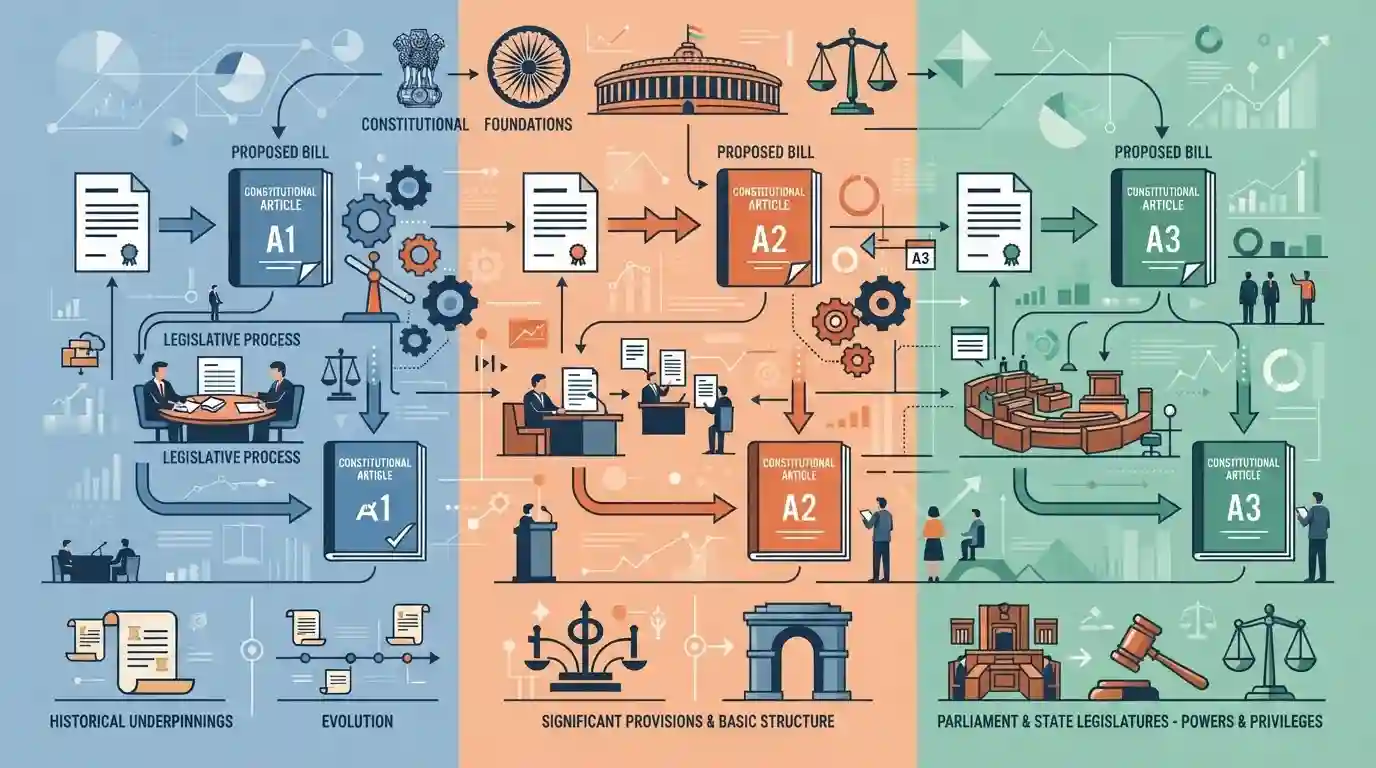
Constitutional Articles and Proposed Legislative Amendments
Source:Indian Express ↗
Why It Matters
It is essential for aspirants to understand how parliamentary bills interact with and modify specific constitutional articles, reflecting the dynamic nature of India's constitutional law and legislative framework.
Summary
An analysis of three proposed bills and the specific constitutional articles they intend to amend, shedding light on the legislative process and constitutional provisions.
Key Points
- The article details three proposed bills and the specific articles of the Indian Constitution they seek to amend.
- Constitutional amendments require specific procedures under Article 368 and other relevant provisions depending on the nature of the change.
- Understanding the intersection of proposed legislation and constitutional articles is crucial for legislative analysis and polity.
Important Terms
Parliament

The supreme legislative body of India, comprising the President, the Lok Sabha (House of the People), and the Rajya Sabha (Council of States), responsible for enacting laws, amending the Constitution, and holding the executive accountable.
UPSC context
GS Paper II (Polity) - Structure, Functioning, Conduct of Business, Powers & Privileges of Parliament and State Legislatures.
Supreme Court of India
The highest judicial court and final court of appeal under the Constitution of India, possessing powers of judicial review to protect fundamental rights and interpret constitutional provisions.
UPSC context
GS Paper II (Polity) - Structure, Organization, and Functioning of the Judiciary.
Static Concepts Connected
What are the different types of majorities required for amending the Indian Constitution?
- Simple Majority: Applies to provisions outside Article 368, such as creation of new states under Article 3.
- Special Majority I: Requires a majority of total membership (50%+) and two-thirds of members present and voting.
- Special Majority II: Requires Special Majority I plus ratification by at least half of the state legislatures by a simple majority.
Cross-Topic Patterns
State Reorganisation & Article 368 vs Simple Majority
Changes to Articles 2 and 3 require simple majority, linking legislative federalism directly to state reorganisation debates under Schedule 1.

Expect match-the-column questions pairing specific Constitutional amendment types with their correct majority requirements (Art 368 vs simple).
Linked PYQs · 2
Linked PYQs · 2
- 2019MainsGS2
“Parliament's power to amend the Constitution is a limited power and it cannot be enlarged into absolute power." In the light of this statement explain whether Parliament under Article 368 of the Constitution can destroy the Basic Structure of the Constitution by expanding its amending power?
- 2025MainsGS2
Indian Constitution has conferred the amending power on the ordinary legislative institutions with a few procedural hurdles. In view of this statement, examine the procedural and substantive limitations on the amending power of the Parliament to change the Constitution.
