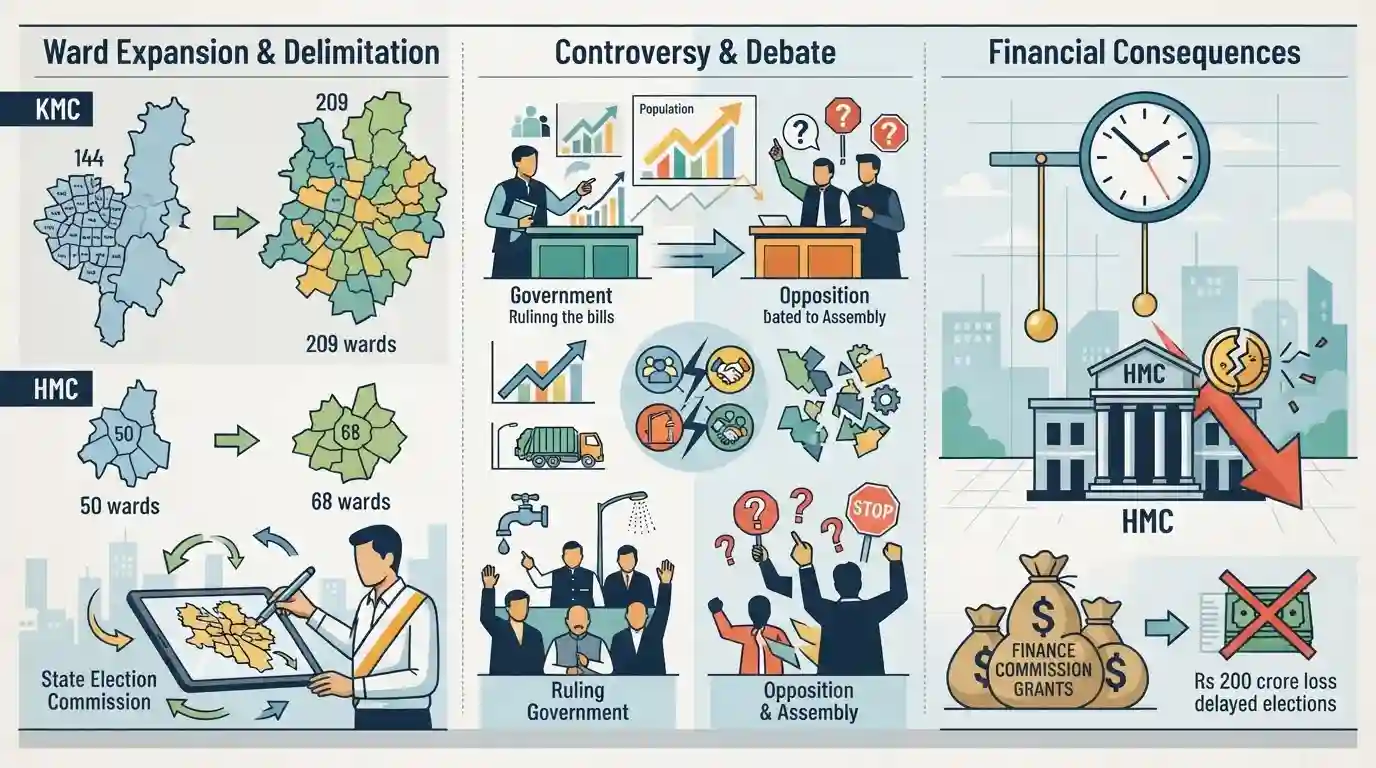
Municipal delimitation: KMC and HMC ward numbers increased
Source:theweek ↗
Why It Matters
This event provides a practical context for the functioning of Urban Local Bodies under the 74th Amendment Act. It highlights the roles of the State Election Commission in local delimitation and the crucial impact of Finance Commission grants on municipal finances, both of which are high-yield topics for civil service exams.
Summary
The West Bengal Assembly has passed delimitation bills to significantly increase the number of wards in the Kolkata Municipal Corporation (KMC) from 144 to 209, and the Howrah Municipal Corporation (HMC) from 50 to 68. Defended by the ruling government as essential for managing population variations and improving civic amenities, the move will see the State Election Commission finalizing ward boundaries. However, the opposition criticized the bills for being passed without sufficient consultation and alleged the restructuring aims to manipulate local demographics. The delay in conducting civic elections has also drawn scrutiny, notably causing the HMC to lose Rs 200 crore in 15th Finance Commission grants.
Key Points
- The West Bengal Assembly passed bills to increase KMC wards from 144 to 209 and HMC wards from 50 to 68.
- The State Election Commission will oversee the finalization of ward boundaries and voter demographics.
- The opposition criticized the delimitation as rushed and raised concerns of political gerrymandering to alter local demographics.
- Delays in conducting civic polls have led to financial setbacks, with the HMC losing Rs 200 crore in grants from the 15th Finance Commission.
- Municipal elections are expected in December following the earlier dissolution of the KMC board and the appointment of an IAS officer as administrator.
Important Terms
State Election Commission

An autonomous constitutional body created under Articles 243K and 243ZA to oversee electoral rolls and conduct elections for Panchayats and Municipalities.
UPSC context
GS Paper II (Polity & Governance). Tests understanding of local self-government, constitutional bodies, and democratic decentralisation.
15th Finance Commission of India
A constitutional body under Article 280 that recommended financial resource distribution for 2021-2026, including performance-linked tied and untied grants to local bodies.
UPSC context
GS Paper II & III (Fiscal Federalism). Tests knowledge of financial devolution and resource mobilization at local government levels.
Kolkata Municipal Corporation Act, 1980
West Bengal legislation that consolidated laws for Kolkata's municipal administration, detailing the governance, powers, duties, and electoral wards of the Kolkata Municipal Corporation.
UPSC context
GS Paper II (Urban Governance). Tests structural understanding of statutory municipal frameworks and legislative processes in urban administration.
Howrah Municipal Corporation Act, 1980
A state-level legislation that established the Howrah Municipal Corporation, detailing its administrative structure, powers, municipal functions, and ward-level election procedures.
UPSC context
GS Paper II (Urban Local Bodies). Tests structural mechanisms governing sub-metropolitan administrations and state legislative control over cities.
Urban Local Bodies (ULBs)
Grassroots democratic institutions of local self-government in urban areas, constitutionally recognized under Part IXA (74th Amendment Act) to handle town planning and civic amenities.
UPSC context
GS Paper II (Local Self-Government). Tests comprehension of the 74th Amendment and financial/administrative challenges in urban governance.
Prelims Trap
The delimitation of municipal ward boundaries falls under the jurisdiction of the Delimitation Commission of India.
Ward delimitation is governed entirely by State laws and conducted by State authorities/State Election Commissions, not the central Delimitation Commission.
Static Concepts Connected
What are the rules governing municipal dissolution and reconstituted terms under Article 243U?
- Five-year term: Every municipality is given a five-year tenure from the date appointed for its first meeting unless dissolved earlier.
- Six-month rule: If dissolved early, elections must be completed within six months of dissolution to reconstitute the body.
- Remainder term: A reconstituted municipality serves only the remainder of the dissolved body's term, not a fresh five-year term.
How does the 15th Finance Commission link local body grants to democratic governance?
- Entry-level conditions: States must set up State Finance Commissions and ensure timely audits of municipal accounts to access grants.
- Democratic mandate: No grants are released to local bodies that do not have duly elected councils in place, penalizing electoral delays.
Cross-Topic Patterns
Fiscal federalism meets local democracy
The 15th Finance Commission's withholding of grants for delayed polls demonstrates how fiscal leverage is used to enforce the democratic mandates of the 73rd and 74th Amendments.
SEC autonomy and judicial precedents
Landmark rulings like Kishan Singh Tomar establish that State Election Commissions have independent plenary powers over local polls, making state-induced delays constitutionally unacceptable.

UPSC may combine 74th Amendment rules on municipality tenure (Article 243U) with fiscal penalties of the 15th Finance Commission in 2026.
Linked PYQs · 4
Linked PYQs · 4
- 2018WBCS_PRELIMSGS1
Which Amendment of the constitution provided constitutional status to the Panchayats?
- 2024WBCS_PRELIMSGS1
Which of the following is matched incorrectly?
- 2024WBCS_PRELIMSGS1
Consider the following statements: (I) Finance Commission is a Constitutional Body. (II) National Commission for Women is a Statutory Body. Which option is correct?
- 2011WBCS_PRELIMSGS1
Finances are distributed between the Centre and the States on the basis of the recommendations of the
