Kerala Livestock Board Sets Up High Tech Bovine Research Center
Source:The Hindu ↗
Why It Matters
Livestock is a major source of livelihood and agricultural income in India, but it also contributes significantly to greenhouse gas emissions (enteric methane). Technological interventions like sex-sorted semen, IVF, and anti-methanogenic feed supplements are critical for increasing dairy productivity while mitigating climate change impacts, directly overlapping with GS-3 themes of agriculture economics and environment conservation.
Summary
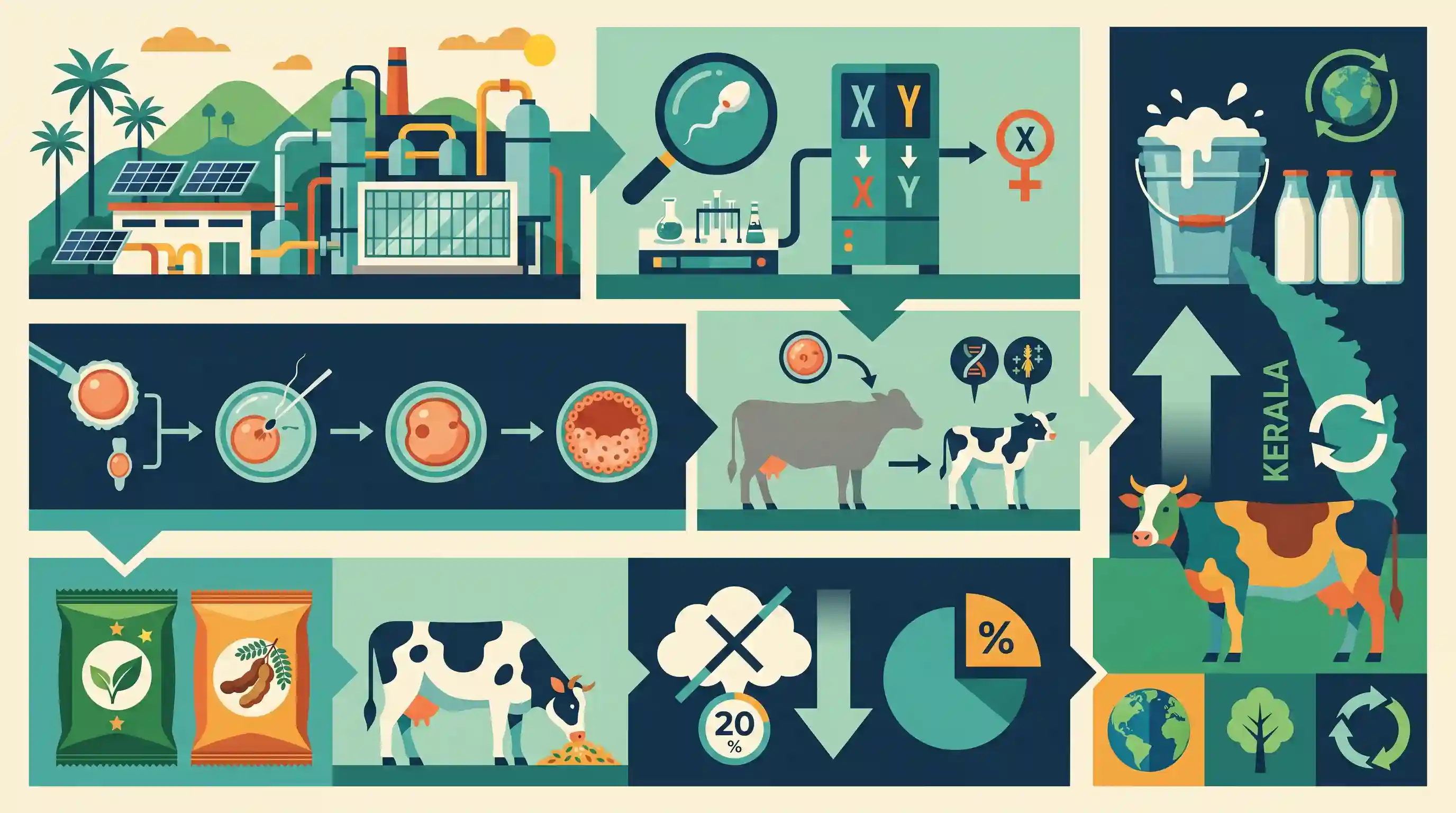
The Kerala Livestock Development Board (KLDB) is establishing a high-tech research centre for bovine production in Kulathupuzha to achieve self-sufficiency in milk production. The centre will leverage advanced technologies like indigenous nanotechnology-based sex-sorting of semen, In-Vitro Fertilization (IVF), and embryo transfer to improve cattle genetics. Furthermore, to make dairy farming environmentally sustainable, the initiative will utilize ICAR-developed anti-methanogenic feed supplements ('Harit Dhara' and 'Tamarin Plus') to reduce enteric methane emissions from livestock by up to 20%.
Key Points
- KLDB is setting up the Advanced Technologies in Bovine Production and Research Centre (ATBPRC) in Kulathupuzha, Kollam to boost dairy production.
- The project aims to make Kerala self-sufficient in milk production by increasing the average daily milk yield of crossbred cows from 10.79 kg to 13.5 kg by 2031.
- Key innovations include indigenous sex-sorting technology using nanotechnology (developed with IISER Thiruvananthapuram) and a nucleus farm using sex-sorted semen exclusively for In-Vitro Fertilization (IVF).
- The centre will provide embryo transfer services directly to farmers via mobile units.
- To ensure environmental sustainability, ICAR-developed anti-methanogenic feed supplements like 'Harit Dhara' and 'Tamarin Plus' will be used to reduce cattle enteric methane emissions by up to 20%.
Important Terms
Kerala Livestock Development Board (KLDB)

A Kerala state government undertaking responsible for livestock breeding and development. It implements high-tech breeding programs like the Accelerated Breed Improvement Programme to enhance milk productivity.
UPSC context
GS Paper 3: Economics of animal rearing; key agency for state-level agricultural and livestock infrastructure.
ICAR-National Institute of Animal Nutrition and Physiology (NIANP)
A premier Bengaluru-based research institute under the Indian Council of Agricultural Research (ICAR). It specializes in animal nutrition, physiology, and climate-resilient livestock farming technologies.
UPSC context
GS Paper 3: Science & Tech; primary body for research on methane mitigation and animal productivity.
Harit Dhara
An indigenous anti-methanogenic feed supplement developed by ICAR-NIANP. It uses plant-based tannins and saponins to reduce enteric methane emissions from livestock by up to 20%.
UPSC context
GS Paper 3: Environment/Climate Change; mitigation of greenhouse gas emissions in agriculture.
Tamarin Plus
An ICAR-NIANP developed feed supplement made from tamarind seed husk. It acts as a methane suppressant while providing balanced nutrition to ruminants.
UPSC context
GS Paper 3: Agriculture/Technology; sustainable livestock management and resource utilization.
Sex-sorted Semen Technology
A reproductive technology that pre-selects X-chromosome-carrying sperm to ensure approximately 90% probability of female offspring, reducing the birth of unproductive male calves.
UPSC context
GS Paper 3: Biotechnology applications in agriculture and livestock productivity enhancement.
IISER Thiruvananthapuram
An autonomous research institute in Kerala partnering with KLDB to develop indigenous, nanotechnology-based solutions for cattle semen sorting and genetic improvement.
UPSC context
GS Paper 3: Science & Technology; indigenization of high-tech agricultural tools through academic-industry collaboration.
University of Calgary
A Canadian public research university collaborating with KLDB on high-level livestock research exchanges, professional training, and advanced diagnostic services for bovine infertility.
UPSC context
GS Paper 2/3: International cooperation in scientific research and agricultural innovation.
Prelims Trap
"Anti-methanogenic feed supplements like Harit Dhara reduce cattle methane emissions but negatively compromise overall milk production."
False. Harit Dhara suppresses methane-producing protozoa while increasing propionic acid production, which actually enhances milk yield and animal weight gain.
Static Concepts Connected
How does enteric fermentation in livestock cause methane emissions?
- Methanogenic archaea: Microbes in the rumen of herbivores break down complex carbohydrates during digestion, producing methane as a natural metabolic byproduct.
- Hydrogen utilization: Archaea utilize hydrogen and carbon dioxide released during fermentation to form methane, which the animal predominantly exhales or eructates (burps).
- Largest agri-emitter: Enteric fermentation constitutes the absolute largest share of India's agricultural greenhouse gas emissions, significantly surpassing paddy cultivation.
What is the scientific basis of sex-sorted semen technology in dairy farming?
- DNA mass differential: 'X' (female) chromosome-bearing sperm contain roughly 3.8% to 4% more DNA than 'Y' (male) sperm, allowing for physical or optical separation.
- Flow cytometry: Traditionally, sperm are fluorescently dyed and passed through a laser; heavier female sperm are separated to guarantee female calf births with ~90% accuracy.
- Nanotech sorting: Emerging indigenous techniques (like those in Kerala) use nanotechnology instead of expensive flow cytometry machines to sort sperm, significantly reducing costs.
Cross-Topic Patterns
Biotech for agricultural GHG mitigation
Linking anti-methanogenic feeds to national climate goals highlights India's dual-purpose strategy: increasing dairy yields while working towards UNFCCC COP commitments to reduce agricultural GHG footprints.
Solving the stray cattle menace
Agricultural mechanization drastically reduced the utility of male draught animals. Sex-sorting technology tackles the resulting socio-political 'stray cattle' problem directly at its reproductive root.

Expect a 2026 Prelims question on ICAR's 'Harit Dhara' or enteric methane mitigation linking animal husbandry directly to GHG inventories.
Linked PYQs · 4
Linked PYQs · 4
- 2015MainsGS3
Livestock rearing has a big potential for providing non-farm employment and income in rural areas. Discuss suggesting suitable measures to promote this sector in India.
- 2017PrelimsGS1
What is the application of Somatic Cell Nuclear Transfer Technology?
- 2019PrelimsGS1
Consider the following statements: 1. Agricultural soils release nitrogen oxides into environment. 2. Cattle release ammonia into environment. 3. Poultry industry releases reactive nitrogen compounds into environment. Which of the statements given above is/are correct?
- 2019PrelimsGS1
Consider the following: 1. Carbon monoxide 2. Methane 3. Ozone 4. Sulphur dioxide Which of the above are released into atmosphere due to the burning of crop/biomass residue?
