Global Buddhist Summit Highlights Cultural Heritage and Ancient Relics
Source:The Hindu ↗
Why It Matters
Buddhism remains a foundational topic for UPSC across Prelims (history/culture), GS1 (heritage), GS2 (soft power diplomacy), and GS4 (ethics). The unveiling of the 'Gyan Bharatam' mission and the spotlight on the Piprahwa relics offer specific factual fodder for Prelims, while the summit's emphasis on global coexistence informs Mains answers on cultural diplomacy.
Summary
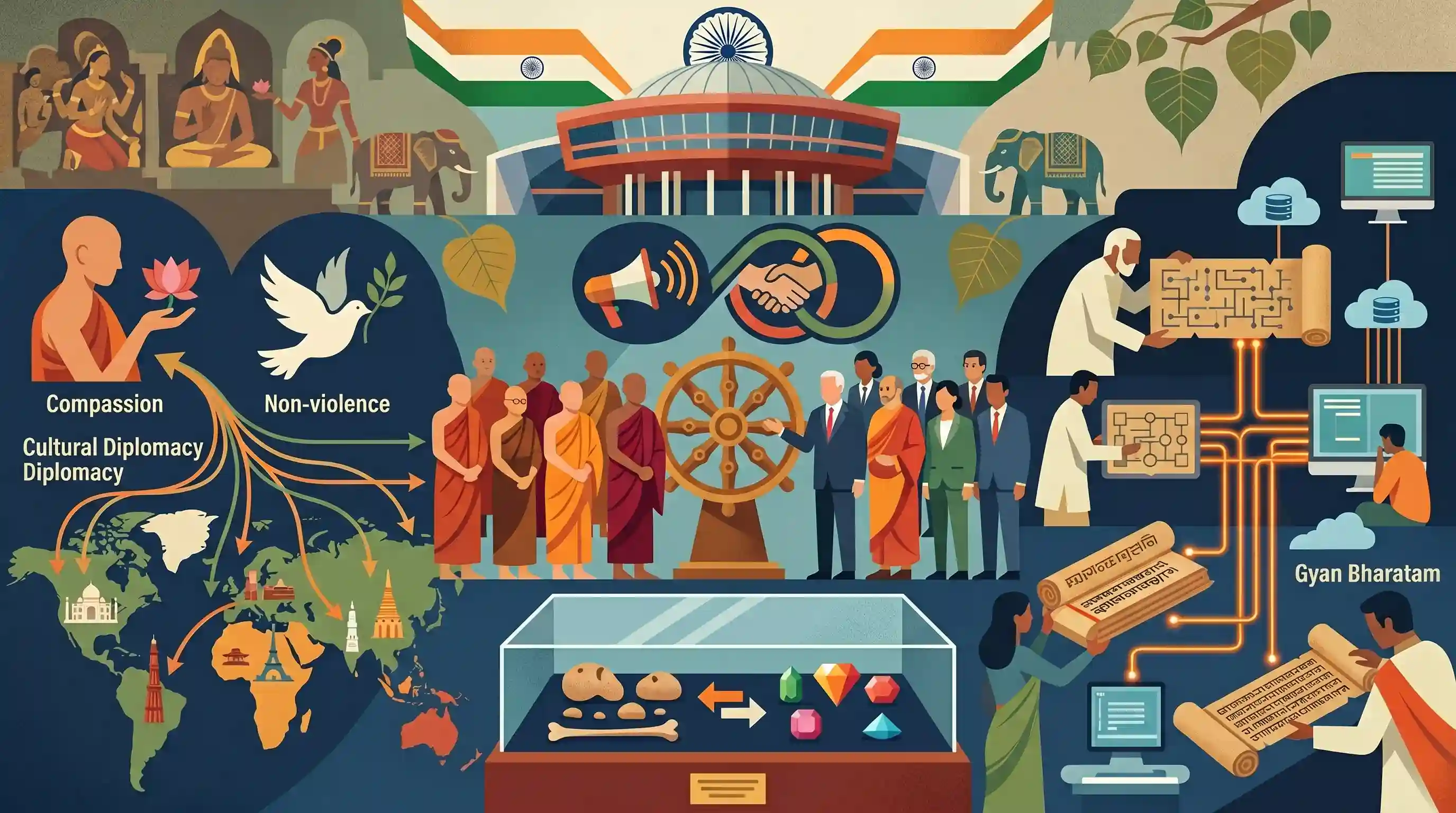
The 2nd Global Buddhist Summit 2026, held at Bharat Mandapam in New Delhi, was co-organised by the Ministry of Culture and the International Buddhist Confederation. Revolving around the theme of 'Collective Wisdom, United Voice, and Mutual Coexistence', the summit highlighted the global relevance of Buddhist values such as compassion and non-violence. Alongside the diplomatic push for India's soft power, the government showcased its commitment to cultural preservation by spotlighting the 'Gyan Bharatam' mission, a massive initiative to digitise ancient manuscripts. Concurrently, an exhibition featured the ancient Buddha-linked Piprahwa relics and recently repatriated Piprahwa gems, underlining India's central role in global Buddhist heritage.
Key Points
- The 2nd Global Buddhist Summit was organised at Bharat Mandapam by the Ministry of Culture and the International Buddhist Confederation (IBC).
- The summit's theme was 'Collective Wisdom, United Voice, and Mutual Coexistence', promoting Buddhist ethics of compassion and non-violence.
- An exhibition showcased the historic Piprahwa relics of the Buddha, excavated in the late 19th century, alongside newly repatriated Piprahwa gems.
- The 'Gyan Bharatam' mission was highlighted as one of the world's largest initiatives for the digitisation and preservation of ancient manuscripts.
- The event served as a major platform for India's cultural diplomacy, projecting its soft power through its shared Buddhist heritage.
Important Terms
Piprahwa relics

Sacred artifacts (bone fragments, caskets, gems) from Piprahwa, UP, linked to the Buddha’s Sakya clan; recently highlighted by the repatriation of gems from a private collection in 2025.
UPSC context
GS Paper I (History/Culture); tests knowledge of archaeological sites, relic distribution (Drona Stupa), and India’s heritage repatriation efforts.
Gyan Bharatam mission
A Ministry of Culture initiative (2024–2031) to survey, digitise, and create a National Digital Repository for nearly 50 crore pages of ancient Indian manuscripts to preserve traditional knowledge.
UPSC context
GS Paper I (Art & Culture) and GS Paper II (Governance); tests knowledge of heritage conservation through digital technology.
International Buddhist Confederation (IBC)
A New Delhi-based global umbrella body for Buddhists worldwide, operating under the Ministry of Culture to preserve heritage and provide a unified platform for addressing global challenges.
UPSC context
GS Paper I (Culture) and GS Paper II (International Relations); tests understanding of institutional frameworks for India’s cultural diplomacy.
Global Buddhist Summit 2026
The second international forum (New Delhi, 2026) co-organised by the GOI and IBC, focusing on ‘Collective Wisdom’ to promote Buddhist values in global diplomacy and peacebuilding.
UPSC context
GS Paper II (International Relations); tests India’s strategic use of Buddhist soft power to influence global discourse and regional relations.
Soft Power
A diplomatic strategy using cultural, spiritual, and ideological appeal (e.g., Buddhism, Yoga) to influence international affairs and enhance global standing without using military or economic coercion.
UPSC context
GS Paper II (International Relations); tests awareness of non-military tools in foreign policy and India’s civilizational outreach.
Prelims Trap
The International Buddhist Confederation (IBC) is a UN-led intergovernmental organization.
It is not a UN or foreign entity. It is a global umbrella body headquartered in New Delhi, operating under India's Ministry of Culture.
Static Concepts Connected
What is the historical significance of the Piprahwa Stupa?
- 19th-Century Discovery: Excavated in 1898 in Uttar Pradesh's Siddharthnagar district, the stupa yielded sacred bone fragments and gems of the Buddha.
- Brahmi Inscription: A reliquary casket found at the site features a Brahmi inscription connecting the relics to the Sakya clan.
- Kapilavastu Link: These archaeological findings widely establish Piprahwa as the ancient city of Kapilavastu, where the Buddha spent his early life.
What is the scope of the Gyan Bharatam mission?
- Massive Scale: Announced in the 2025-26 Budget, it is a mega-initiative to survey, document, and digitise over one crore ancient Indian manuscripts.
- Kriti Sampada: The digitised manuscripts will be housed in a centralized National Digital Repository named 'Kriti Sampada'.
- Nodal Authority: Operated by the Ministry of Culture, it scales up previous heritage conservation efforts for global academic access.
Cross-Topic Patterns
Act East via Buddhist Soft Power
India leverages bodies like the IBC to strengthen cultural ties with ASEAN and East Asian nations, using shared heritage to complement strategic diplomacy and counterbalance China.
Digital India meets Ancient Heritage
The Gyan Bharatam mission's creation of 'Kriti Sampada' merges Digital Public Infrastructure (DPI) goals with art and culture, reflecting a modern governance approach to heritage conservation.

A 2026 Prelims question will likely pair historical Piprahwa relics (Brahmi inscriptions) with the new Gyan Bharatam digital mission.
Linked PYQs · 3
Linked PYQs · 3
- 2020MainsGS4
What teachings of Buddha are most relevant today and why? Discuss.
- 2023PrelimsGS1
With reference to ancient India, consider the following statements: 1. The concept of Stupa is Buddhist in origin. 2. Stupa was generally a repository of relics. 3. Stupa was a votive and commemorative structure in Buddhist tradition. How many of the statements given above are correct?
- 2019PrelimsGS1
Consider the following: 1. Deification of the Buddha 2. Treading the path of Bodhisattvas 3. Image worship and rituals Which of the above is/are the feature/features of Mahayana Buddhism?
