Delimitation Bill Consensus and Political Party Consultations
Source:Indian Express ↗
Why It Matters
Delimitation directly affects the balance of political power, federal representation, and legislative equity across Indian states, making consensus-building between national parties critical for constitutional stability.
Summary
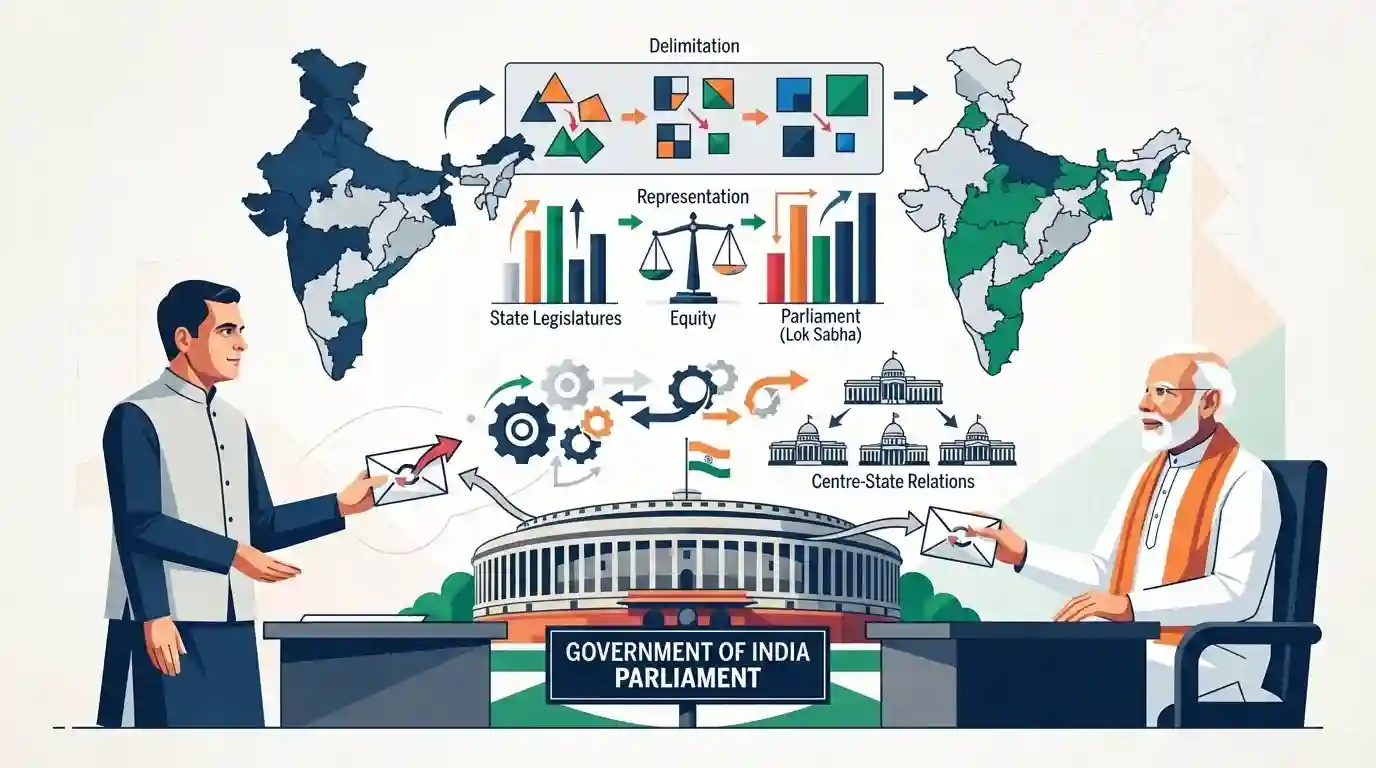
Union Parliamentary Affairs Minister Kiren Rijiju has written to Congress president Mallikarjun Kharge seeking the party's cooperation and support for the upcoming Delimitation Bill, reigniting national discussions on constituency re-mapping, federal representation, and inter-state equity.
Key Points
- Union Minister Kiren Rijiju wrote a letter to Congress chief Mallikarjun Kharge urging support for the upcoming Delimitation Bill.
- Delimitation involves redrawing the boundaries of Lok Sabha and Assembly constituencies based on population trends, which raises debates over federal representation balance between northern and southern states.
- The exercise is critical for reforming electoral representation while addressing political and regional concerns regarding population-control achievements.
Important Terms
Delimitation Bill

The process of redrawing the boundaries of Lok Sabha and State Legislative Assembly constituencies based on recent census data to ensure equal representation.
UPSC context
GS Paper II - Polity & Governance: Important aspects of governance, federalism, and representation of states in Parliament.
Prelims Trap
Orders of the Delimitation Commission can be challenged in any court of law under extraordinary writ jurisdiction.
Aspirants often believe Delimitation Commission orders can be challenged in High Courts or Supreme Court on grounds of constitutional violation. In reality, Article 82/statutes bar judicial review of their final orders.
Static Concepts Connected
What are the constitutional provisions and historical context of Delimitation in India?
- Constitutional Mandate: Under Articles 82 and 170, Parliament enacts a Delimitation Act after every Census to readjust Lok Sabha and State Assembly seats.
- Historical Commissions: Four Delimitation Commissions have been set up post-independence in 1952, 1963, 1972, and 2002 under respective Acts.
- Seat Freeze: The 42nd Amendment (1976) and 84th Amendment (2001) froze seat allocations based on the 1971 Census, extending the freeze up to the first census after 2026.
- Judicial Bar: Delimitation Commission is a statutory body whose orders have the force of law and cannot be questioned in any court.
Cross-Topic Patterns
Delimitation + Fiscal Federalism & Population Control
Delimitation exercises risk shifting electoral weight from southern states that excelled in population control to northern states with high growth, impacting cooperative federalism and Finance Commission devolution formulas.
Delimitation + Representation & Coalition Dynamics
Parliamentary constituency redrawing directly alters regional representation balance, testing the resilience of coalition politics and national party strategies across linguistic and geographic divides.

Delimitation constitutional provisions, immunity of commission orders, and freezing of seats under 42nd/84th Amendments are prime UPSC traps.
Linked PYQs · 3
Linked PYQs · 3
- 2024MainsGS2
What changes has the Union Government recently introduced in the domain of Centre-State relations ? Suggest measures to be adopted to build the trust between the Centre and the States and for strengthening federalism.
- 2024PrelimsGS1
How many Delimitation Commissions have been constituted by the Government of India till December 2023?
- 2023PrelimsGS1
Consider the following statements in respect of election to the President of India: 1. The members nominated to either House of the Parliament or the Legislative Assemblies of States are also eligible to be included in the Electoral College. 2. Higher the number of elective Assembly seats, higher is the value of vote of each MLA of that State. 3. The value of vote of each MLA of Madhya Pradesh is greater than that of Kerala. 4. The value of vote of each MLA of Puducherry is higher than that of Arunachal Pradesh because the ratio of total population to total number of elective seats in Puducherry is greater as compared to Arunachal Pradesh. How many of the above statements are correct?
