Kinnaur Kailash Yatra Begins with Daily Pilgrim Caps
Source:tribuneindia ↗
Why It Matters
The event illustrates the governance challenges of managing religious tourism in high-altitude, ecologically fragile regions of Himachal Pradesh. It is highly relevant for HPAS Prelims as it touches upon local geography (Kinnaur district), environmental sustainability, and the role of local institutions like the Dev Samaj in maintaining ecological balance alongside local administration.
Summary
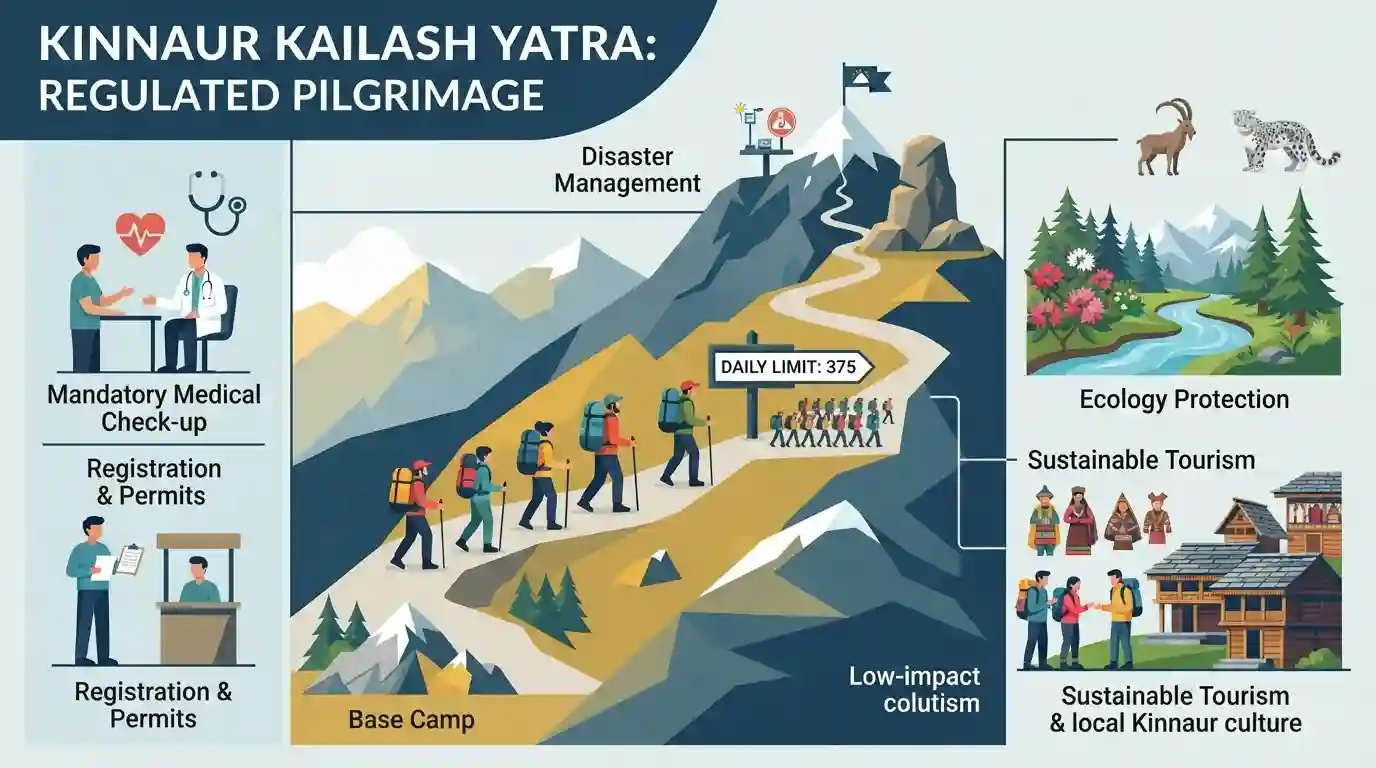
The Kinnaur Kailash Yatra, an annual high-altitude pilgrimage in Himachal Pradesh's Kinnaur district, has officially begun with strict regulatory measures in place. To ensure pilgrim safety and protect the fragile Himalayan ecology, the local administration and the Dev Samaj have imposed a daily cap of 375 pilgrims. Mandatory medical check-ups and registration are required to undertake the arduous trek. These measures reflect a growing emphasis on sustainable religious tourism and disaster risk reduction in ecologically sensitive mountain regions.
Key Points
- The annual Kinnaur Kailash Yatra has commenced in the Kinnaur district of Himachal Pradesh, involving a high-altitude trek to a sacred Shivling.
- The district administration and the local Dev Samaj have jointly managed the yatra, limiting the number of pilgrims to 375 per day to avoid overcrowding and mishaps.
- Pilgrims are required to undergo medical screening and mandatory registration due to the physically demanding nature of the high-altitude terrain.
- The restrictions also aim to preserve the fragile Himalayan ecology and mitigate the environmental impact of religious tourism, addressing concerns over water contamination and ecological degradation.
Important Terms
Kinnaur Kailash Yatra

An annual high-altitude Hindu pilgrimage in Himachal Pradesh's Kinnaur district. It involves a challenging trek to a sacred vertical rock formation, traditionally revered as Lord Shiva's winter abode, amidst a fragile mountain ecosystem.
UPSC context
Relevant to GS Paper 1 (Geography/Culture) and GS 3 (Environment). It illustrates the conflict between mass tourism and Himalayan ecology.
Dev Samaj (Kinnaur)
A representative organization of the local tribal community and traditional deity committees in Kinnaur, Himachal Pradesh. It acts as the custodian of local spiritual heritage and advocates for ecological preservation against unregulated mass tourism.
UPSC context
Important for GS 1 (Tribal Culture) and GS 3 (Environment). Highlights community-driven conservation efforts and the role of local institutions in ecological governance.
Ecological Carrying Capacity
The maximum population size or level of human activity, such as tourism, that a specific geographical area or ecosystem can sustainably support without suffering irreversible environmental degradation.
UPSC context
Highly relevant for GS 3 (Environment, Disaster Management). Frequently tested regarding infrastructure planning and sustainable development in fragile Himalayan regions.
Sustainable Religious Tourism
The management of faith-based travel and large-scale pilgrimages to minimize environmental impact, respect local socio-cultural traditions, and ensure the long-term ecological resilience of sacred, often fragile, destinations.
UPSC context
Key topic in GS 1 (Indian Society/Heritage) and GS 3 (Environment). Tests knowledge on mitigating the ecological footprint of mass religious gatherings.
Prelims Trap
Kinnaur Kailash is located in Uttarakhand and forms part of the Panch Kedar circuit.
Kinnaur Kailash is in Himachal Pradesh and belongs to the 'Pancha Kailash'. It is entirely distinct from Uttarakhand's Panch Kedar circuit.
Static Concepts Connected
What is 'Carrying Capacity' in the context of eco-sensitive mountain zones?
- Definition: The maximum tourist influx or population an ecosystem can sustain indefinitely without facing severe ecological degradation or resource depletion.
- Significance: Vital for the Indian Himalayan Region (IHR) to prevent unchecked infrastructure expansion, land subsidence, and solid waste accumulation.
- Application: Capping pilgrim entries (e.g., 375/day for Kinnaur Kailash) is a direct administrative tool to enforce regional carrying capacity limits.
Which peaks constitute the 'Pancha Kailash' in Hindu tradition?
- Kailash Mansarovar: Located in the Tibet Autonomous Region (China), it is the most prominent of the five.
- Adi Kailash: Situated in the Pithoragarh district of Uttarakhand near the Indo-Tibetan border.
- Himachal Peaks: Kinnaur Kailash, Shrikhand Mahadev Kailash, and Manimahesh Kailash are all sacred high-altitude peaks located in Himachal Pradesh.
Cross-Topic Patterns
Pilgrimage Tourism & Carrying Capacity
The shift towards capping daily pilgrim numbers mirrors responses to the Joshimath land subsidence crisis, linking cultural tourism directly to disaster management and Himalayan carrying capacity.
Dev Samaj & Local Governance
Joint management by the Dev Samaj and district administration highlights decentralized, community-led ecological governance, conceptually similar to the protection of sacred groves.

Mapping high-altitude pilgrimage peaks to their respective states and ecological vulnerabilities is highly probable for Prelims 2026.
Linked PYQs · 4
Linked PYQs · 4
- 2024HPAS_PRELIMSGS1
Arrange the following years based on the number of foreign tourist arrivals in Himachal Pradesh in descending order : (1) 2020 (2) 2021 (3) 2022 (4) 2023 (up to December 2023) Choose the correct option :
- 2024HPAS_PRELIMSGS1
Match the forest cover area/type with their total area in Himachal Pradesh (2021) : | List I (Density/Total Forest Cover) | List II (Area in sq. kms.) | |---|---| | (a) Very dense forest above 70 percent | (i) 7,100 | | (b) Moderate dense forest 40 to 70 percent | (ii) 5,180 | | (c) Open forest 10 percent to 40 percent | (iii) 15,443 | | (d) Total forest cover | (iv) 3,163 | Choose the correct options : Code: (a) (b) (c) (d)
- 2020HPAS_PRELIMSGS1
The Jad tribe of Himachal Pradesh are followers of which of the following religion?
- 2025HPAS_PRELIMSGS1
Given below are two statements : Statement I : The Gujjars of Himachal Pradesh are both Hindus and Muslims. Statement II : Lahaulis and Spitianis have Mongoloid features. In the light of the above statements, choose the most appropriate answer from the options given below :
