Neutralization of Top Maoist Leader Marks Counter Insurgency Milestone
Source:Indian Express ↗
Why It Matters
It provides a contemporary case study of the government's successful multilayered strategy (security operations combined with socio-economic development and rehabilitation) to counter Naxalism, directly relevant to the GS3 syllabus on internal security threats and their linkages to development.
Summary
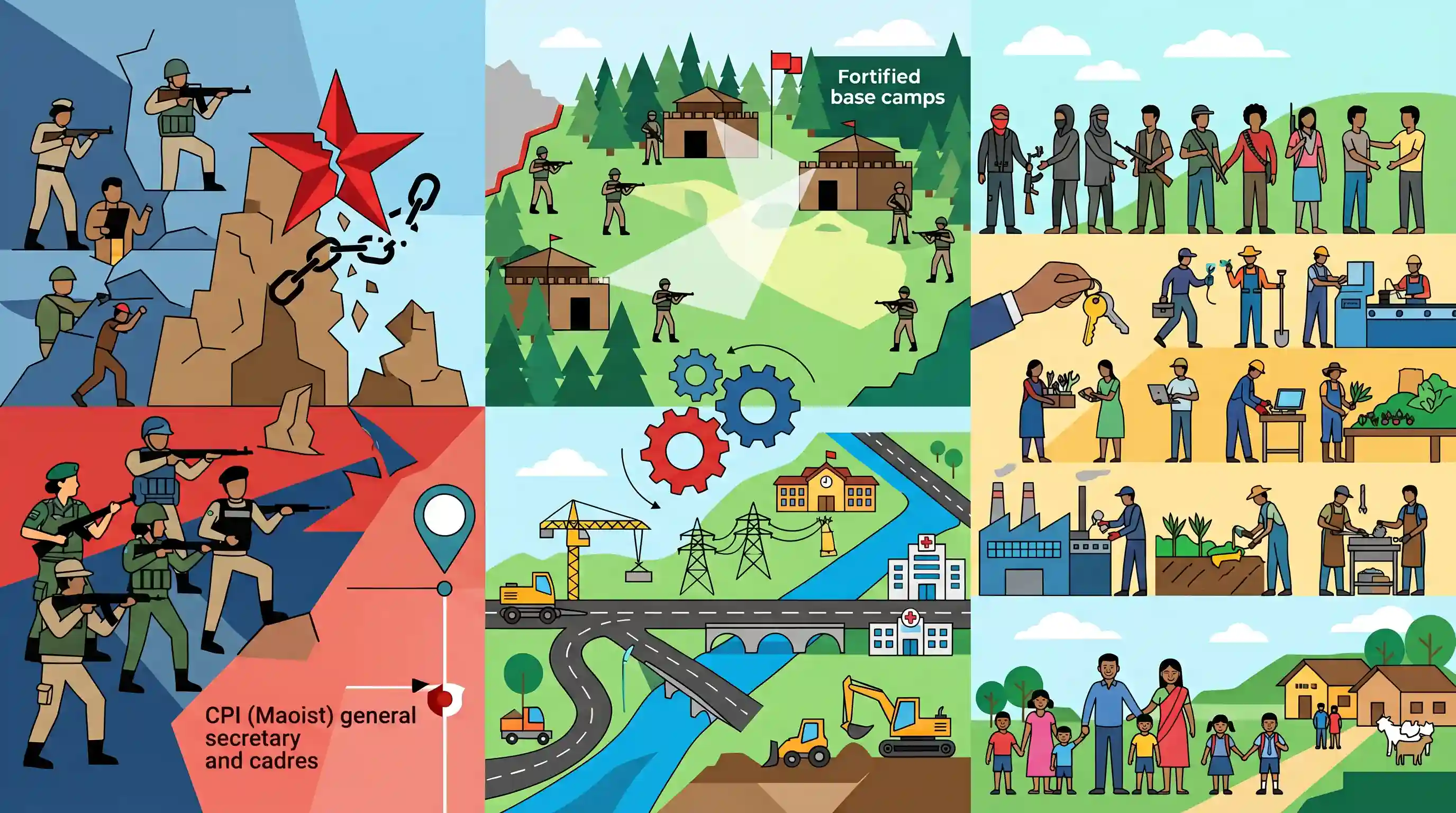
The killing of CPI (Maoist) general secretary Nambala Keshava Rao, alias Basavaraju, along with 26 other cadres in Chhattisgarh, marks a pivotal moment in the fight against Left-Wing Extremism (LWE). Driven by increased coordination between Centre and state security forces, the Vishnu Deo Sai government aims to eliminate Maoism by March 2026. The state's strategy has shifted from past complacency and reliance on civilian militias like Salwa Judum to a robust, two-pronged approach. This involves establishing base camps to eliminate security vacuums in forested borders and accelerating development through infrastructure projects and comprehensive rehabilitation policies, including housing and skill development for surrendered Maoists.
Key Points
- The elimination of top CPI (Maoist) leader Nambala Keshava Rao (Basavaraju) and 26 cadres is a major milestone in combating Left-Wing Extremism (LWE) in Chhattisgarh.
- The Union and State governments are aggressively pursuing the goal of eliminating Maoism by March 2026 through enhanced coordination and intensified security operations.
- Historical spread of LWE was fueled by geographical isolation, economic deprivation, and early strategic missteps like deploying civilian militias (Salwa Judum).
- Current success is attributed to a two-pronged approach: establishing forward base camps to end security vacuums and driving development via infrastructure (roads, mobile towers) and rehabilitation schemes for surrendered extremists.
Important Terms
Left-Wing Extremism (LWE)

An armed insurgency led by the CPI (Maoist) aiming to overthrow the Indian state. The government currently targets its total elimination by March 2026 using a multi-pronged security-development strategy.
UPSC context
GS Paper III: Internal Security. Tests knowledge of India's primary internal security threat and the evolution of the Red Corridor.
CPI (Maoist)
A banned far-left militant organization formed in 2004 by the merger of the PWG and MCCI. It is designated as a terrorist group under the Unlawful Activities (Prevention) Act.
UPSC context
GS Paper III: Security Challenges. Tests understanding of the ideological and organizational backbone of the Naxalite movement in India.
Salwa Judum
A state-sponsored vigilante militia (literally 'Peace March') active from 2005 to 2011 in Chhattisgarh. The Supreme Court declared it unconstitutional for arming civilians and committing human rights abuses.
UPSC context
GS Paper II and III. Key case study (Nandini Sundar judgment) regarding the constitutional limits of counter-insurgency and state-backed militias.
Surrender and Rehabilitation Policy
A government framework offering financial grants, vocational training, and housing to Maoist cadres who abandon violence, aimed at weakening the insurgency by incentivizing mainstream reintegration.
UPSC context
GS Paper III: Internal Security. Evaluates the 'soft-power' and socio-economic strategies used alongside kinetic military operations to end extremism.
Central Reserve Police Force (CRPF)
India's largest Central Armed Police Force (CAPF) and the lead agency for counter-Naxal operations. Its specialized Commando Battalion for Resolute Action (CoBRA) unit focuses on jungle warfare.
UPSC context
GS Paper III: Security Forces. Tests understanding of the mandate and operational role of central forces in conflict-prone tribal regions.
Pradhan Mantri Awas Yojana (PMAY)
A flagship national mission providing 'Housing for All.' In LWE areas, it is strategically used as a rehabilitation tool to provide permanent homes for surrendered extremists.
UPSC context
GS Paper II and III. Demonstrates the convergence of social welfare schemes and internal security objectives for conflict resolution.
Prelims Trap
The Union Government directly controls all anti-Maoist security operations in affected states.
Police and Public Order are State subjects. The Centre only supplements state efforts by providing CAPFs, intelligence sharing, and infrastructure funds.
Static Concepts Connected
What is the National Policy and Action Plan to counter Left-Wing Extremism?
- Multi-pronged approach: The Centre's strategy covers security, development, ensuring rights of local communities, and public perception management.
- Security measures: Includes CAPF deployment, state police modernization, intelligence sharing, the SAMADHAN doctrine, and setting up Forward Operating Bases (FOBs).
- Development push: Focuses on the Road Connectivity Project for LWE Areas (RCPLWEA), mobile towers, Eklavya schools, and financial inclusion.
Why was the state-backed Salwa Judum movement banned by the Supreme Court?
- Nandini Sundar case: In the 2011 Nandini Sundar case, the SC declared arming civilian tribal youth as Special Police Officers unconstitutional.
- Rights violation: Pushing poorly trained, lightly armed civilians to fight heavily armed extremists violated the right to life under Article 21.
- Monopoly on violence: The SC reiterated that the state cannot outsource its sovereign policing and law-enforcement duties to private militias.
Cross-Topic Patterns
LWE & Forest Rights Act
Persistent extremism in tribal belts overlaps with historical land alienation. Addressing LWE requires examining Forest Rights Act (FRA) 2006 compliance alongside security measures.
Telecom via USOF in LWE
Eliminating 'security vacuums' relies on telecom connectivity. The Universal Service Obligation Fund (USOF) under GS3 infrastructure is critical for erecting mobile towers in Naxal-affected areas.

The official March 2026 'Naxal-free' deadline makes the SAMADHAN doctrine and LWE infrastructure schemes high-probability for GS3 Mains.
Linked PYQs · 3
Linked PYQs · 3
- 2022MainsGS3
Naxalism is a social, economic and developmental issue manifesting as a violent internal security threat. In this context, discuss the emerging issues and suggest a multilayered strategy to tackle the menace of Naxalism.
- 2018MainsGS3
Left Wing Extremism (LWE) is showing a downward trend, but still affects many parts of the country. Briefly explain the Government of India's approach to counter the challenges posed by LWE.
- 2015MainsGS3
The persisting drives of the Government for development of large industries in backward areas have resulted in isolating the tribal population and the farmers who face multiple displacements. With Malkangiri and Naxalbari foci, discuss the corrective strategies needed to win the Left Wing Extremism (LWE) doctrine affected citizens back into the mainstream of social and economic growth.
