Khas grass as bio-engineering solution for landslides
Source:garhwal-post ↗
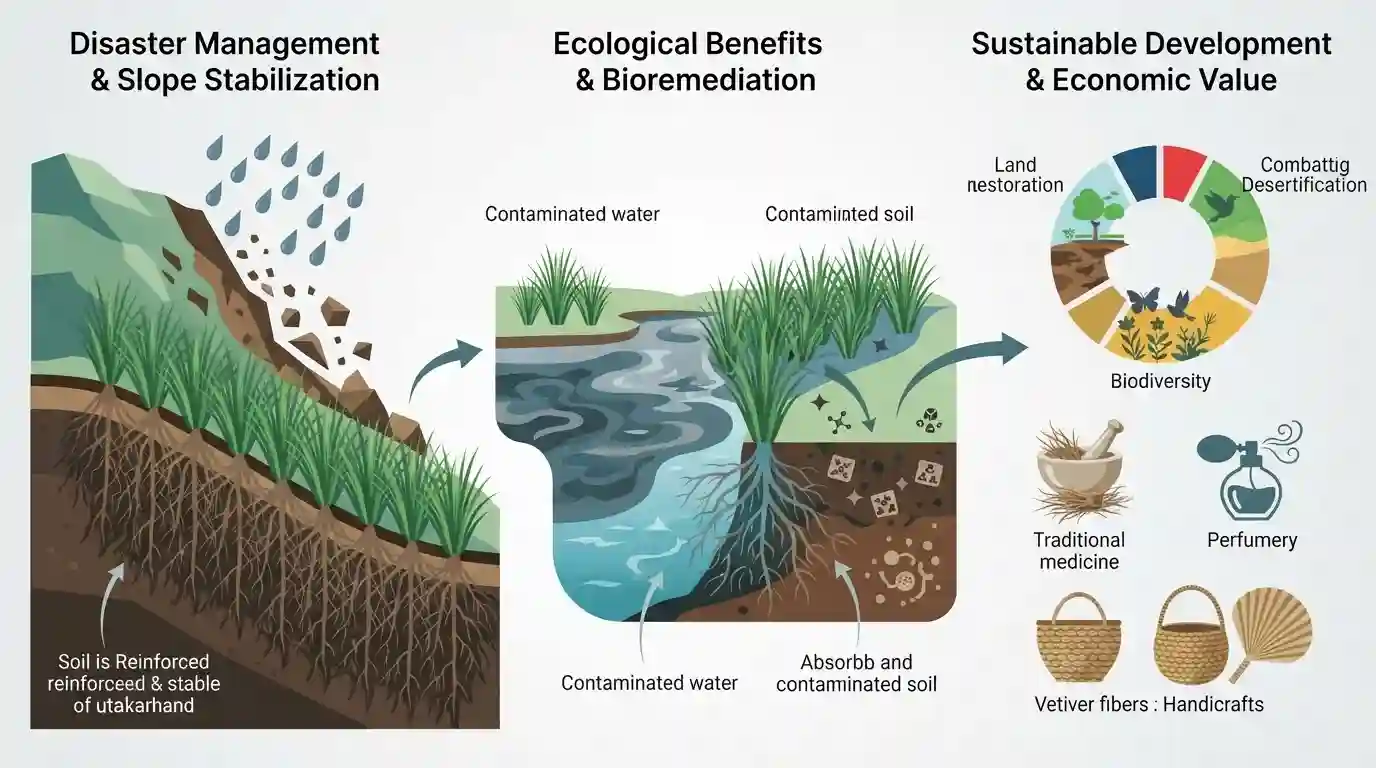
Why It Matters
Offers an important case study on nature-based solutions and bio-engineering techniques (Vetiver System) for disaster management in fragile ecosystems like the Himalayas. It bridges ecological conservation, climate resilience, and rural economic development.
Summary
The article highlights Khas (Vetiveria zizanioides), a versatile perennial grass, as a sustainable and cost-effective natural solution to combat landslides and soil erosion in Uttarakhand. Characterized by its extraordinarily deep and strong root system, Vetiver grass binds the soil effectively, acting as a bio-engineering tool for slope stabilization and drainage control. Beyond disaster mitigation, the plant offers ecological benefits through bioremediation, purifying contaminated water and soil. Additionally, Khas holds significant economic and cultural value, widely used in traditional medicine, perfumery, and handicrafts. Its large-scale cultivation aligns with Sustainable Development Goal 15 (Life on Land) by addressing land degradation, desertification, and biodiversity loss.
Key Points
- Vetiver grass (Khas), native to India, possesses a deep, vertically-growing fibrous root system that can extend 3-4 meters into the ground, functioning as natural ground anchors or 'living nails'.
- It serves as an effective bio-engineering solution for mitigating landslides, soil erosion, and slope instability in vulnerable Himalayan states like Uttarakhand.
- Khas is highly resilient to harsh climatic conditions, including drought and frost, and its high moisture content acts as a natural barrier against forest fires.
- The plant facilitates bioremediation by extracting heavy metals and pollutants from soil and water, aiding in ecological restoration.
- Economically, vetiver roots yield essential oils heavily utilized in perfumery, cosmetics, aromatherapy, and Ayurveda, while also aligning with SDG 15 by preventing land degradation.
Important Terms
Khas (Vetiveria zizanioides)

A versatile, deep-rooted perennial grass used globally for soil conservation. Its massive, fibrous root system binds soil effectively to prevent landslides, while its adaptability aids in water purification and heavy metal removal.
UPSC context
GS-3 (Disaster Management). Tests knowledge of nature-based biological solutions for slope stabilization in vulnerable Himalayan regions.
Sustainable Development Goal 15 (Life on Land)
A UN mandate aiming to protect and restore terrestrial ecosystems, sustainably manage forests, combat desertification, halt land degradation, and reverse global biodiversity loss.
UPSC context
GS-3 (Environment). Tests understanding of international commitments to address desertification, ecological conservation, and biodiversity preservation.
Bioremediation
An eco-friendly technique utilizing living organisms like microbes, fungi, or plants (such as Vetiver grass) to break down, neutralize, or extract environmental pollutants from contaminated soil and water.
UPSC context
GS-3 (Science & Tech). Highly tested topic regarding sustainable pollution control, heavy metal toxicity, and wastewater treatment methods.
Bio-engineering
The strategic integration of living plant materials with civil engineering principles to reinforce soil, reduce erosion, and build structural resilience against natural disasters like landslides.
UPSC context
GS-3 (Disaster Management). Tests application of cost-effective, nature-based technical solutions for hazard mitigation and infrastructure resilience in fragile terrains.
Prelims Trap
"Vetiver grass prevents soil erosion by forming a dense horizontal root web across the topsoil."
Vetiver's defining feature is its deep, vertically growing root system (up to 4m) acting as 'living nails'. It does not spread horizontally, meaning it won't become invasive or compete with adjacent crops.
Static Concepts Connected
What are the main mechanisms of phytoremediation?
- Phytoextraction: Roots absorb heavy metals and toxic substances from the soil and store them in harvestable shoots and leaves.
- Phytostabilization: Roots immobilize contaminants in the soil, reducing their bioavailability and preventing them from leaching into groundwater.
- Phytovolatilization: Plants take up water-soluble pollutants and transpire them into the atmosphere in a modified, less toxic form.
What are the core strategies for Himalayan landslide mitigation?
- Hazard Zonation: Creating micro-zonation maps to legally restrict settlements and heavy infrastructure development on high-vulnerability slopes.
- Bio-engineering: Planting deep-rooted native vegetation to act as natural soil binders, reduce pore water pressure, and control surface runoff.
- Structural Measures: Constructing physical barriers like retaining walls, gabions, and soil-nailing, alongside proper slope drainage networks.
Cross-Topic Patterns
Nature-based Disaster Solutions
UPSC increasingly links disaster management with ecological conservation. Vetiver acting as 'living nails' for Himalayan slopes is ecologically analogous to planting mangroves to buffer coastal cyclones.
Traditional NTFPs + Bioremediation
Species like Vetiver bridge traditional economic value (Khus oil in Ayurveda/perfumery) with advanced ecological applications like heavy metal extraction (phytoremediation).

Expect a Prelims question on Vetiver blending its native Indian origin, vertical 'living nail' roots, and phytoremediation capabilities.
Linked PYQs · 4
Linked PYQs · 4
- 2024UKPSC_PRELIMSGS1
Which of the following helps some hydrophytes to thrive in wetlands and marshes where water level fluctuates time to time ?
- 2025UKPSC_PRELIMSGS1
Consider the following statements and select the correct answer from the options given below : Statement 1 : Uttarakhand is highly vulnerable to climate change. Statement 2 : Climate change is causing water stress and depleting biodiversity in Uttarakhand.
- 2016UKPSC_PRELIMSGS1
In Uttarakhand, Oak-Rhododendron are characteristic plants of
- 2025UKPSC_PRELIMSGS1
Correct hierarchy of classification of plants is :
