Kharif Sowing Recovery and El Nino Monsoon Risks in Agriculture
Source:Indian Express ↗
Why It Matters
The article highlights the delicate interplay between climate anomalies (El Niño), domestic agricultural yields, global market factors (such as the diversion of edible oils to biofuels), and macroeconomic stability (food inflation and buffer stock management). This makes it highly relevant for understanding the vulnerability of India's agricultural economy and food security architecture.
Summary
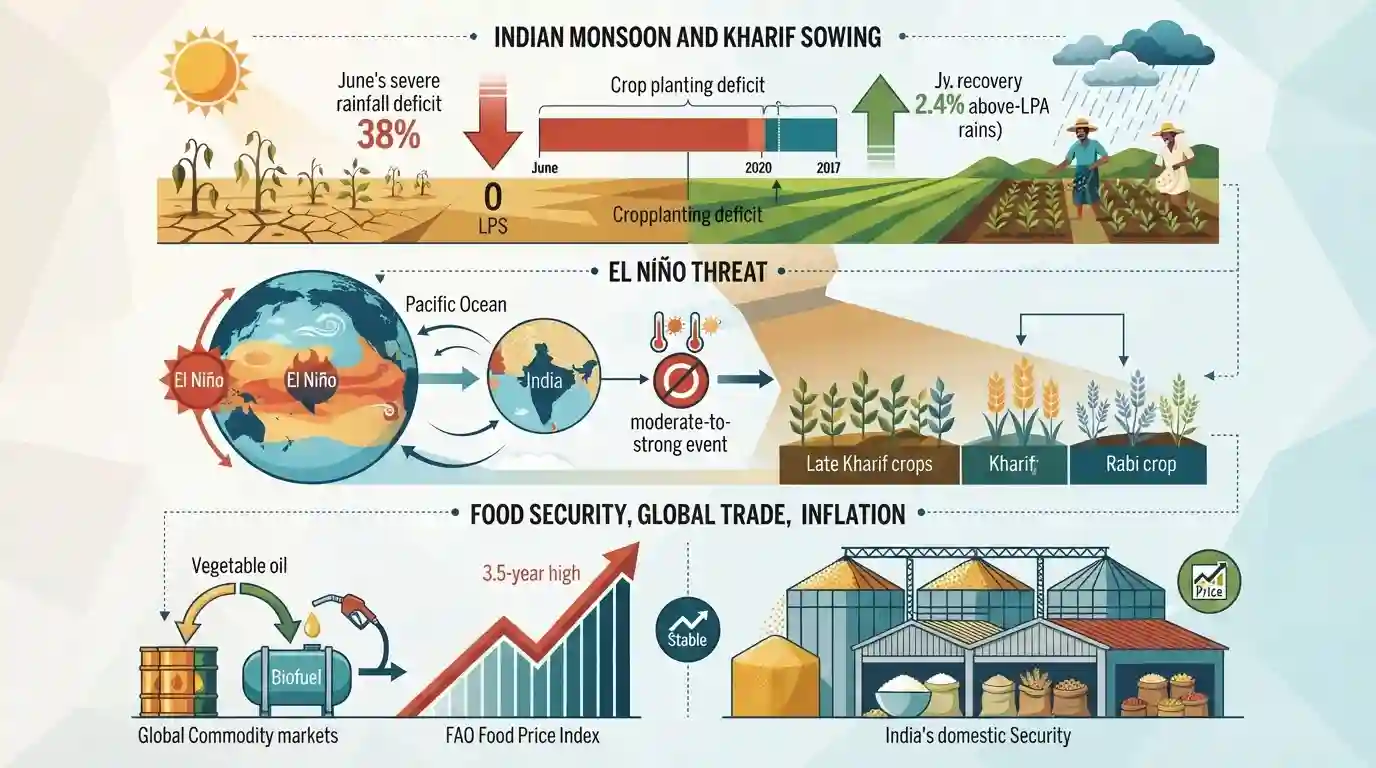
Despite a severe 38% rainfall deficit in June due to zero Low-Pressure Systems (LPS), India's kharif sowing recovered substantially in July as active monsoon winds brought 2.4% above-LPA rains, narrowing the crop planting deficit to 1.8% of the previous year's levels. However, El Niño has transitioned into a moderate-to-strong event and is expected to peak in winter, threatening late kharif crop yields and Rabi crops with a warmer winter. Globally, the FAO Food Price Index hit a 3.5-year high, driven primarily by vegetable oil prices being diverted to biofuels, though India remains cushioned by comfortable rice, wheat, and pulse buffer stocks to combat domestic inflation.
Key Points
- June 2026 registered a 38% rainfall deficit below the Long-Period Average (LPA), making it the sixth-driest June since 1901 due to an anomalous absence of Low-Pressure Systems (LPS).
- A July turnaround saw four slow-moving LPSs yielding 24 rainy days (against the normal of 14) and 2.4% above-LPA rain, narrowing the total kharif sowing gap to just 1.8% compared to last year.
- While the active July rainfall provided 'amrit-varsha' (life-saving showers) for vegetative crop stages, late-stage yield (flowering and pod formation) in August-September remains vulnerable to delayed atmospheric impacts of El Niño.
- The ongoing El Niño is projected to peak as a 'very strong' event during October–December and persist until March 2027, raising fears of a warm winter that could adversely affect Rabi crop yields (wheat, mustard, potato).
- The global FAO Food Price Index hit a 3.5-year high of 131.1 points in July, driven primarily by a 17.3% year-on-year surge in vegetable oils. This is linked to the diversion of palm, soyabean, and rapeseed oils into biofuel production when crude oil prices harden.
- To insulate domestic markets from food inflation, India holds substantial buffer stocks of 92.6 million tonnes of wheat and rice (against a 41.1 million tonnes minimum requirement) and over 4 million tonnes of pulses as of July 1.
Important Terms
Low-Pressure Systems (LPS)

Atmospheric vortices within the monsoon circulation, typically forming over the Bay of Bengal. Tracking northwestward, these weather systems drive active monsoon phases and deliver over half of the annual summer precipitation to central and northern India.
UPSC context
GS Paper 1 (Geography). Essential for questions on Indian monsoon mechanics, spatial rainfall distribution, and agricultural impacts.
El Niño
A climate phenomenon involving the abnormal warming of sea surface temperatures in the central and eastern equatorial Pacific Ocean. It alters global atmospheric circulation, frequently weakening India's southwest monsoon and exacerbating heatwaves or droughts.
UPSC context
GS Papers 1 & 3. Consistently tested in Prelims and Mains regarding extreme weather events, monsoons, and agricultural disruptions.
India Meteorological Department (IMD)
The principal government agency under the Ministry of Earth Sciences responsible for meteorological observations, weather forecasting, and seismology. It provides crucial monsoon forecasts and issues early warnings for extreme weather events in India.
UPSC context
GS Papers 1 & 3. Key institutional body tested in contexts of disaster management, agricultural planning, and climate change monitoring.
Long Period Average (LPA)
The average rainfall recorded over a specific region and interval over 50 years. The IMD currently uses the 1971–2020 average (87 cm nationwide) as its benchmark to classify the monsoon as normal, deficient, or excess.
UPSC context
GS Paper 1 & Prelims. Fundamental IMD metric for understanding monsoon forecasting, agricultural planning, and drought declarations.
Food and Agriculture Organization (FAO)
A specialized United Nations agency that leads international efforts to defeat hunger, improve nutrition, and ensure food security. It publishes crucial agricultural data, including the globally tracked FAO Food Price Index.
UPSC context
GS Paper 2 (International Organizations). Important for questions on global governance, hunger eradication strategies, and international food security initiatives.
Buffer Stocks
A reserve of essential food commodities, like rice and wheat, procured and stored by the government. They are used to ensure food security, run the Public Distribution System (PDS), and stabilize domestic prices during supply shocks.
UPSC context
GS Paper 3 (Economy/Agriculture). Core to India's food security architecture, Minimum Support Price (MSP) policy, and inflation management.
Prelims Trap
El Niño's agricultural impact in India is confined to the Southwest Monsoon (Kharif) and does not affect winter Rabi crops.
El Niño has a 1-to-2-month atmospheric lag, peaking in winter (Oct-Dec) to cause warmer temperatures and low soil moisture, directly threatening Rabi yields like wheat.
Static Concepts Connected
What is the structure and authority behind India's Foodgrain Buffer Stock Norms?
- CCEA authority: The Cabinet Committee on Economic Affairs, chaired by the Prime Minister, fixes the minimum quarterly buffer stock norms.
- Quarterly cycle: Norms vary across four distinct dates (Jan 1, Apr 1, Jul 1, Oct 1) to align with Kharif and Rabi harvest timelines.
- Operational agencies: While FCI manages wheat and rice buffers, agencies like NAFED and SFAC handle dedicated buffer stocks for pulses.
What is the FAO Food Price Index (FFPI) and how is it measured?
- Composition: It is a monthly index tracking global prices of five commodity groups: cereals, vegetable oils, dairy, meat, and sugar.
- Base period: The index uses 2014–2016 as its base period to measure average changes in international food prices.
Cross-Topic Patterns
Biofuels vs Food Security
Rising crude oil prices incentivize diverting edible vegetable oils into biodiesel, driving up global food inflation and straining developing nations' import balances.
Meteorology meets Fiscal Policy
El Niño-induced crop failures force higher MSP procurement and open-market interventions, inflating the government's food subsidy bill and straining fiscal deficit targets.

Multi-statement questions in 2026 will likely link El Niño's winter lag effect on Rabi crops with the FAO Food Price Index methodology.
Linked PYQs · 5
Linked PYQs · 5
- 2011PrelimsGS1
La Nina is suspected to have caused recent floods in Australia. How is La Nina different from El Nino? 1. La Nina is characterised by unusually cold ocean temperature in equatorial Indian Ocean whereas El Nino is characterised by unusually warm ocean temperature in the equatorial Pacific Ocean. 2. El Nino has adverse effect on south-west monsoon of India, but La Nina has no effect on monsoon climate. Which of the statements given above is/are correct?
- 2017PrelimsGS1
With reference to 'Indian Ocean Dipole (IOD)' sometimes mentioned in the news while forecasting Indian monsoon, which of the following statements is/are correct? 1. IOD phenomenon is characterised by a difference in sea surface temperature between tropical Western Indian Ocean and tropical Eastern Pacific Ocean. 2. An IOD phenomenon can influence an El Nino's impact on the monsoon. Select the correct answer using the code given below:
- 2019PrelimsGS1
With reference to the cultivation of Kharif crops in India in the last five years, consider the following statements: 1. Area under rice cultivation is the highest. 2. Area under the cultivation of jowar is more than that of oilseeds. 3. Area of cotton cultivation is more than that of sugarcane. 4. Area under sugarcane cultivation has steadily decreased. Which of the statements given above are correct?
- 2020PrelimsGS1
With reference to pulse production in India, consider the following statements: 1. Black gram can be cultivated as both kharif and rabi crop. 2. Green-gram alone accounts for nearly half of pulse production. 3. In the last three decades, while the production of kharif pulses has increased, the production of rabi pulses has decreased. Which of the statements given above is/are correct?
- 2024MainsGS3
Elucidate the importance of buffer stocks for stabilizing agricultural prices in India. What are the challenges associated with the storage of buffer stock? Discuss.
