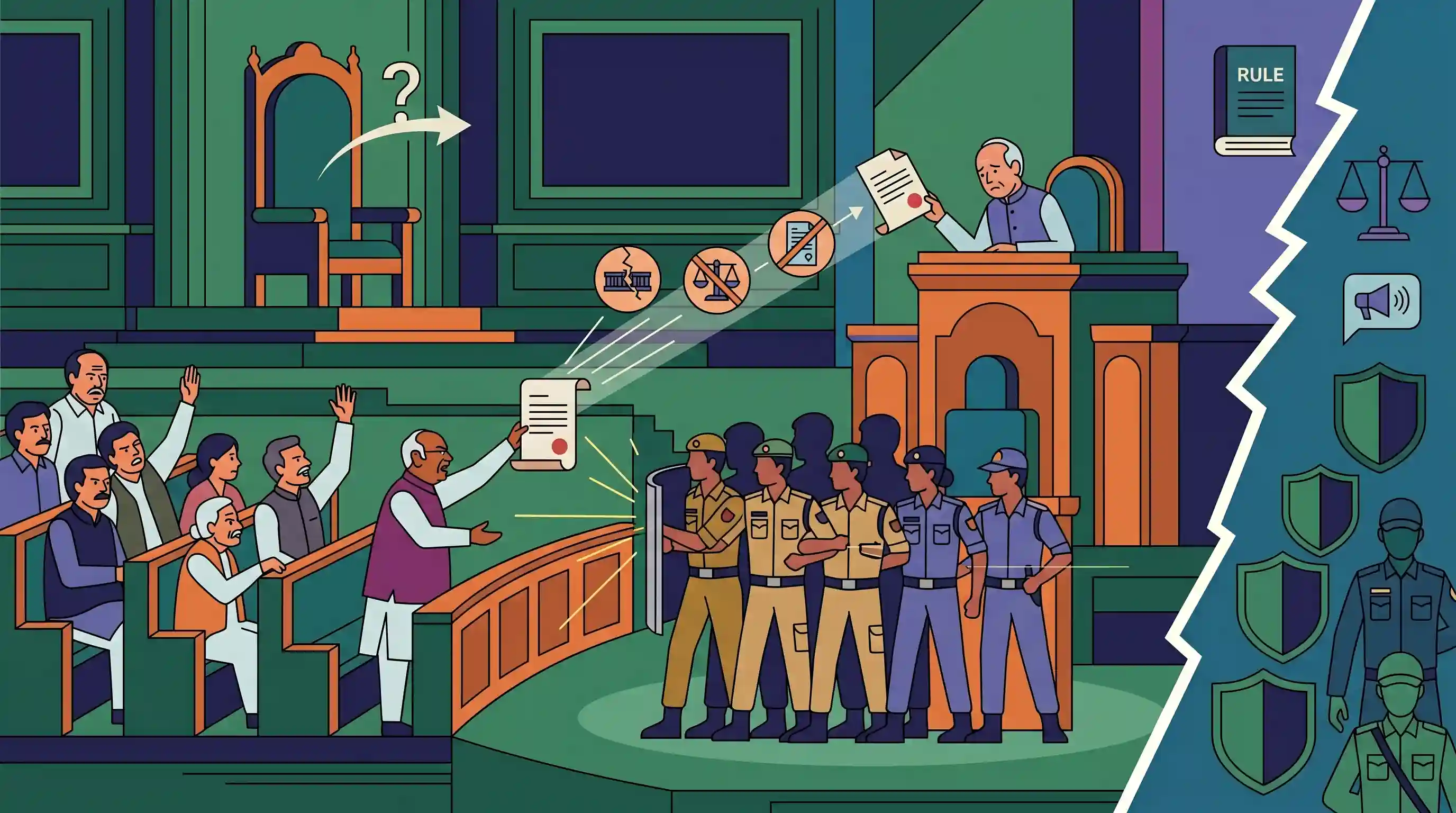
Opposition Protests Security Forces Deployment in Parliament Well
Source:The Hindu ↗
Why It Matters
This issue highlights the delicate balance between maintaining parliamentary order and upholding the democratic right to protest. The deployment of security forces within the well of the House raises critical questions about parliamentary privileges, the role of Presiding Officers, and the erosion of conventional parliamentary practices, which are vital for GS-2 Polity and Governance.
Summary
Mallikarjun Kharge, the Leader of the Opposition in the Rajya Sabha, has strongly condemned the deployment of Central Industrial Security Force (CISF) personnel inside the well of the House. In a formal letter to Deputy Chairman Harivansh, Kharge criticized the unprecedented move, asserting that physically blocking opposition MPs from protesting undermines their fundamental democratic rights and parliamentary privileges. The incident, which occurred amidst turmoil following the sudden resignation of the Rajya Sabha Chairman, saw MPs from various opposition parties blocked by security forces. Kharge demanded the immediate withdrawal of the personnel, reiterating that parliamentary decorum must be maintained through established rules and members' self-regulation, rather than coercion.
Key Points
- Leader of Opposition Mallikarjun Kharge formally protested the unprecedented deployment of CISF personnel in the well of the Rajya Sabha.
- Kharge argued that using security forces to physically block protesting MPs suppresses their democratic rights and turns the Parliament into a 'fortress'.
- The confrontation follows the sudden resignation of the Rajya Sabha Chairman, further heightening tensions between the government and the opposition.
- Kharge emphasized that parliamentary decorum relies on self-regulation and established rules of procedure, not coercive security measures.
- Opposition MPs from TMC, AAP, and DMK were actively blocked by CISF personnel while attempting to enter the well to protest.
Important Terms
Rules of Procedure and Conduct of Business in the Council of States

Rules established under Article 118(1) of the Constitution to regulate proceedings, debates, and conduct of members within the Upper House to ensure orderly business.
UPSC context
GS Paper II: Parliament functioning. Tests knowledge of the regulatory framework for legislative decorum and the Presiding Officer's disciplinary powers.
Parliamentary Privileges
Constitutional rights and immunities (Article 105) granted to MPs and the House collectively to ensure they perform duties without external interference or legal repercussions.
UPSC context
GS Paper II: Constitution/Parliament. Crucial for understanding the balance between legislative independence and the rule of law.
Well of the House
The central area of the legislative chamber directly in front of the Presiding Officer's chair, where members sometimes congregate to protest or demand attention.
UPSC context
GS Paper II: Parliament. Relates to issues of parliamentary ethics, decorum, and the limits of the right to protest within the House.
Central Industrial Security Force (CISF)
A Central Armed Police Force (CAPF) that recently took over security duties at the Parliament complex, replacing the Delhi Police and Parliament Security Service after the 2023 breach.
UPSC context
GS Paper III: Security. Relevant for internal security changes and the administrative shift in protecting the "nerve centre" of democracy.
Leader of the Opposition (LoP)
A statutory post recognized under the 1977 Act; the leader of the largest opposition party in the House who provides constructive criticism and alternative policy perspectives.
UPSC context
GS Paper II: Parliament. Tests understanding of the official role of the opposition in maintaining government accountability.
Rajya Sabha
The Upper House of India's bicameral Parliament, representing States and UTs (Council of States), presided over by the Vice President as ex-officio Chairman.
UPSC context
GS Paper II: Parliament structure. Basic constitutional knowledge regarding the composition and special powers of the Upper House.
Prelims Trap
The Rajya Sabha Chairman can suo motu suspend an MP for grave disorder in the House.
Unlike the Lok Sabha Speaker (Rule 374A), the Rajya Sabha Chairman cannot unilaterally suspend a member. A formal motion must be adopted by the House.
Static Concepts Connected
How do suspension powers differ between the Lok Sabha and Rajya Sabha?
- Lok Sabha: Under Rule 374A, the Speaker can unilaterally suspend a member for a maximum of five consecutive sittings for grave disorder.
- Rajya Sabha: The Chairman cannot unilaterally suspend an MP. A formal motion must be introduced and adopted by the House under Rule 374.
- Common power: Both presiding officers can direct a disorderly member to withdraw immediately for the remainder of the day's sitting.
What is the constitutional procedure for the resignation of the Vice-President?
- Resignation addressee: Under Article 67(a), the Vice-President (ex-officio RS Chairman) resigns by submitting a hand-written letter to the President of India.
- Interim arrangement: The Deputy Chairman performs the duties of the office while the Chairman position is vacant, as per Article 91.
- Election timeline: An election to fill a vacancy caused by resignation, death, or removal must be held "as soon as possible" (Article 68).
Cross-Topic Patterns
Internal Security vs Parliamentary Privilege
The 2023 Parliament breach shifted complex security from Delhi Police/PSS to CISF. This creates novel friction between stringent internal security protocols and traditional parliamentary immunities under Article 105.
LoP: Statutory vs Constitutional status
India's Leader of Opposition is not constitutional. It is defined by a 1977 statute, meaning questions often merge statutory LoP privileges with the presiding officer's discretion over the 10% quorum requirement.

Expect a multi-statement Prelims 2026 question contrasting RS Chairman and LS Speaker disciplinary powers regarding MP suspensions.
Linked PYQs · 3
Linked PYQs · 3
- 2013PrelimsGS1
Consider the following statements : 1. The Chairman and the Deputy Chairman of the Rajya Sabha are not the members of that House. 2. While the nominated members of the two Houses of the Parliament have no voting right in the presidential election, they have the right to vote in the election of the Vice President. Which of the statements given above is/are correct?
- 2023MainsGS2
Discuss the role of Presiding Officers of state legislatures in maintaining order and impartiality in conducting legislative work and in facilitating best democratic practices.
- 2019MainsGS2
Individual Parliamentarian's role as the national law maker is on a decline, which in turn, has adversely impacted the quality of debates and their outcome. Discuss.
