J and K Police FIR Over Fake News Amid Protests
Source:Indian Express ↗
Why It Matters
The incident serves as a contemporary case study for GS-3 Internal Security, demonstrating how unverified news about international developments can swiftly trigger law and order challenges locally. It highlights the urgent need for agile police administration, robust fact-checking mechanisms, and effective management of public sentiment in strategically sensitive border regions like J&K.
Summary
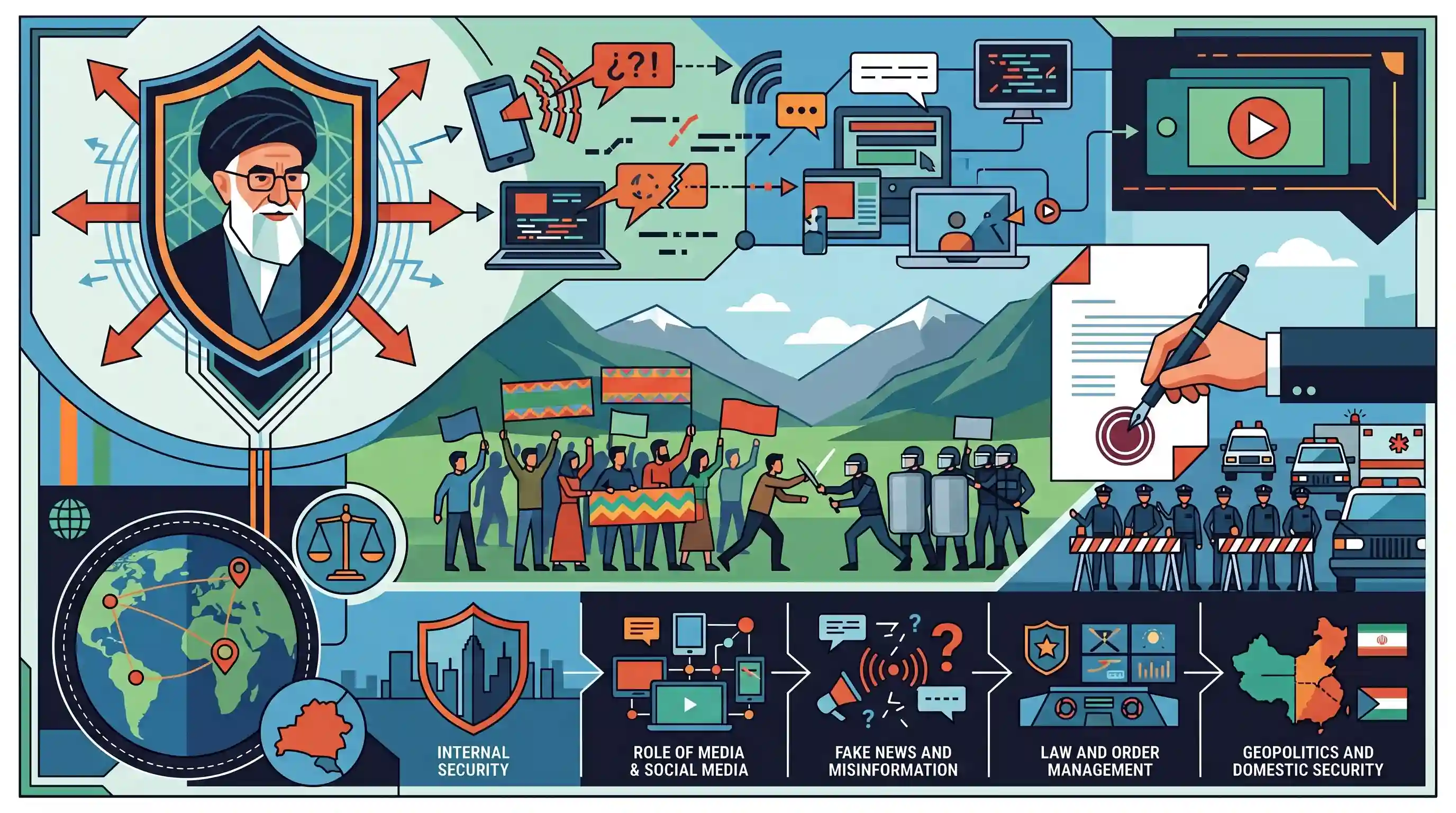
Jammu and Kashmir Police have registered an FIR to curb the spread of fake news regarding the alleged killing of Iran's Supreme Leader Ayatollah Ali Khamenei, which had sparked sudden pro-Iran protests in the valley. In response to the growing unrest, authorities placed the region on high alert to secure law and order. The incident underscores the swift and destabilizing impact that international geopolitical rumors can have on sensitive domestic regions, as well as the ongoing internal security challenges posed by the rapid dissemination of misinformation via social media.
Key Points
- J&K Police registered an FIR over the circulation of fake news claiming the death of Iran's Supreme Leader, Ayatollah Ali Khamenei.
- The spread of this misinformation led to immediate pro-Iran protests across the Kashmir valley.
- Authorities placed the valley on high alert to maintain law and order and prevent any escalation or violence.
- The situation highlights the vulnerability of sensitive areas to international rumors and the critical role of social media in amplifying such unverified information.
Important Terms
Jammu & Kashmir Police

The law enforcement agency of the Union Territory of Jammu and Kashmir, pivotal for maintaining human intelligence (HUMINT) and counter-insurgency operations in the region.
UPSC context
GS III: Internal Security; tests understanding of the role of state/UT police and community-led policing in sensitive border areas.
First Information Report (FIR)
A written document prepared by police after receiving information about a cognizable offense; it sets the criminal justice process in motion (recorded under Section 173 of BNSS/Section 154 CrPC).
UPSC context
GS II: Governance and Criminal Justice; essential for understanding legal procedures and the role of police in law enforcement.
Fake News/Misinformation
False or fabricated information spread with the intent to deceive or manipulate public opinion, often amplified by social media to incite social unrest.
UPSC context
GS III: Challenges to Internal Security via Communication Networks; tests knowledge on how social media manipulation affects communal harmony.
Internal Security
The maintenance of peace and law and order within a country's borders, involving the protection of territorial integrity and societal harmony against non-state actors or internal threats.
UPSC context
GS III: Internal Security; a core syllabus topic covering extremism, radicalization, and the security-governance nexus.
Public Order
A state of societal peace where the 'even tempo of life' is maintained; it is broader than 'law and order' and pertains to threats affecting the community at large.
UPSC context
GS II/III: Governance and Security; tests the ability to distinguish between individual criminal acts and large-scale societal disruptions.
Information Warfare
The strategic use of information (misinformation, propaganda, or cyber operations) to influence, disrupt, or manipulate an adversary’s decision-making and public perception.
UPSC context
GS III: Internal Security; covers emerging non-traditional threats and the impact of global geopolitical narratives on domestic stability.
Prelims Trap
The Fact Check Unit (FCU) under IT Rules 2021 regulates all international fake news affecting public order.
The FCU's mandate under the amended IT Rules 2021 was strictly limited to the 'business of the Central Government', not general global news.
Static Concepts Connected
What are the grounds for restricting Free Speech under Article 19(2)?
- Sovereignty & Security: Protecting the sovereignty and integrity of India, and maintaining the security of the State.
- Public Order & Diplomacy: Preventing incitement to offenses, managing public order, and maintaining friendly relations with foreign states.
- Morality & Contempt: Restrictions to uphold decency, morality, and to prevent contempt of court or defamation.
How does the Bharatiya Nyaya Sanhita (BNS) 2023 tackle fake news?
- Section 353: Section 353 criminalizes the creation or publication of false information intended to cause public mischief, replacing IPC Section 505.
- Digital Scope: The new framework explicitly recognizes the digital dissemination of rumors, upgrading the legal machinery for the social media era.
Cross-Topic Patterns
Geopolitics spilling into internal security
The deep socio-religious ties of Kashmir's Shia population (often called 'Iran-e-Sagheer') demonstrate how West Asian conflicts directly trigger domestic law and order challenges in India.
IT Rules vs. Free Speech limits
Tackling digital misinformation via the BNS and IT Rules directly invokes the judicial debate over arbitrary censorship and the precise limits of 'public order' under Article 19(2).

The intersection of BNS 2023 fake news provisions, Article 19(2) public order limits, and IT Rules is highly likely in a 2026 prelims MCQ.
Linked PYQs · 3
Linked PYQs · 3
- 2024MainsGS3
Social media and encrypting messaging services pose a serious security challenge. What measures have been adopted at various levels to address the security implications of social media? Also suggest any other remedies to address the problem.
- 2016MainsGS3
Use of Internet and social media by non-state actors for subversive activities is a major security concern. How have these been misused in the recent past? Suggest effective guidelines to curb the above threat.
- 2023MainsGS3
What are the internal security challenges being faced by India? Give out the role of Central Intelligence and Investigative Agencies tasked to counter such threats.
