Visakhapatnam Hospital Gets Centre for Haemoglobinopathies
Source:The Hindu ↗
Why It Matters
Provides a concrete example of public health infrastructure targeted at vulnerable tribal populations for the management of endemic genetic disorders like sickle cell anaemia. Useful for GS-2 (Health, Vulnerable Sections) and GS-3 (Science & Tech).
Summary
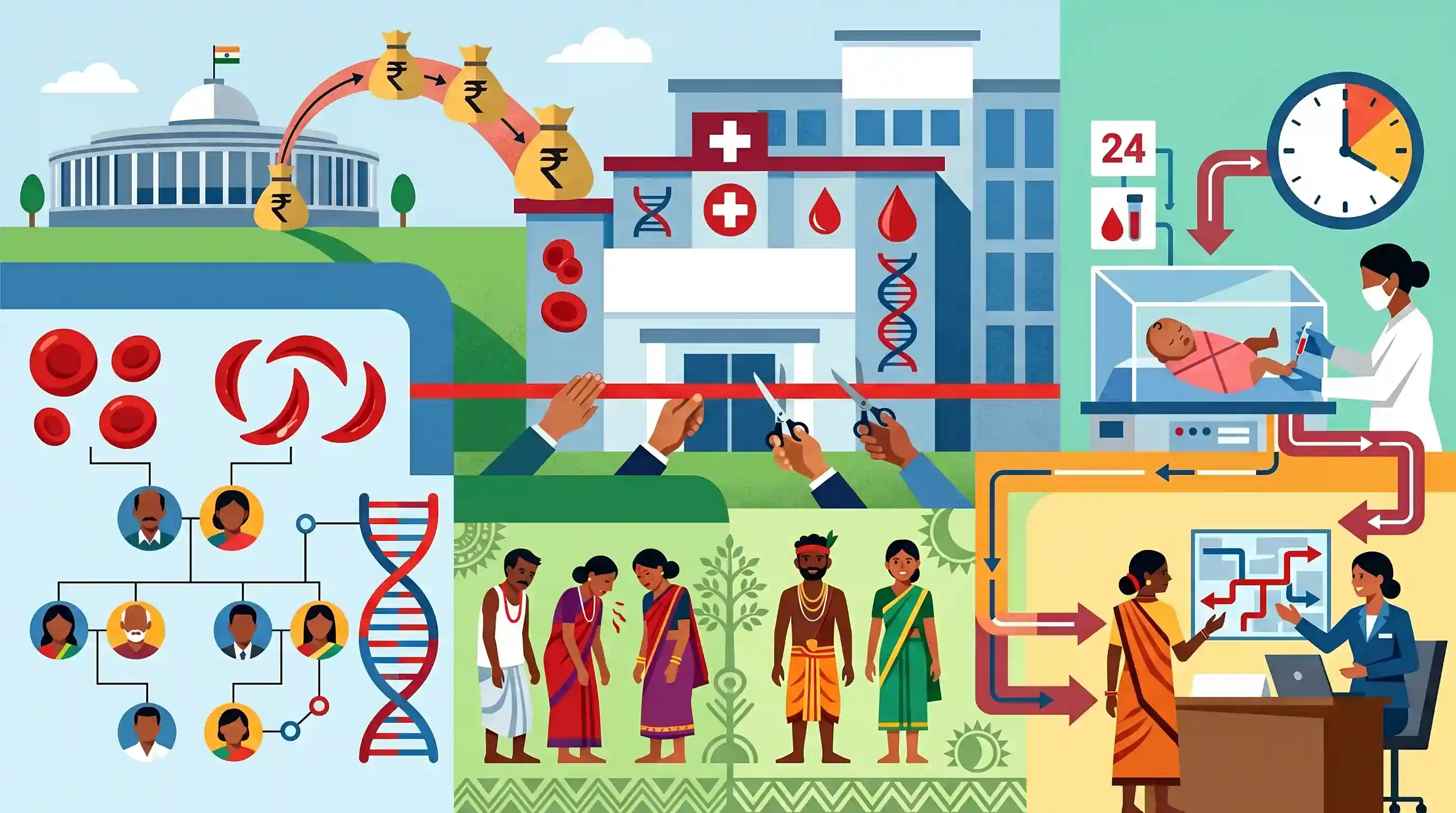
A specialized Centre of Competence for Haemoglobinopathies has been inaugurated at King George Hospital (KGH) in Visakhapatnam to provide comprehensive care for genetic blood disorders such as sickle cell anaemia and thalassaemia. With funding from the Central government, the ₹3.77 crore facility is particularly targeted at serving tribal populations, who show a high prevalence of these diseases. The centre will offer crucial services, including newborn screening within 24 hours of birth. Additionally, an ST Cell operating under the ITDA has been set up to assist tribal patients in navigating the healthcare system.
Key Points
- The Central government has sanctioned a ₹3.77 crore Centre of Competence for Haemoglobinopathies (CoC) at King George Hospital (KGH) in Visakhapatnam.
- The facility aims to treat and manage genetic blood disorders like sickle cell anaemia and thalassaemia, which are highly prevalent among tribal communities.
- A key feature of the centre is the introduction of newborn screening for genetic disorders within 24 hours of birth to enable early intervention.
- To facilitate better healthcare access for tribal patients, an ST Cell has been established at KGH under the Integrated Tribal Development Agency (ITDA).
Important Terms
Haemoglobinopathies

A group of inherited genetic disorders where the structure or production of haemoglobin—the oxygen-carrying protein in red blood cells—is abnormal. Examples include sickle cell anaemia and thalassaemia.
UPSC context
Relevant for GS Paper II (Health) and GS Paper III (Science & Tech; genetics/diseases). Tests awareness of public health challenges.
National Sickle Cell Anaemia Elimination Mission 2047
A central government initiative launched in 2023 to eradicate sickle cell disease by 2047 through mass screening of 7 crore people, genetic counselling, and affordable treatment.
UPSC context
Critical for GS Paper II (Government Policies/Health). Tests knowledge of specific national health targets and tribal welfare.
Integrated Tribal Development Agency (ITDA)
A nodal agency established to implement development and welfare schemes in tribal-populated areas, providing single-line administration for health, education, and infrastructure.
UPSC context
Relevant for GS Paper II (Welfare schemes for vulnerable sections). Tests understanding of administrative structures for tribal development.
Sickle Cell Anaemia
An inherited blood disorder where red blood cells become crescent-shaped, blocking blood flow and causing pain and organ damage. It is highly prevalent in Indian tribal communities.
UPSC context
GS Paper II (Social Justice/Health). A major focus area under the Tribal Health Expert Committee's recommendations.
Thalassaemia
A genetic blood disorder characterized by less haemoglobin and fewer red blood cells than normal, often requiring lifelong blood transfusions and iron chelation therapy.
UPSC context
GS Paper II (Health/Social Justice). Tests understanding of chronic genetic diseases and the healthcare burden in vulnerable regions.
King George Hospital (KGH)
A premier government teaching hospital in Visakhapatnam, Andhra Pradesh, now housing a specialized Centre of Competence for Haemoglobinopathies to serve tribal patients.
UPSC context
Mentioned as a regional hub for implementing central health schemes for tribal welfare (GS Paper II).
Prelims Trap
The National Sickle Cell Anaemia Elimination Mission targets complete eradication by 2030.
The mission targets elimination of sickle cell disease as a public health problem by 2047, aligning with India's centenary, not 2030 (the SDG target for TB/Malaria).
Static Concepts Connected
How is Sickle Cell Anaemia genetically linked to malaria resistance?
- Autosomal recessive: It requires inheriting two defective hemoglobin genes (one from each parent) to manifest the full disease.
- Heterozygote advantage: Individuals with just one defective gene (sickle cell trait) are largely asymptomatic and possess natural resistance to severe malaria.
- Endemic overlap: The genetic trait survived evolutionarily in tropical tribal belts because of the protective advantage against prevalent malaria.
What is the mandate of Integrated Tribal Development Agencies (ITDA)?
- Nodal agency: ITDA functions at the district level to coordinate micro-level tribal development programs and administer Tribal Sub-Plan (TSP) funds.
- Geographic focus: It operates primarily in Integrated Tribal Development Project (ITDP) areas where the ST population is 50% or more.
- Scheme convergence: Ensures the convergence of various state and central schemes (like healthcare screening) specifically tailored to tribal vulnerabilities.
Cross-Topic Patterns
Tribal health & ITDA convergence
High incidence of genetic disorders in Scheduled Areas frequently anchors Mains GS2 questions linking tribal healthcare deficits with specialized administrative tools like ITDAs.
Evolutionary biology in Prelims
UPSC frequently tests applied genetics. The evolutionary trade-off (heterozygote advantage) between the sickle cell trait and malaria resistance is a classic Science and Tech crossover.

Expect a 2026 multi-statement Prelims question merging the autosomal genetics of sickle cell with the 2047 National Elimination Mission.
Linked PYQs · 3
Linked PYQs · 3
- 2023PrelimsGS1
Consider the following statements in the context of interventions being undertaken under Anaemia Mukt Bharat Strategy: 1. It provides prophylactic calcium supplementation for pre-school children, adolescents and pregnant women. 2. It runs a campaign for delayed cord clamping at the time of child-birth. 3. It provides for periodic deworming to children and adolescents. 4. It addresses non-nutritional causes of anaemia in endemic pockets with special focus on malaria, hemoglobinopathies and fluorosis. How many of the statements given above are correct?
- 2017MainsGS3
Stem cell therapy is gaining popularity in India to treat a wide variety of medical conditions including Leukaemia, Thalassemia, damaged cornea and severe burns. Describe briefly what stem cell therapy is and what advantages it has over other treatments?
- 2019MainsGS2
Performance of welfare schemes that are implemented for vulnerable sections is not so effective due to absence of their awareness and active involvement at all stages of policy process. Discuss.
