Tirupati adopts climate resilience and blue green infrastructure
Source:The Hindu ↗
Why It Matters
It provides a perfect case study for UPSC Mains on how Indian cities are adapting to climate change, specifically utilizing 'blue-green infrastructure' and 'nature-based solutions' to tackle urban flooding, a recurring theme in GS1 and GS3.
Summary
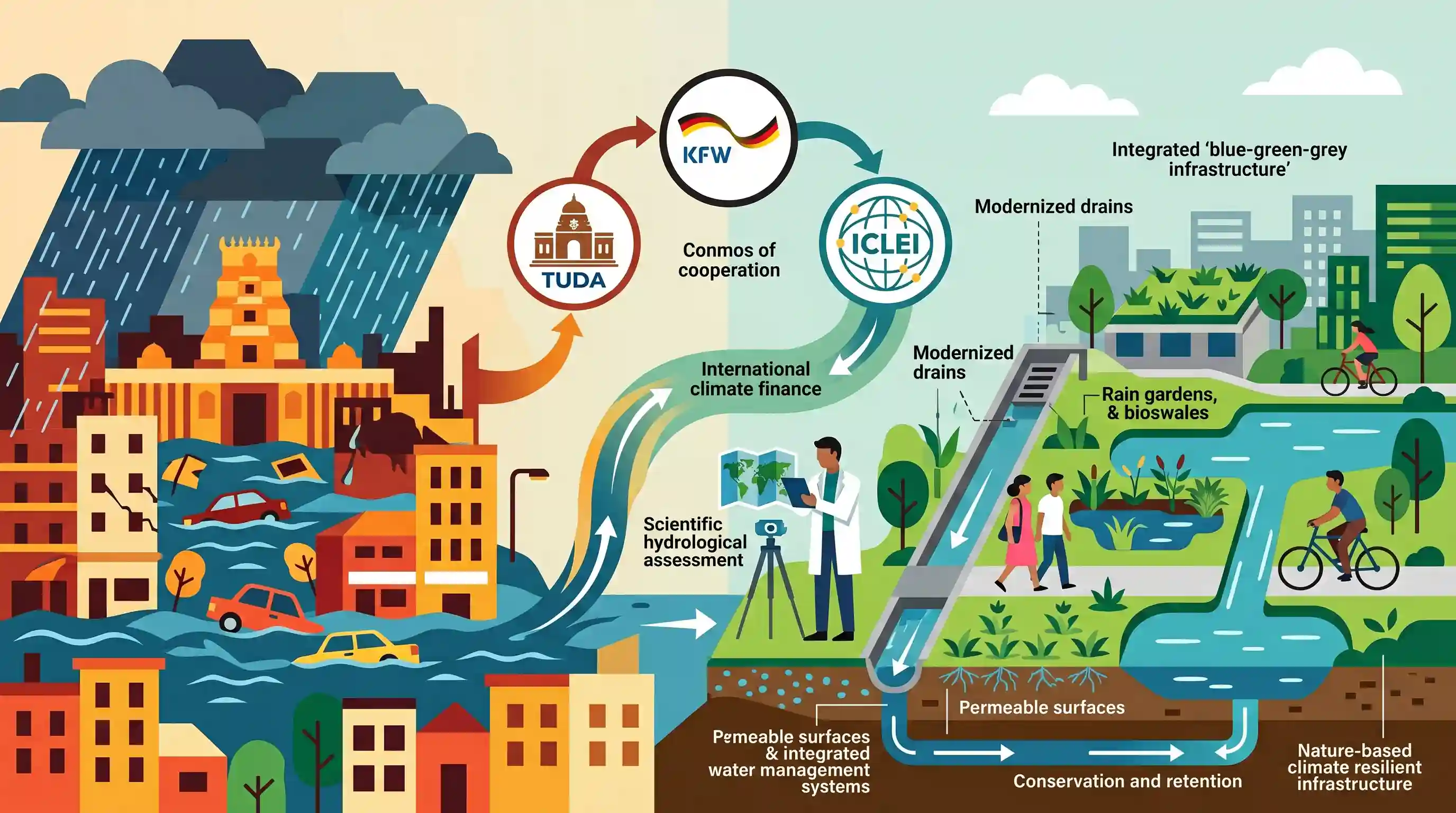
Tirupati is set to become a climate-resilient city through a collaboration between the Tirupati Urban Development Authority (TUDA), Germany's KfW Development Bank, and ICLEI South Asia. The initiative primarily addresses urban flooding and extreme weather events by integrating blue-green-grey infrastructure and rejuvenating water bodies. By adopting Nature-Based Solutions (NBS) and conducting scientific hydrological assessments, the project signifies a shift toward sustainable urban planning backed by international climate finance and expertise.
Key Points
- Tirupati Urban Development Authority (TUDA) is collaborating with Germany's KfW Development Bank and ICLEI South Asia to transform Tirupati into a 'climate resilient' city.
- The initiative aims to mitigate extreme weather impacts, with a specific focus on combating urban flooding.
- Key interventions include the rejuvenation of local water bodies and the integration of 'blue-green-grey' infrastructure.
- The project heavily emphasizes Nature-Based Solutions (NBS), moving away from purely conventional civil engineering approaches.
- Comprehensive scientific hydrological surveys and social-environmental impact assessments will be conducted prior to implementation.
Important Terms
KfW Development Bank

Germany’s state-owned investment and development bank. It provides financial and technical support for global sustainable development, significantly funding India’s climate-resilient urban infrastructure and green energy transitions.
UPSC context
GS Paper 2 (International Relations) and GS Paper 3 (Environment/Economy). Tests knowledge of international climate finance and bilateral development cooperation.
ICLEI South Asia
A regional secretariat of a global network (ICLEI) that helps local governments in South Asia implement sustainable urban development, climate action, and resource management through technical expertise and capacity building.
UPSC context
GS Paper 1 (Urbanization) and GS Paper 2 (Governance). Relevant for understanding the role of NGOs and international networks in urban governance.
Tirupati Urban Development Authority (TUDA)
The statutory body responsible for the planned development of the Tirupati region. It leads local initiatives like the 'city of tanks and lakes' to enhance urban water resilience.
UPSC context
GS Paper 1 (Urbanization) and GS Paper 2 (Governance). Example of a local authority implementing international best practices in urban planning.
Nature-Based Solutions (NbS)
Actions to protect, sustainably manage, and restore ecosystems to address societal challenges (e.g., climate change, flooding) while providing human well-being and biodiversity benefits. Known for being cost-effective and resilient.
UPSC context
GS Paper 3 (Environment and Disaster Management). A core concept for climate adaptation and sustainable development strategies.
Blue-Green-Grey Infrastructure
An integrated urban planning approach combining water bodies (blue), vegetation/parks (green), and engineered systems like drains/roads (grey) to manage stormwater, reduce heat, and improve city resilience.
UPSC context
GS Paper 1 (Urbanization) and GS Paper 3 (Disaster Management). Crucial for addressing urban flooding and creating 'Sponge Cities'.
Prelims Trap
"ICLEI is a specialized agency of the United Nations established to fund urban climate resilience."
ICLEI is a global network of over 2,500 local and regional governments committed to sustainable urban development, not a UN agency.
Static Concepts Connected
What is Blue-Green-Grey Infrastructure in urban climate adaptation?
- Blue infrastructure: Natural and man-made water systems like lakes, wetlands, rivers, and ponds that act as natural drainage and storage.
- Green infrastructure: Vegetation, urban forests, parks, and bioswales that absorb rainfall, reduce surface runoff, and lower temperatures.
- Grey infrastructure: Conventional, engineered civil structures such as concrete stormwater drains, pipes, culverts, and retaining walls.
What are key NDMA recommendations for mitigating Urban Flooding?
- Permeable surfaces: Adopting the 'Sponge City' concept to ensure urban surfaces can absorb, hold, and naturally filter rainwater locally.
- Wetland protection: Strict prohibition of encroachment on floodplains, traditional wetlands, and natural hydrological sinks.
- Drainage maintenance: Pre-monsoon desilting of stormwater drains and strictly preventing solid waste dumping into drainage networks.
Cross-Topic Patterns
NBS + Sendai Framework for DRR
Nature-Based Solutions (NBS) bridge GS3 Environment and Disaster Management, directly supporting the Sendai Framework's emphasis on Ecosystem-based Disaster Risk Reduction (Eco-DRR) to mitigate urban floods.
Bilateral vs Multilateral Climate Finance
KfW’s involvement in Indian municipalities highlights the growing importance of bilateral green finance (e.g., Indo-German Green Partnership) supplementing traditional Multilateral Development Bank (MDB) funding mechanisms.

Expect a 2026 Prelims question differentiating Nature-Based Solutions from Geo-engineering, paired with ICLEI's organizational status.
Linked PYQs · 3
Linked PYQs · 3
- 2024MainsGS3
Flooding in urban areas is an emerging climate-induced disaster. Discuss the causes of this disaster. Mention the features of two such major floods in the last two decades in India. Describe the policies and frameworks in India that aim at tackling such floods.
- 2021MainsGS1
What are the environmental implications of the reclamation of water bodies into urban land use ? Explain with examples.
- 2018MainsGS1
The ideal solution of depleting ground water resources in India is water harvesting system." How can it be made effective in urban areas?
