Consumer Price Index Revision and Macroeconomic Policy Impact
Source:Indian Express ↗
Why It Matters
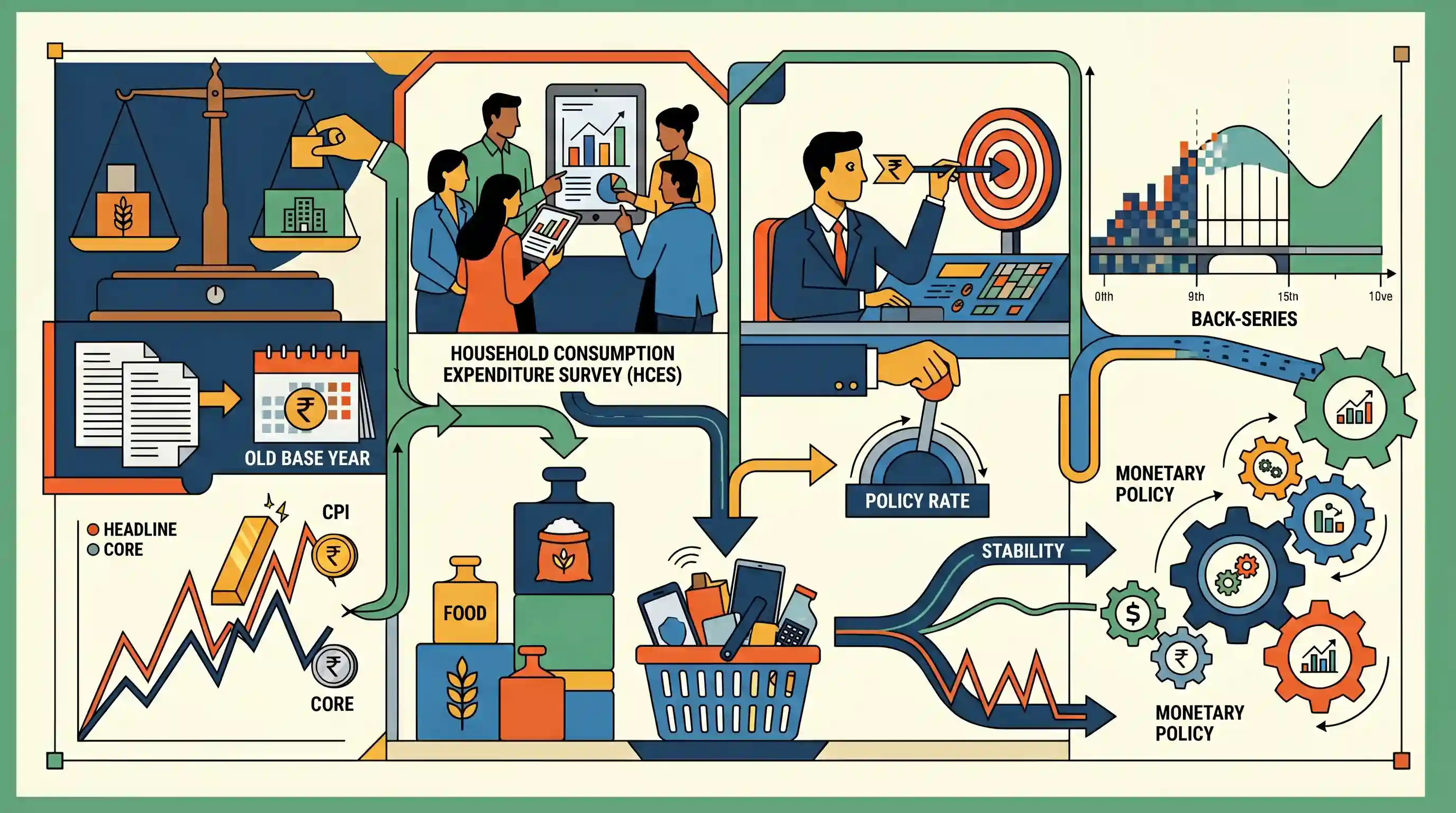
The CPI is the primary metric used by the RBI to track inflation and set interest rates. A revision in the CPI base year and basket weights fundamentally changes how inflation is measured in India, affecting macroeconomic policy, debt yields, and the purchasing power analysis for citizens.
Summary
The article examines the crucial themes surrounding the upcoming revision of the Consumer Price Index (CPI) base year in India. Driven by updated consumption patterns from the recent Household Consumption Expenditure Survey (HCES), the new series will recalibrate the weightage of various goods and services. A key focus is on how gold and silver are treated in the basket, given that their price volatility can skew the measurement of core inflation. Furthermore, the creation of a back-series is highlighted as essential for maintaining historical data comparability. Because CPI serves as the nominal anchor for the Reserve Bank of India's inflation-targeting mandate, these structural revisions—including expected shifts in food weightage—are critical for future monetary policy formulation and interest rate decisions.
Key Points
- The government is revising the base year and consumption basket for the Consumer Price Index (CPI) to align with changing consumption trends captured by the latest Household Consumption Expenditure Survey (HCES).
- The treatment of gold and silver in the index is a central theme; their dual nature as both consumption items (ornaments) and investments complicates their inclusion, as their price volatility can distort core inflation metrics.
- The introduction of a 'back-series' is planned to allow economists and policymakers to seamlessly compare the new CPI data with historical inflation trends.
- Changes in the basket's weights—such as a potential reduction in the weight of food items—will alter how headline inflation is calculated, directly impacting the Reserve Bank of India's (RBI) inflation-targeting framework.
- A refined measurement of core inflation (which traditionally strips out volatile food and fuel prices) will provide the RBI's Monetary Policy Committee with a more accurate picture of underlying domestic price pressures.
Important Terms
Household Consumption Expenditure Survey (HCES)

A quinquennial survey conducted by the NSSO (under MoSPI) to capture household spending patterns. It provides the essential 'weighting diagram' used to update the Consumer Price Index (CPI) basket.
UPSC context
GS III: Indian Economy; crucial for understanding poverty estimation, consumption trends, and updating macroeconomic indicators.
Consumer Price Index (CPI)
A measure of the average change over time in the retail prices of a fixed basket of goods and services. CPI (Combined) is India's primary inflation anchor.
UPSC context
GS III: Economy; essential for inflation targeting and determining the cost of living adjustments.
Monetary Policy Committee (MPC)
A six-member statutory body chaired by the RBI Governor. It is mandated to maintain price stability by setting the repo rate to achieve a CPI inflation target of 4% (+/- 2%).
UPSC context
GS III: Economy; key to understanding monetary policy transmission and institutional frameworks for price stability.
Core vs Headline Inflation
Headline inflation reflects total price changes including volatile food and fuel. Core inflation excludes these volatile components to measure underlying long-term price trends.
UPSC context
GS III: Economy; tests ability to analyze the drivers of inflation and the impact of price shocks.
Back-series
A recalculated historical data set adjusted to a new base year or methodology. This ensures continuity, allowing researchers to compare current economic performance with past trends accurately.
UPSC context
GS III: Economy; important for statistical consistency and long-term macroeconomic analysis.
Wholesale Price Index (WPI)
An index measuring price changes at the wholesale/producer level. Unlike CPI, it excludes services and gives higher weightage to manufactured goods. It is published by the Ministry of Commerce.
UPSC context
GS III: Economy; tested as a point of comparison for retail inflation and producer-side price pressures.
Ministry of Statistics and Programme Implementation (MoSPI)
The nodal ministry for official statistics in India. It oversees the National Statistical Office (NSO), which compiles GDP, CPI, and the Index of Industrial Production (IIP).
UPSC context
GS III: Indian Economy; relevant for the institutional role in data collection and reporting.
Prelims Trap
"Core inflation excludes the volatile prices of food, fuel, gold, and silver."
Standard core inflation strips out only food and fuel. Excluding gold and silver to remove global price volatility yields "super core inflation"—a crucial distinction for UPSC.
Static Concepts Connected
How do headline, core, and super-core inflation differ in India?
- Headline Inflation: The total inflation rate in the economy (CPI-Combined), which serves as the RBI's official nominal anchor for monetary policy.
- Core Inflation: Headline inflation minus volatile food and fuel components. It reflects underlying domestic demand but still includes precious metals.
- Super-core Inflation: Core inflation further stripped of gold and silver prices. It prevents volatile global bullion markets from skewing domestic inflation metrics.
What drives structural changes in the CPI basket weights over time?
- Engel's Law: As household income grows, the proportion of income spent on food drops. This necessitates reducing food weightage in updated CPI baskets.
- HCES Data: The MoSPI uses the Household Consumption Expenditure Survey (HCES) to capture changing consumer habits and update the CPI base year accordingly.
- Back-series Creation: A mathematical 'linking factor' is used to connect the old series (2012) with the new (2024), enabling historical comparisons.
Cross-Topic Patterns
Monetary policy & climate-driven food shocks
A lower food weightage in the new CPI reduces the RBI's vulnerability to monsoon-driven food price shocks, fundamentally shifting how interest rates respond to climate events and El Niño.
Changing consumption & poverty estimation
The HCES data updating the CPI basket is the exact same foundational dataset utilized by NITI Aayog to revise multidimensional poverty lines and reassess targeted PDS (ration) allocations.

Expect a Prelims question in 2026 contrasting Core vs Super-Core inflation, specifically targeting the trap of gold/silver inclusion.
Linked PYQs · 4
Linked PYQs · 4
- 2020PrelimsGS1
Consider the following statements: 1. The weightage of food in Consumer Price Index (CPI) is higher than that in Wholesale Price Index (WPI). 2. The WPI does not capture changes in the prices of services, which CPI does. 3. Reserve Bank of India has now adopted WPI as its key measure of inflation and to decide on changing the key policy rates. Which of the statements given above is/are correct?
- 2010PrelimsGS1
With reference to India, consider the following statements : 1. The Wholesale Price Index (WPI) in India is available on a monthly basis only. 2. As compared to Consumer Price Index for Industrial Workers (CPI(IW)), the WPI gives less weight to food articles. Which of the statements given above is/are correct ?
- 2022PrelimsGS1
In India, which one of the following is responsible for maintaining price stability by controlling inflation?
- 2024MainsGS3
What are the causes of persistent high food inflation in India? Comment on the effectiveness of the monetary policy of the RBI to control this type of inflation.
