Manipur Ethnic Conflict Rehabilitation and Peace Strategy
Source:Indian Express ↗
Why It Matters
The Manipur crisis represents a critical internal security and governance challenge. Understanding the government's approach—combining infrastructure pushes with peacebuilding and rehabilitation—is crucial for UPSC aspirants tackling questions on border area management, ethnic conflicts, and the socio-economic dimensions of security in the North-East.
Summary
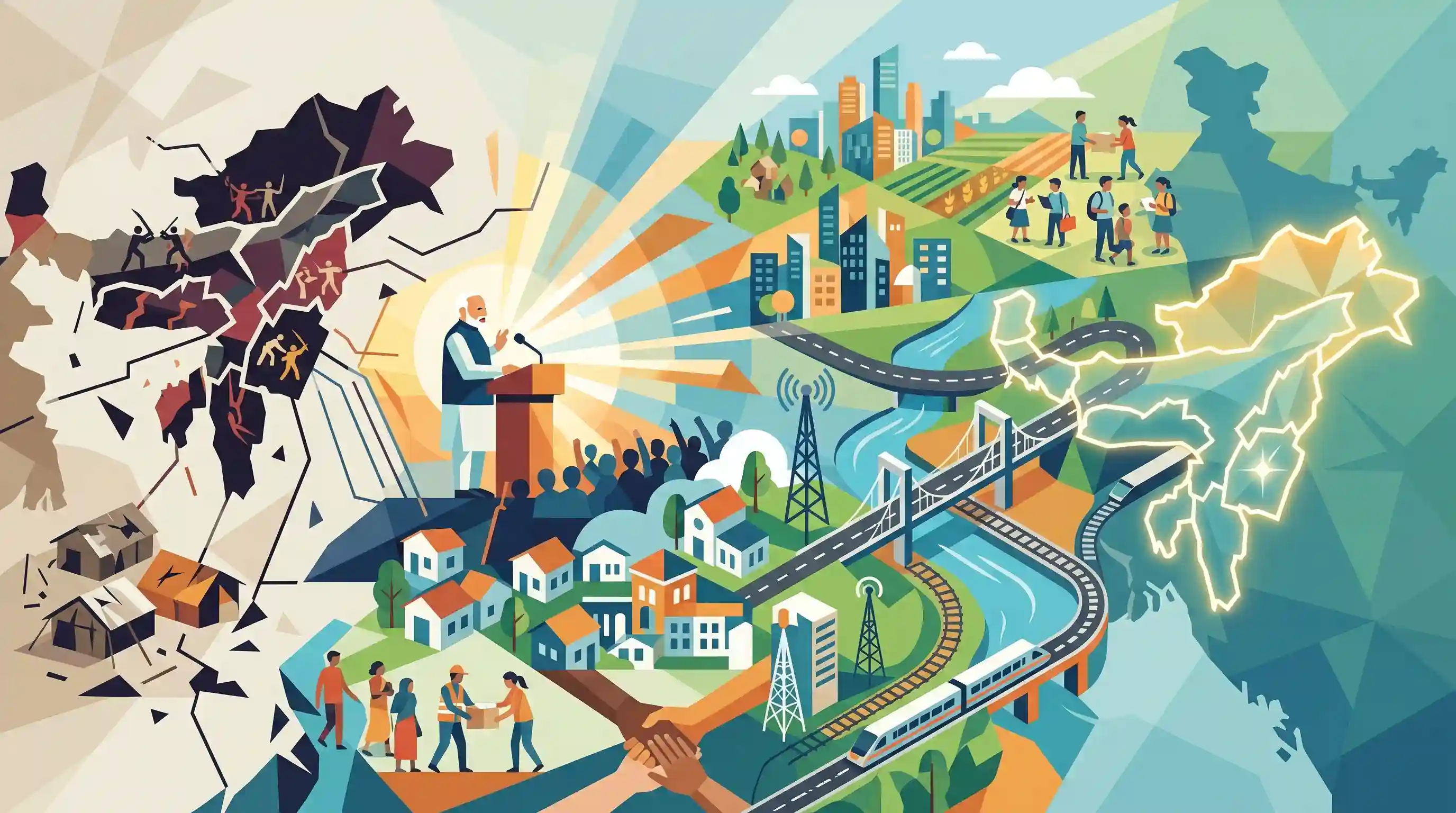
Prime Minister Narendra Modi’s speech in Churachandpur, Manipur, marked a crucial political and developmental outreach to a region scarred by ethnic conflict. His address underscored the need for peace, unity, and the active rehabilitation of internally displaced persons. By linking infrastructure development to long-term stability, the speech reflects the government's strategy of utilizing socio-economic growth and improved connectivity as primary tools for conflict resolution and peacebuilding in North-East India.
Key Points
- Prime Minister Narendra Modi delivered a significant address in Churachandpur, Manipur, focusing heavily on peacebuilding and restoring unity in the region following prolonged ethnic violence.
- The speech featured a strong outreach to internally displaced persons (IDPs), promising rehabilitation and government support to rebuild lives affected by the conflict.
- A major push for infrastructure development was emphasized as a cornerstone for long-term peace and economic normalization in the North-East.
- The visit highlights the dual approach of political engagement and developmental interventions to resolve the complex internal security and socio-economic challenges in Manipur.
Important Terms
Internally Displaced Persons (IDPs)

Individuals forced to flee their homes due to conflict or disasters who remain within their country's borders, lacking refugee status.
UPSC context
GS Paper 2 (Social Justice/Governance); tests knowledge of humanitarian crises and rehabilitation of vulnerable sections.
Ethnic Conflict
Conflicts between groups over identity, political power, or resources, exemplified in Manipur by the Meitei and Kuki-Zo hostilities.
UPSC context
GS Paper 1 (Society) and GS Paper 3 (Internal Security); crucial for understanding regional stability and communal harmony.
Internal Security
The protection of a nation's territory and citizens from domestic threats such as insurgency, communal violence, and organized crime.
UPSC context
GS Paper 3 core topic; focuses on North-East insurgency, border management, and the development-security nexus.
Act East Policy
A diplomatic initiative to boost economic, strategic, and cultural ties with the Asia-Pacific, positioning North-East India as a regional gateway.
UPSC context
GS Paper 2 (International Relations) and GS Paper 3 (Economy); emphasizes connectivity projects and regional integration.
Rehabilitation and Resettlement
Comprehensive measures to restore housing, livelihoods, and social stability for those affected by conflict or forced migration.
UPSC context
GS Paper 2 (Governance); involves the Disaster Management Act and welfare schemes for displaced communities.
Conflict Resolution
Methods used to manage disputes and establish long-term stability through dialogue, peace accords, and addressing root causes of violence.
UPSC context
GS Paper 3 (Security) and GS Paper 4 (Ethics); tests strategies for peacebuilding and inclusive governance.
Prelims Trap
"India has a comprehensive national legislative framework specifically dedicated to rehabilitating conflict-induced Internally Displaced Persons."
India lacks a dedicated national law for IDPs. Rehabilitation of conflict-affected populations is managed via ad-hoc administrative measures by the Center and State governments.
Static Concepts Connected
What are the special Constitutional provisions for the state of Manipur?
- Article 371C: Empowers the President to constitute a Hill Areas Committee comprising Members of Legislative Assembly (MLAs) elected from the state's designated hill areas.
- Governor's Role: The Governor has a special responsibility to submit an annual report to the President regarding the administration of the Hill Areas.
- Not Sixth Schedule: Unlike the Autonomous District Councils in Assam, Meghalaya, Tripura, and Mizoram, Manipur's tribal regions are NOT covered under the Sixth Schedule.
How does the Free Movement Regime (FMR) historically impact internal security in the North-East?
- Transnational Ties: Historically allowed tribes along the Indo-Myanmar border to travel 16 km across without a visa, maintaining cross-border ethnic kinship ties.
- Security Risks: Porous, unfenced borders facilitate insurgent safe havens, arms smuggling, and illegal drug trafficking due to proximity to the Golden Triangle.
- Policy Reversal: Due to escalating ethnic conflict and security concerns, the Center suspended the FMR in 2024 to initiate border fencing.
Cross-Topic Patterns
FMR suspension + Border Security
The Manipur conflict accelerates the GS3 shift from open borders (FMR) to smart-fencing along Myanmar, directly impacting India's Act East policy and transnational tribal kinship networks.
Internal Displacement + Fundamental Rights
The crisis tests the constitutional friction between Article 19(1)(e) (right to reside) and protective tribal land laws under Article 371C, generating questions on federal intervention in state public order.

Mains 2026 GS3: Expect a question evaluating if infrastructure schemes (PM-DevINE) can substitute political dialogue in NE peacebuilding.
Linked PYQs · 4
Linked PYQs · 4
- 2025MainsGS3
What are the major challenges to internal security and peace process in the North-Eastern States? Map the various peace accords and agreements initiated by the government in the past decade.
- 2019MainsGS3
Cross-border movement of insurgents is only one of the several security challenges facing the policing of the border in North-East India. Examine the various challenges currently emanating across the India-Myanmar border. Also, discuss the steps to counter the challenges.
- 2017MainsGS3
The North-East region of India has been infested with insurgency for a very long time. Analyze the major reasons for the survival of armed insurgency in this region.
- 2024MainsGS3
India has a long and troubled border with China and Pakistan fraught with contentious issues. Examine the conflicting issues and security challenges along the border. Also give out the development being undertaken in these areas under the Border Area Development Programme (BADP) and Border Infrastructure and Management (BIM) Scheme.
