Rajasthan State Budget and Capital Expenditure Priorities
Source:Indian Express ↗
Why It Matters
State budgets provide practical examples of how governments balance revenue constraints with the capital expenditure needed for socio-economic development. Rajasthan's focus on basic infrastructure offers a concrete case study for Mains answers regarding inclusive growth, state fiscal health, and infrastructure bottlenecks.
Summary
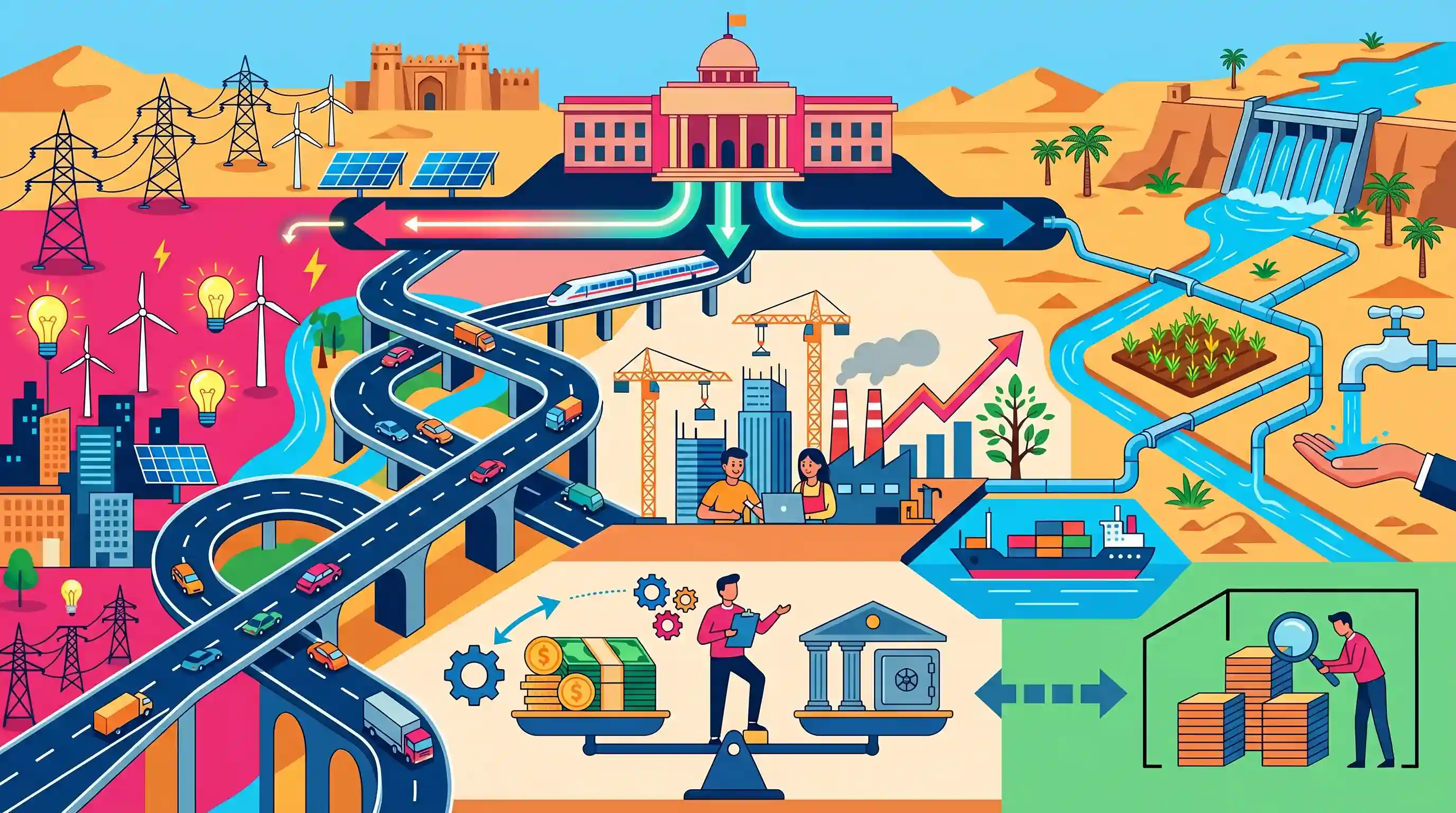
Rajasthan's recently announced Rs 6 lakh crore state budget prioritizes core developmental infrastructure, colloquially termed 'Bijli, Sadak, Paani' (electricity, roads, and water). The budget highlights the government's strategy to spur economic growth through intensive capital expenditure in connectivity, power generation/distribution, and water resource management—the latter being a persistent challenge for the arid state. For UPSC aspirants, this serves as a prime case study on state-level fiscal policy, balancing massive infrastructural outlays with the constraints of fiscal prudence and public debt management.
Key Points
- Rajasthan presented a massive Rs 6 lakh crore state budget heavily focused on foundational infrastructure — electricity, roads, and water ('Bijli, sadak, paani').
- The budget signals the state's intent to substantially increase capital expenditure to drive economic development and address local infrastructure bottlenecks.
- Focusing on water management is particularly critical for Rajasthan given its geographical aridity, pointing toward rural water supply and irrigation investments.
- The sheer size of the budget outlay emphasizes the ongoing challenge state governments face in balancing heavy capital expenditure needs with sustainable fiscal deficit targets under the FRBM framework.
Important Terms
FRBM Act (State)

A statutory framework mandating state governments to maintain fiscal discipline by limiting fiscal deficits and outstanding debt as a percentage of GSDP.
UPSC context
GS III (Fiscal Policy); tests understanding of budgetary discipline and debt sustainability in federal finance.
Jal Jeevan Mission (JJM)
A flagship Centrally Sponsored Scheme aiming to provide Functional Household Tap Connections (FHTC) to every rural household by 2024 (extended in some states).
UPSC context
GS II (Welfare Schemes) and GS III (Infrastructure); crucial for questions on water security and rural development.
PM-KUSUM
A multi-component scheme focusing on solarizing agricultural pumps and installing small solar power plants to provide energy security and additional income to farmers.
UPSC context
GS III (Agriculture/Energy); relevant for renewable energy adoption and doubling farmers' income.
Gross State Domestic Product (GSDP)
The total market value of all finished goods and services produced within a state's borders in a specific period, serving as a key growth indicator.
UPSC context
GS III (Indian Economy); basic macro-economic metric for comparing state-level performance and fiscal targets.
Capital Outlay
Government spending dedicated to the creation or acquisition of long-term physical assets like roads, bridges, and power plants to boost economic productivity.
UPSC context
GS III (Infrastructure/Economy); distinguishes between productive investment and recurring revenue expenditure (salaries/interest).
AMRUT 2.0
The second phase of the Atal Mission, focusing on making cities water-secure through tap connections, sewage treatment, and rejuvenation of water bodies.
UPSC context
GS II (Governance) and GS III (Urban Infrastructure); vital for urban planning and Sustainable Development Goal 6.
Prelims Trap
"Capital expenditure by states is exempted from the fiscal deficit limits prescribed under the FRBM Act."
Fiscal deficit is total expenditure (revenue + capital) minus non-debt receipts. Capex is not exempt; states must still manage it within their GSDP borrowing limits.
Static Concepts Connected
What are the constitutional provisions regarding state government borrowing?
- Article 293: States can borrow only within the territory of India upon the security of the Consolidated Fund of the State. They cannot borrow directly from external sources.
- Centre's Consent: Consent of the Government of India is mandatory for state borrowing if the state has any outstanding loan made or guaranteed by the Centre.
How does the FRBM framework regulate state-level fiscal health?
- Deficit Target: States are typically required to limit their fiscal deficit to 3% of their Gross State Domestic Product (GSDP), though temporary relaxations occur during crises.
- Conditional Allowance: An additional 0.5% borrowing space is often granted, tied to specific performance milestones like power sector reforms or one nation one ration card implementation.
- Debt-to-GSDP Target: The NK Singh Committee recommended a cumulative debt-to-GDP ratio of 20% for the states collectively to ensure macroeconomic stability.
Cross-Topic Patterns
Power sector reforms + State borrowing limits
The Centre incentivizes states to invest in 'Bijli' by linking an additional 0.5% of GSDP borrowing space to specific power sector reforms, such as reducing AT&C losses and direct benefit transfers.
Capex multiplier + Quality of Expenditure
Heavy allocation towards physical infrastructure demonstrates a shift towards capital expenditure, which has a much higher macroeconomic multiplier effect (approx 2.45) compared to revenue expenditure like subsidies.

GS3 Mains 2026: Expect a question evaluating the tension between states' need for heavy capital expenditure (infrastructure) and rigid FRBM caps.
Linked PYQs · 5
Linked PYQs · 5
- 2025MainsGS3
Explain how the Fiscal Health Index (FHI) can be used as a tool for assessing the fiscal performance of states in India. In what way would it encourage the states to adopt prudent and sustainable fiscal policies?
- 2013MainsGS3
What were the reasons for the introduction of Fiscal Responsibility and Budget Management (FRBM) Act, 2003 ? Discuss critically its salient features and their effectiveness.
- 2021MainsGS3
Distinguish between Capital Budget and Revenue Budget. Explain the components of both these Budgets.
- 2021MainsGS3
“Investment in infrastructure is essential for more rapid and inclusive economic growth.” Discuss in the light of India's experience.
- 2024MainsGS3
What are the major challenges faced by Indian irrigation system in recent times? State the measures taken by the government for efficient irrigation management.
