Historical reform movements and social progress in Kerala model
Source:The Hindu ↗
Why It Matters
The evolution of Kerala's society provides critical case studies for GS1 (Social Reform Movements, Annihilation of Caste) and GS2/GS3 (Human Resource Development, Kerala Model, Land Reforms). Understanding how historical grassroots movements paved the way for modern developmental successes is essential for analyzing social justice and inclusive growth policies in India.
Summary
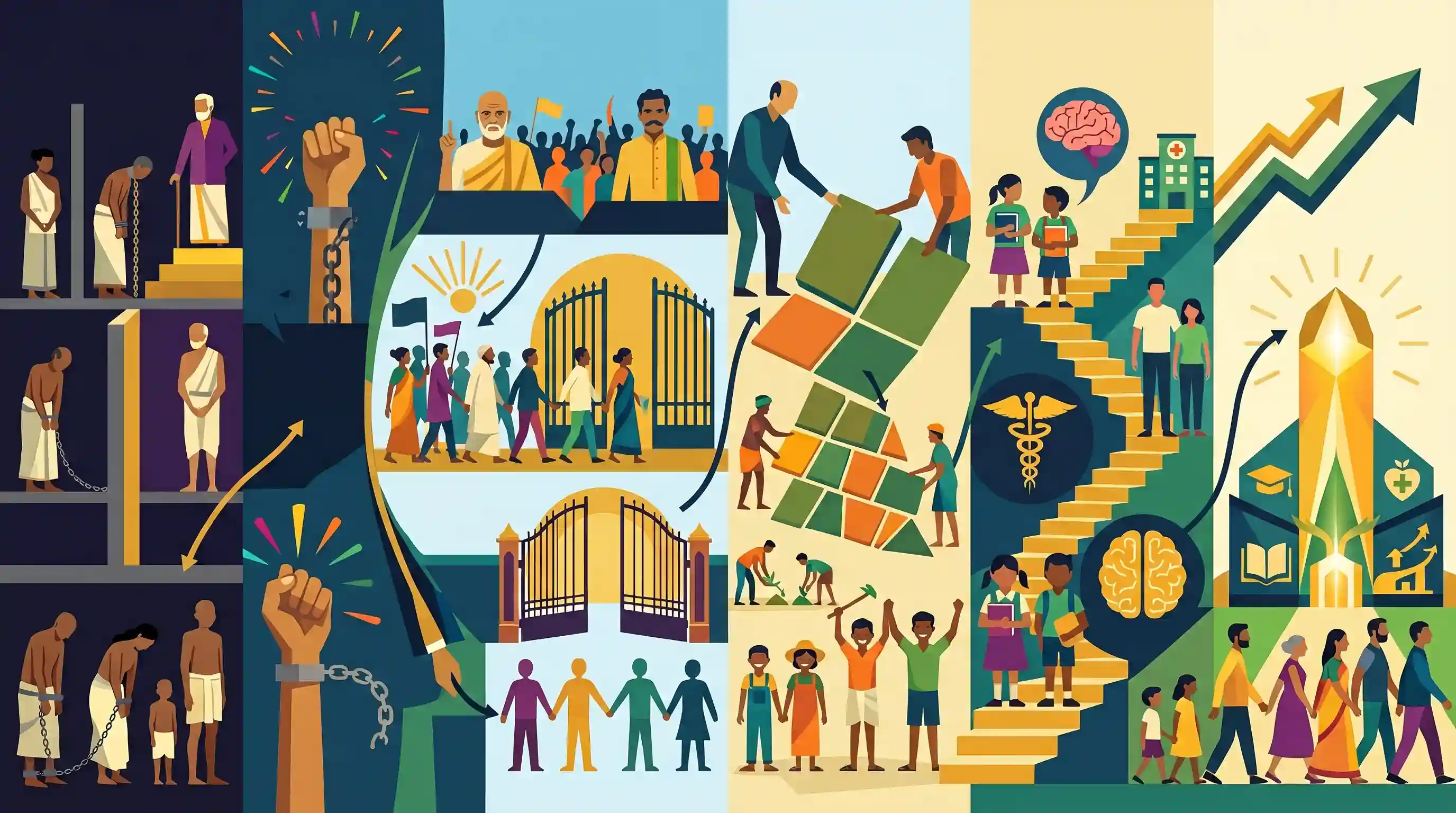
The article examines Kerala’s remarkable journey from a deeply unequal, caste-ridden society to a model of high human development and social justice. This 'social miracle' was achieved through persistent, long-term social reform movements led by figures like Sree Narayana Guru and Ayyankali, alongside landmark events such as the Vaikom Satyagraha and the Temple Entry Proclamation. These struggles to break the chains of untouchability and caste discrimination laid the foundation for building strong civic rights. This socio-cultural awakening, combined with progressive state policies like land reforms and investments in health and education, culminated in the much-lauded Kerala Model of Development, showcasing a unique pathway to inclusive growth and human empowerment.
Key Points
- Kerala underwent a profound social transformation over the last century, moving from a rigidly caste-stratified society to one with high human development indicators.
- Historical struggles such as the Channar revolt, Vaikom Satyagraha, and the Temple Entry Proclamation were pivotal in breaking the chains of caste-based discrimination.
- Visionary social reformers like Sree Narayana Guru and Ayyankali led movements that championed the cause of Dalits, lower castes, and women, laying the groundwork for a rights-based society.
- The synergy between these socio-cultural reform movements and subsequent progressive political actions (such as land reforms and universal education) created the unique 'Kerala Model of Development'.
Important Terms
Temple Entry Proclamation

A 1936 decree by the Maharaja of Travancore that opened state-controlled temples to all Hindus, effectively ending the institutional religious exclusion of 'avarna' (lower-caste) communities.
UPSC context
GS Paper I: Modern Indian History (Social Reform). A landmark victory against untouchability and a precursor to constitutional anti-discrimination.
Kerala Land Reforms Act
Comprehensive 1963 legislation that abolished feudal landlordism (Janmi-Kudiyan system), imposed land ceilings, and transferred ownership rights to cultivating tenants and landless hutment dwellers.
UPSC context
GS Paper III: Land Reforms. Tests the impact of agrarian restructuring on social justice and economic equality.
SNDP Yogam
Founded in 1903 by Sree Narayana Guru, this organization spearheaded the social and educational upliftment of the Ezhava community, challenging caste-based disabilities in Kerala.
UPSC context
GS Paper I: Modern History (Reformers). Evaluates the role of caste-based associations in the socio-cultural awakening of modern India.
Vaikom Satyagraha
A non-violent civil disobedience movement (1924–25) in Travancore for the right of lower castes to access public roads surrounding the Vaikom Mahadeva Temple.
UPSC context
GS Paper I: Modern History. Significant as the first mass movement in Kerala integrating Gandhian methods with social reform.
Kerala Model of Development
A unique development paradigm emphasizing high human development indicators—such as literacy and health—achieved through public policy and social welfare despite modest economic growth.
UPSC context
GS Paper II: Social Justice/Governance. A comparative model for inclusive growth and human-centric development policies.
Prelims Trap
"The Kerala Model of Development is characterized by high economic growth and industrialization driving human development."
The 'Kerala Model' is uniquely defined by high human development indicators achieved despite historically low per-capita income, primarily through wealth redistribution and public action.
Static Concepts Connected
Who were the key social reformers in Kerala and their primary contributions?
- Sree Narayana Guru: Founded the SNDP Yogam (1903), led the Aruvippuram movement, and propagated the philosophy of "One Caste, One Religion, One God for mankind."
- Mahatma Ayyankali: Pioneering Dalit leader who founded the Sadhu Jana Paripalana Sangham (1907) and organized the first agricultural strike for Dalit education.
- K. Kelappan: Known as the 'Kerala Gandhi', he was instrumental in leading the Vaikom (1924) and Guruvayur (1931) Satyagrahas for temple and road entry.
What were the core pillars of the historic Kerala Land Reforms Act?
- Tenancy Abolition: Abolished the deeply entrenched Janmi (landlord) system by conferring absolute ownership rights to the cultivating tenants.
- Land Ceilings: Placed strict caps on the size of agricultural landholdings, enabling the state to acquire and redistribute surplus land to the landless.
- Hutment Rights: Granted proprietary rights over small homestead plots (kudikidappu) to agricultural laborers who were previously living at the mercy of landlords.
Cross-Topic Patterns
Social capital driving economic models
Kerala's history demonstrates how early 20th-century anti-caste mobilizations built the civic consciousness necessary to force post-independence governments into aggressive redistributive policies like land reforms.
Regional reforms fusing with INC politics
The Vaikom Satyagraha (1924) represents a critical juncture where regional anti-untouchability struggles fused with Gandhian constructive programs, integrating marginalized communities into the broader National Movement.

Expect match-the-following Prelims questions pairing South Indian reformers (Ayyankali, Kelappan) with their organizations and agitations.
Linked PYQs · 5
Linked PYQs · 5
- 2021MainsGS1
Trace the rise and growth of socio-religious reform movements with special reference to Young Bengal and Brahmo Samaj.
- 2018MainsGS1
Caste system is assuming new identities and associational forms. Hence, caste system cannot be eradicated in India." Comment.
- 2023MainsGS2
The crucial aspect of development process has been the inadequate attention paid to Human Resource Development in India. Suggest measures that can address this inadequacy.
- 2015MainsGS1
Debate the issue of whether and how contemporary movements for assertion of Dalit identity work towards annihilation of caste.
- 2017MainsGS1
The women's questions arose in modern India as a part of the 19th century social reform movement. What were the major issues and debates concerning women in that period?
