Kerala Lottery Revenue Faces Decline Due to GST Council Rate Hike
Source:The Hindu ↗
Why It Matters
Provides a real-world example of fiscal federalism challenges, illustrating how centralized taxation policies under the GST Council can impact the autonomy and revenue generation capacities of individual states.
Summary
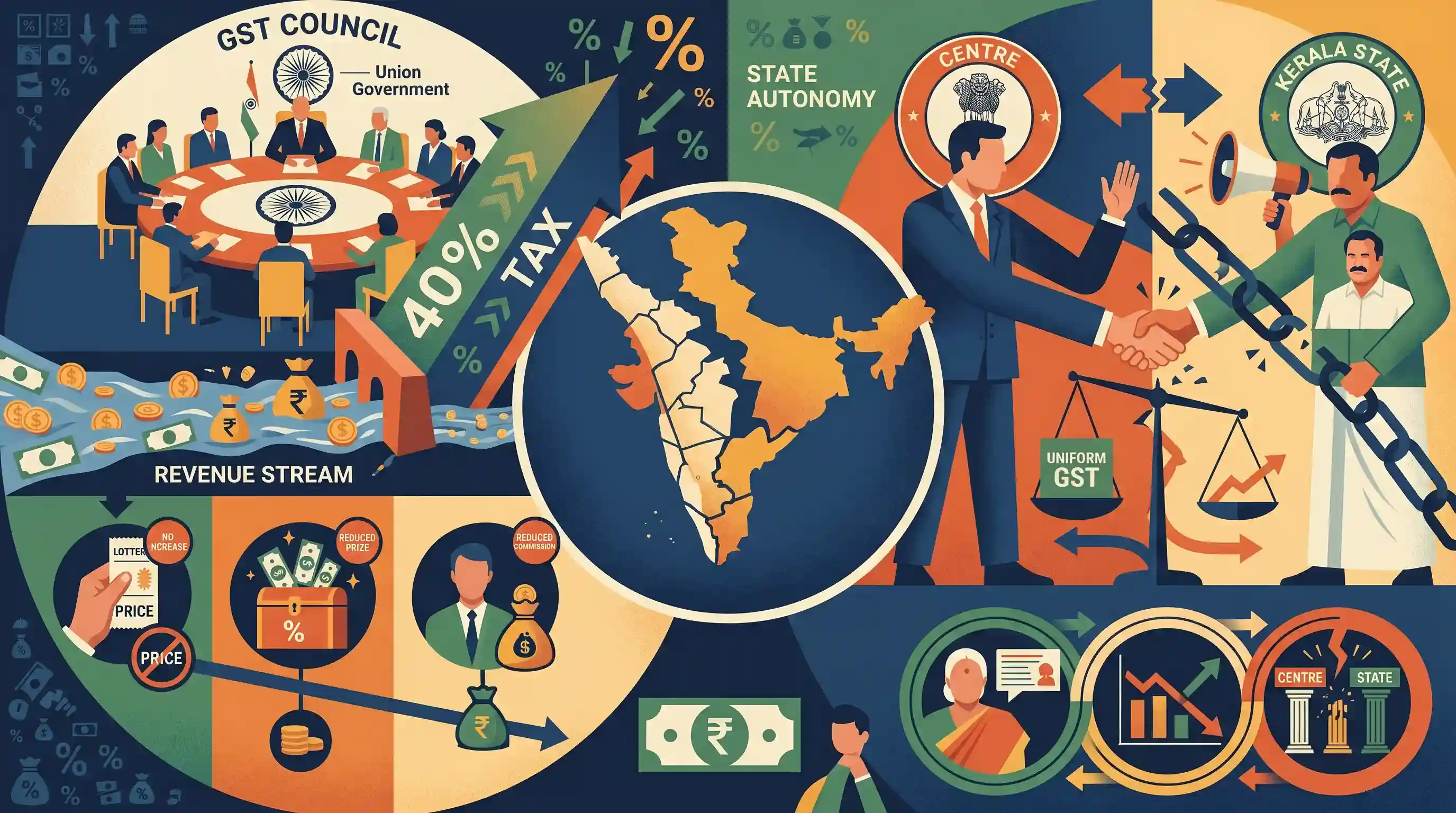
Kerala's Finance Minister K.N. Balagopal warned that the state's lottery revenue might decline due to the GST Council's decision to increase the GST rate on lottery tickets from 28% to 40%. To avoid passing the burden to consumers via higher ticket prices, the state opted to marginally reduce the prize money and the commission paid to lottery agents. The Kerala government had previously appealed to the Union Finance Minister against the tax hike, requesting that states be given the autonomy to determine lottery tax rates within their jurisdictions. This dispute highlights ongoing frictions in Centre-State fiscal relations and demonstrates how standardized GST rates can constrain state revenue streams.
Key Points
- Kerala anticipates a decline in state lottery revenue following the GST Council's decision to raise the GST on lottery tickets from 28% to 40%.
- To prevent a hike in lottery ticket prices, the Kerala government implemented nominal reductions in prize money and agent commissions.
- Kerala had formally requested the Union government to refrain from increasing the tax and to grant states the autonomy to set lottery tax rates within their own jurisdictions.
- The issue underscores the challenges of fiscal federalism and the impact of centralized GST Council decisions on state-specific revenue generation.
Important Terms
Goods and Services Tax (GST)

A comprehensive, multi-stage, destination-based indirect tax levied on the supply of goods and services, aimed at creating a unified national market.
UPSC context
GS Paper III: Indian Economy and issues relating to planning, mobilization of resources, and taxation.
GST Council
A joint forum of the Centre and the States, established under Article 279A, to make recommendations on GST rates, exemptions, and thresholds.
UPSC context
GS Paper II: Statutory, regulatory, and various quasi-judicial bodies; Constitutional provisions.
Fiscal Federalism
The financial relations and division of taxing powers and spending responsibilities between the Central and State governments in a federal system.
UPSC context
GS Paper II: Issues and challenges pertaining to the federal structure and devolution of powers.
Actionable Claim
A claim to any debt or beneficial interest in movable property. Under the CGST Act, lottery tickets are specifically taxed as actionable claims.
UPSC context
GS Paper III: Legal aspects of taxation and the definition of goods under indirect tax laws.
Sin Goods
Goods considered socially undesirable or harmful (e.g., tobacco, lottery, gambling), which are often taxed at higher 'demerit' rates to discourage consumption.
UPSC context
GS Paper III: Government budgeting and revenue-raising measures through demerit taxation.
Article 279A
The Constitutional provision introduced by the 101st Amendment Act that mandates the formation of the GST Council by the President.
UPSC context
GS Paper II: Important Constitutional amendments and their impact on the polity.
Prelims Trap
Lotteries organized by State governments fall under the State List.
While general betting and gambling belong to the State List (Entry 34), lotteries organized by Central or State Governments specifically fall under the Union List (Entry 40).
Static Concepts Connected
How are 'actionable claims' treated under the GST framework?
- General Exemption: Under Schedule III of the CGST Act, actionable claims are largely excluded from being classified as a supply of goods or services.
- The Exceptions: Lottery, betting, casinos, horse racing, and online gaming are explicit exceptions to this rule and are fully taxable under GST.
- Judicial Backing: The Supreme Court has upheld this, affirming Parliament's absolute power to define 'goods' inclusively to cover specific actionable claims like lotteries.
How does the 7th Schedule divide legislative powers regarding lotteries and gambling?
- Union List: Entry 40 gives the Centre power over lotteries organized by the Government of India or State Governments.
- State List: Entry 34 covers broader betting and gambling, while Entry 62 explicitly covers taxes on betting and gambling.
Cross-Topic Patterns
GST Council vs. State Fiscal Autonomy
Standardized GST rates restrict states' ability to tweak indirect taxes on local monopolies. States must instead alter expenditures, like cutting prize pools, to absorb tax shocks without collapsing demand.
Actionable Claims & Online Gaming
The constitutional and taxation logic applied to state lotteries is identical to the contentious 28% GST levied on the full face value of online real-money gaming and casinos.

Expect a tricky 2026 Prelims statement mixing Entry 40 (Union List for state lotteries) with GST exceptions for actionable claims.
Linked PYQs · 5
Linked PYQs · 5
- 2019MainsGS3
Enumerate the indirect taxes which have been subsumed in the Goods and Services Tax (GST) in India. Also, comment on the revenue implications of the GST introduced in India since July 2017.
- 2020MainsGS3
Explain the rationale behind the Goods and Services Tax (Compensation to States) Act of 2017. How has COVID-19 impacted the GST compensation fund and created new federal tensions?
- 2025MainsGS2
Examine the evolving pattern of Centre-State financial relations in the context of planned development in India. How far have the recent reforms impacted the fiscal federalism in India?
- 2024MainsGS2
What changes has the Union Government recently introduced in the domain of Centre-State relations ? Suggest measures to be adopted to build the trust between the Centre and the States and for strengthening federalism.
- 2017PrelimsGS1
What is/are the most likely advantages of implementing 'Goods and Services Tax (GST)'? 1. It will replace multiple taxes collected by multiple authorities and will thus create a single market in India. 2. It will drastically reduce the 'Current Account Deficit' of India and will enable it to increase its foreign exchange reserves. 3. It will enormously increase the growth and size of economy of India and will enable it to overtake China in the near future. Select the correct answer using the code given below:
