Kerala Paradox and Transition toward a Knowledge Economy
Source:The Hindu ↗
Why It Matters
Provides a critical regional case study for UPSC aspirants on the limitations of purely social-sector-driven development models, the challenges of structural unemployment, and the strategic utilization of the Indian diaspora and knowledge economy for inclusive growth.
Summary
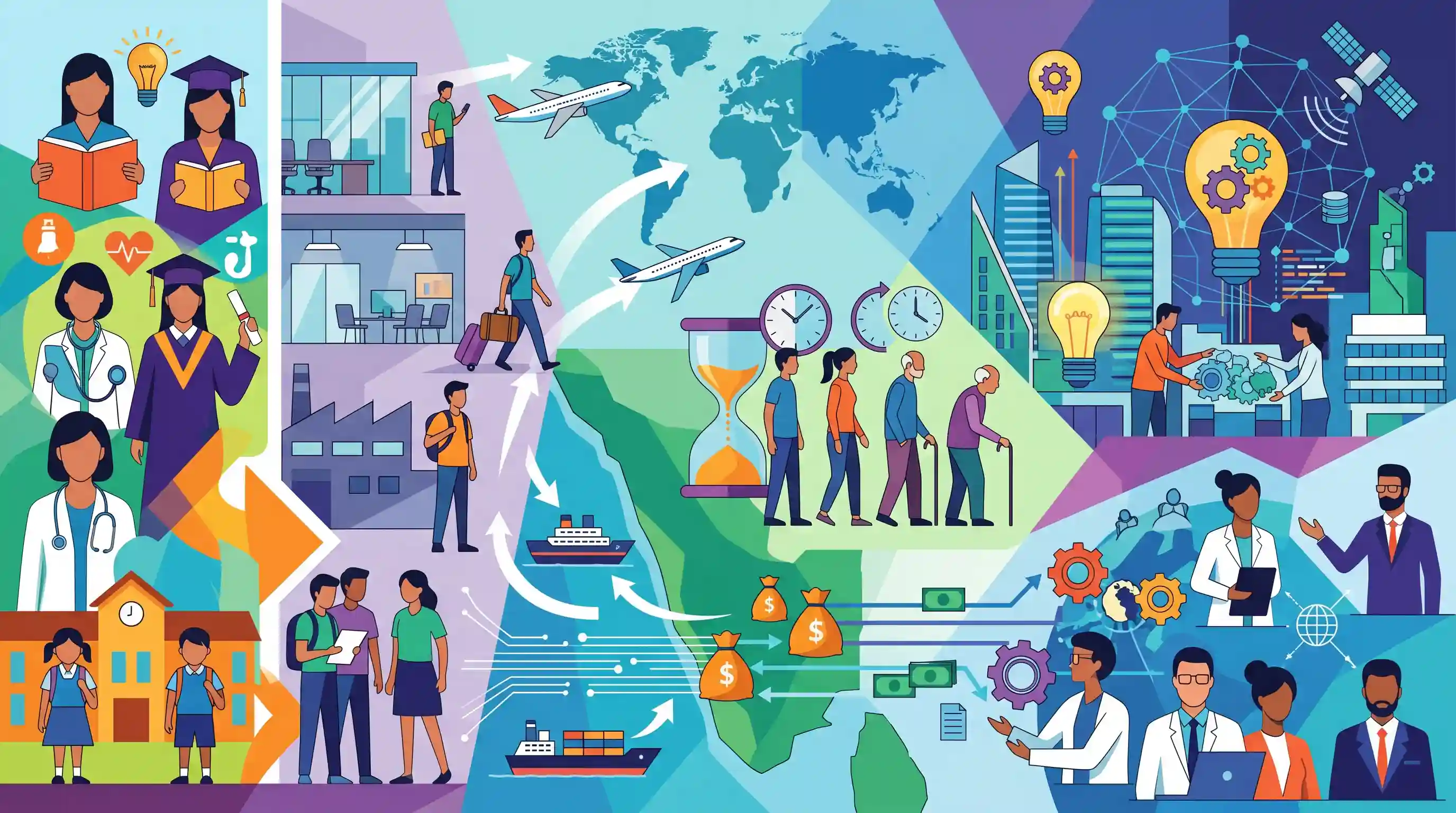
The article explores the 'Kerala Paradox'—the state's unique trajectory of achieving world-class human development indicators alongside low domestic industrial growth and high educated unemployment. Driven by outward migration, Kerala's economy has been heavily bolstered by global remittances. However, as the state experiences rapid demographic aging, it is shifting toward a global vision by transitioning into a knowledge economy. This involves leveraging its massive global diaspora not merely as a source of remittances, but as conduits for knowledge transfer, investment, and integration into global value chains, effectively turning its structural paradox into a strategic global advantage.
Key Points
- The 'Kerala Paradox' highlights the divergence between the state's exceptionally high Human Development Index (HDI) and its lagging domestic industrial growth and high educated unemployment.
- Kerala's economy heavily relies on out-migration and remittances, which have created a powerful global diaspora but exposed the state to external economic shocks.
- To resolve the paradox, the state aims to transition to a 'Knowledge Economy', focusing on IT, specialized services, and the care economy to utilize its highly literate workforce.
- Kerala is undergoing rapid demographic transition, facing an aging population ahead of the rest of India, which requires policy shifts toward the care economy and leveraging global workforce mobility.
- A 'Global Vision' entails integrating the state's economy with global value chains and utilizing the diaspora for knowledge transfer and investment, rather than just remittances.
Prelims Trap
States with the highest Human Development Index (HDI) in India concurrently exhibit the lowest rates of educated unemployment.
High HDI (widespread education) without parallel domestic industrial growth actually leads to exceptionally high structural unemployment among educated youth.
Static Concepts Connected
What characterizes the late stages of the Demographic Transition Model?
- Stage 4 demographics: Low birth and death rates lead to a stabilizing, but rapidly aging population structure, ending the demographic dividend phase.
- Demographic burden: The working-age population shrinks relative to the elderly, increasing the dependency ratio and generating high demand for a structured care economy.
What is Structural Unemployment in the Indian economic context?
- Skill mismatch: It occurs when there is a fundamental mismatch between the skills workers possess (e.g., advanced degrees) and the jobs actively available in the domestic economy.
- Long-term nature: Unlike frictional or cyclical unemployment, it is chronic and requires deep economic restructuring, reskilling, or out-migration to resolve.
Cross-Topic Patterns
Remittance dependency & BoP
Kerala's reliance on Gulf remittances links state-level consumption directly to India's Balance of Payments 'invisibles' and exposes the regional economy to West Asian geopolitical shocks.
Formalizing the Care Economy
Transitioning unpaid caregiving into a monetized sector addresses aging demographics (GS1 Society) while simultaneously boosting Female Labor Force Participation and service sector growth (GS3 Economy).

Mains 2026 GS3: Expect a question linking regional demographic aging, the 'care economy', and structural unemployment in advanced states.
Linked PYQs · 5
Linked PYQs · 5
- 2023MainsGS3
Most of the unemployment in India is structural in nature. Examine the methodology adopted to compute unemployment in the country and suggest improvements.
- 2025MainsGS3
Distinguish between the Human Development Index (HDI) and the Inequality-adjusted Human Development Index (IHDI) with special reference to India. Why is the IHDI considered a better indicator of inclusive growth?
- 2023MainsGS2
Indian diaspora has scaled new heights in the West. Describe its economic and political benefits for India.
- 2024MainsGS1
What is the concept of a 'demographic winter'? Is the world moving towards such a situation? Elaborate.
- 2020MainsGS2
Indian diaspora has a decisive role to play in the politics and economy of America and European Countries'. Comment with examples.
