Kerala Government to Publish White Paper on State Finances and Debt
Source:The Hindu ↗
Why It Matters
The issue highlights persistent structural challenges in sub-national (state) finances in India. Examining how states leverage Special Purpose Vehicles (SPVs) like KIIFB for off-budget borrowings is crucial for understanding loopholes in the FRBM Act and the macro-fiscal stability of the country. It also brings the oversight role of constitutional bodies like the CAG into focus.
Summary
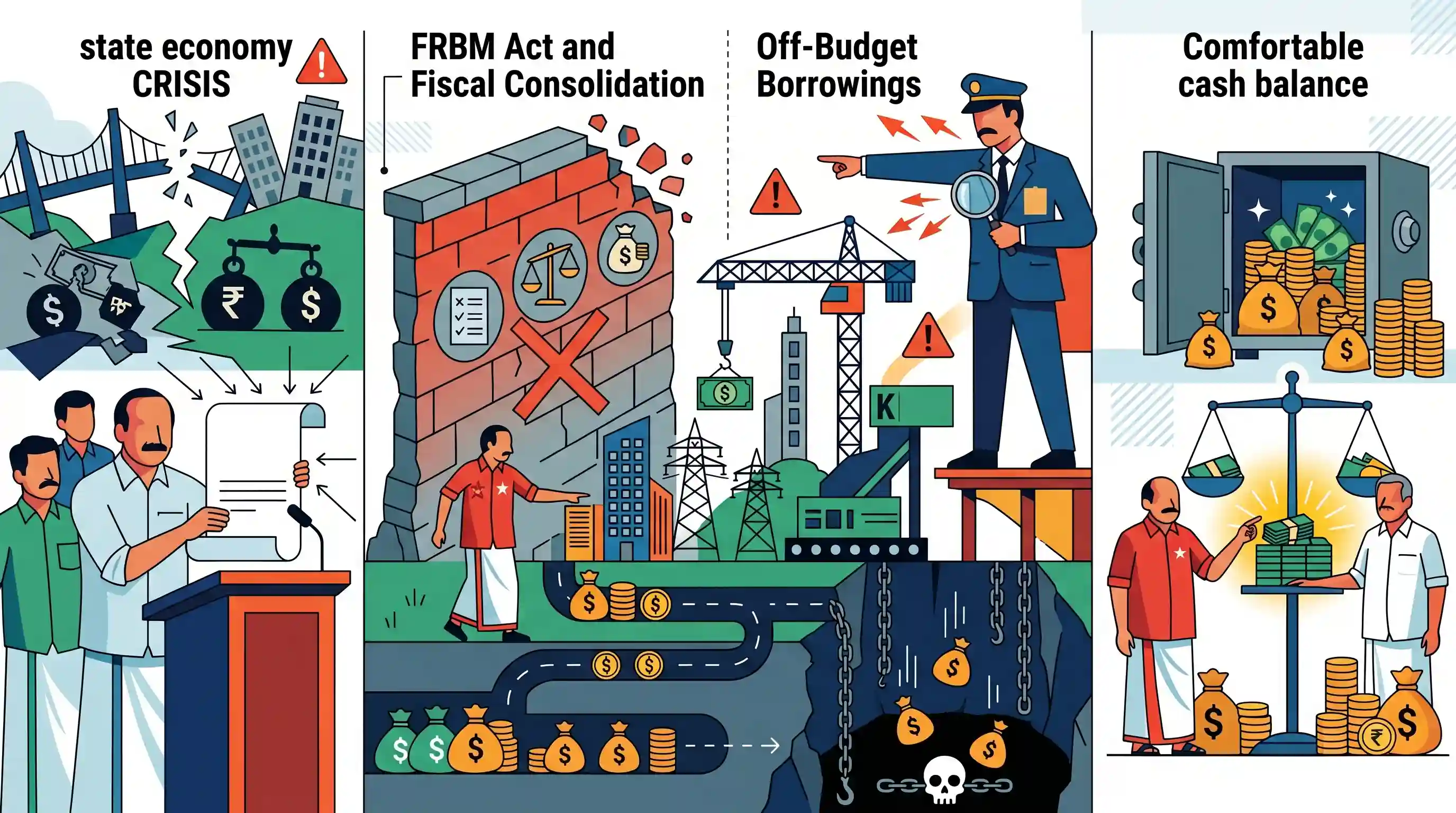
Kerala's newly sworn-in United Democratic Front (UDF) government, led by Chief Minister V.D. Satheesan, announced it will publish a White Paper on the state's finances to reveal the true depth of its economic challenges. The government criticized the preceding Left Democratic Front (LDF) administration for allegedly pushing the state into a severe debt crisis by bypassing the Fiscal Responsibility and Budget Management (FRBM) Act. Specifically, the UDF highlighted the controversial use of the Kerala Infrastructure Investment Fund Board (KIIFB) for off-budget borrowings—a practice also criticized by the Comptroller and Auditor General (CAG) as risking a state debt trap. Conversely, the outgoing LDF government defended its fiscal track record, asserting that they handed over the treasury with a comfortable cash balance of ₹6,000 crore.
Key Points
- Kerala's newly formed UDF government plans to publish a White Paper detailing the true state of Kerala's finances.
- The UDF alleges that the previous LDF government severely worsened state debt by bypassing the FRBM Act using off-budget borrowings through KIIFB.
- The Comptroller and Auditor General (CAG) has previously criticized KIIFB's off-budget borrowings for risking a debt trap for the state.
- Defending the previous administration, former Finance Minister K.N. Balagopal stated the treasury retained a cash balance of ₹6,000 crore, refuting claims of an 'empty treasury'.
Important Terms
Fiscal Responsibility and Budget Management (FRBM) Act

A 2003 law institutionalizing fiscal discipline by setting mandatory targets for reducing fiscal deficits and public debt to ensure long-term macroeconomic stability.
UPSC context
GS Paper III (Economy). Key for questions on fiscal consolidation, deficit management, and N.K. Singh Committee recommendations.
Off-Budget Borrowings
Loans raised by government-controlled entities or SPVs that are not reflected in the formal budget deficit, effectively bypassing fiscal ceiling limits.
UPSC context
GS Paper III (Economy). Critical for topics on fiscal transparency, budget integrity, and Article 293 borrowing limits.
Comptroller and Auditor General (CAG)
A constitutional authority under Article 148 empowered to audit all government receipts and expenditures to ensure financial accountability and transparency.
UPSC context
GS Paper II (Polity). Tests knowledge of constitutional oversight, audit roles, and executive accountability to the legislature.
Kerala Infrastructure Investment Fund Board (KIIFB)
A statutory body in Kerala used to mobilize infrastructure funds via market borrowings, recently scrutinized for creating significant off-budget state liabilities.
UPSC context
GS Paper III (Economy). A case study for state-level infrastructure financing, off-budget debt, and fiscal federalism tensions.
White Paper
An authoritative government report or policy document issued to inform the public and legislature about a specific issue or "true" financial status.
UPSC context
GS Paper II (Governance). Relates to administrative transparency, public disclosure, and evidence-based policy formulation.
Prelims Trap
Off-budget borrowings by state SPVs are exempt from the Centre's borrowing limits under Article 293(3).
The Centre now explicitly includes off-budget borrowings (if serviced out of the state budget) within a State's Net Borrowing Ceiling, making them subject to Central consent.
Static Concepts Connected
How does the Constitution regulate State borrowings?
- Article 293(3): A State cannot raise any new loan without the Centre's consent if there is any outstanding loan owed to the Government of India.
- Net Borrowing Ceiling: The Centre sets a borrowing limit for states, which now strictly incorporates off-budget borrowings serviced directly from the state's consolidated fund.
What is the scope of CAG's audit regarding state debt?
- Propriety Audit: Beyond mere legality, the CAG checks the wisdom and economy of public expenditure, authorizing it to warn governments against looming 'debt traps'.
- SPV Audits: CAG audits Extra Budgetary Resources and state-created Special Purpose Vehicles to ensure complete fiscal transparency and uncover hidden sovereign liabilities.
Cross-Topic Patterns
Fiscal Federalism vs Article 293
State complaints about borrowing restrictions tie into broader Centre-State financial relations, frequently highlighted by states approaching the Supreme Court against the Centre's Net Borrowing Ceilings.
FRBM Act & Fiscal Illusion
Off-budget borrowings create a 'fiscal illusion' where statutory FRBM deficit targets are met on paper, but the actual public debt liability continues to rise through government-backed SPVs.

Expect a 2026 Prelims question linking Article 293(3) borrowing consent mechanisms with off-budget borrowings and FRBM compliance.
Linked PYQs · 4
Linked PYQs · 4
- 2013MainsGS3
What were the reasons for the introduction of Fiscal Responsibility and Budget Management (FRBM) Act, 2003 ? Discuss critically its salient features and their effectiveness.
- 2025MainsGS3
Explain how the Fiscal Health Index (FHI) can be used as a tool for assessing the fiscal performance of states in India. In what way would it encourage the states to adopt prudent and sustainable fiscal policies?
- 2018MainsGS2
“The Comptroller and Auditor General (CAG) has a very vital role to play.” Explain how this is reflected in the method and terms of his appointment as well as the range of powers he can exercise.
- 2024MainsGS2
“The duty of the Comptroller and Auditor General is not merely to ensure the legality of expenditure but also its propriety.” Comment.
