Mangrove Cover Expansion in Kerala and Coastal Conservation
Source:The Hindu ↗
Why It Matters
Mangrove ecosystems are vital components of India's coastal management and climate mitigation strategy. Analyzing regional trends in mangrove cover helps policy formulation for coastal protection, disaster risk reduction, and blue carbon initiatives under sustainable development goals.
Summary
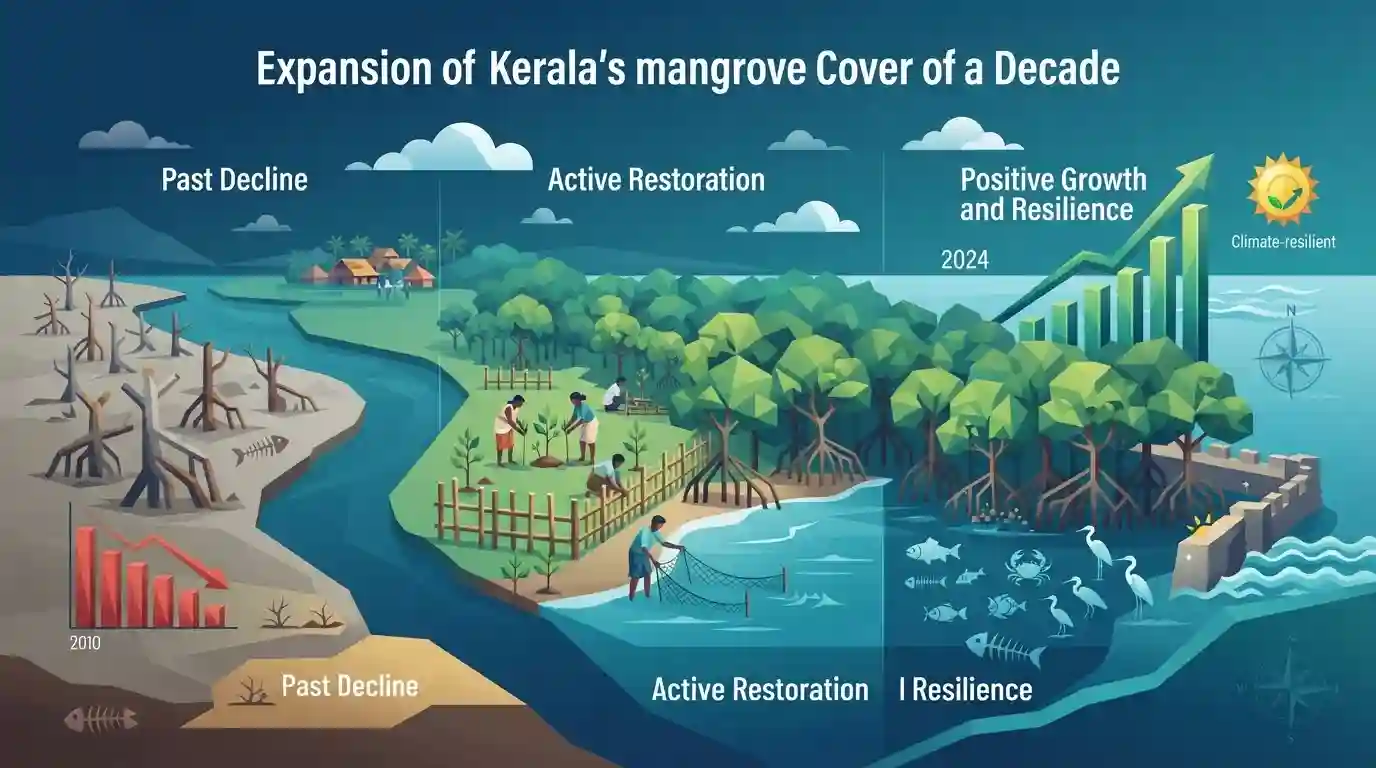
A recent study has highlighted a positive trend in Kerala's coastal environment, showing that the State's mangrove cover has expanded over the past decade following previous periods of decline. The findings underscore the resilience of mangrove ecosystems, the importance of local conservation efforts, and their critical role in coastal protection, biodiversity preservation, and climate resilience.
Key Points
- A recent study reveals that Kerala's mangrove cover has expanded over the past decade despite historical declines.
- Mangroves serve crucial ecological functions, including acting as natural bio-shields against coastal erosion, storm surges, and climate change impacts.
- Community participation and targeted conservation interventions play a vital role in restoring degraded coastal wetlands.
- Continuous monitoring through remote sensing and field studies is essential for effective coastal ecosystem management.
Important Terms
Kerala State Biodiversity Board

A statutory body established under the Biological Diversity Act, 2002, to advise state governments on biodiversity conservation, sustainable use of its components, and equitable sharing of benefits.
UPSC context
GS Paper III (Environment & Ecology): Tests knowledge of institutional frameworks for biodiversity conservation, state-level bodies, and implementation of the Biological Diversity Act.
Forest Survey of India
An organization under the Ministry of Environment, Forest and Climate Change that assesses forest and tree resources, including biennial satellite mapping of India's mangrove cover.
UPSC context
GS Paper III (Environment & Ecology): Tests understanding of official data sources, remote sensing applications, and national forest/mangrove cover reporting in India.
Static Concepts Connected
What are the key ecological adaptations and environmental significance of mangrove ecosystems?
- Root Systems: Specialized roots like pneumatophores (breathing roots) and stilt roots enable survival in anaerobic, waterlogged saline soils.
- Reproduction: Many mangrove species exhibit viviparity, where seeds germinate while still attached to the parent tree to survive tidal extremes.
- Ecological Role: They act as natural bio-shields, absorbing wave energy, protecting coastlines from erosion, and sequestering massive amounts of carbon (blue carbon).
Cross-Topic Patterns
Mangroves + Local Self-Government + Climate Adaptation
Mangrove restoration overlaps with climate adaptation finance and local government decentralization under the 73rd/74th Constitutional Amendments for community-led environmental management.
Mangrove Conservation + CRZ Notifications
Coastal zone protection directly intersects with the Coastal Regulation Zone (CRZ) notification rules under the Environment Protection Act, 1986.

Expect a statement-based prelims question pairing mangrove ecological adaptations (vivipary, pneumatophores) with state-wise distribution trends.
Linked PYQs · 3
Linked PYQs · 3
- 2026PrelimsGS1
Which of the following best explain(s) the rationale for protecting mangrove ecosystems in the context of climate resilience? 1. Mangroves reduce tidal energy and store freshwater, making them ideal sites for paddy cultivation in saline estuarine belts. 2. Their salt-sensitive roots filter seawater, making mangroves key to converting coastal land into freshwater aquaculture zones. 3. By withstanding tidal surges and offering biomass resources, mangroves function both as natural bio-shields and livelihood bases for rural communities. Select the answer using the code given below :
- 2022MainsGS3
Explain the causes and effects of coastal erosion in India. What are the available coastal management techniques for combating the hazard?
- 2023MainsGS3
The Intergovernmental Panel on Climate Change (IPCC) has predicted a global sea level rise of about one metre by AD 2100. What would be its impact in India and the other countries in the Indian Ocean region?
