Measles Outbreaks and Disease Epidemiology in Kerala
Source:The Hindu ↗
Why It Matters
Understanding resurgence of vaccine-preventable diseases like measles highlights the gaps in public health immunization coverage and epidemiology, directly relevant to GS Paper 2 (Health issues and governance).
Summary
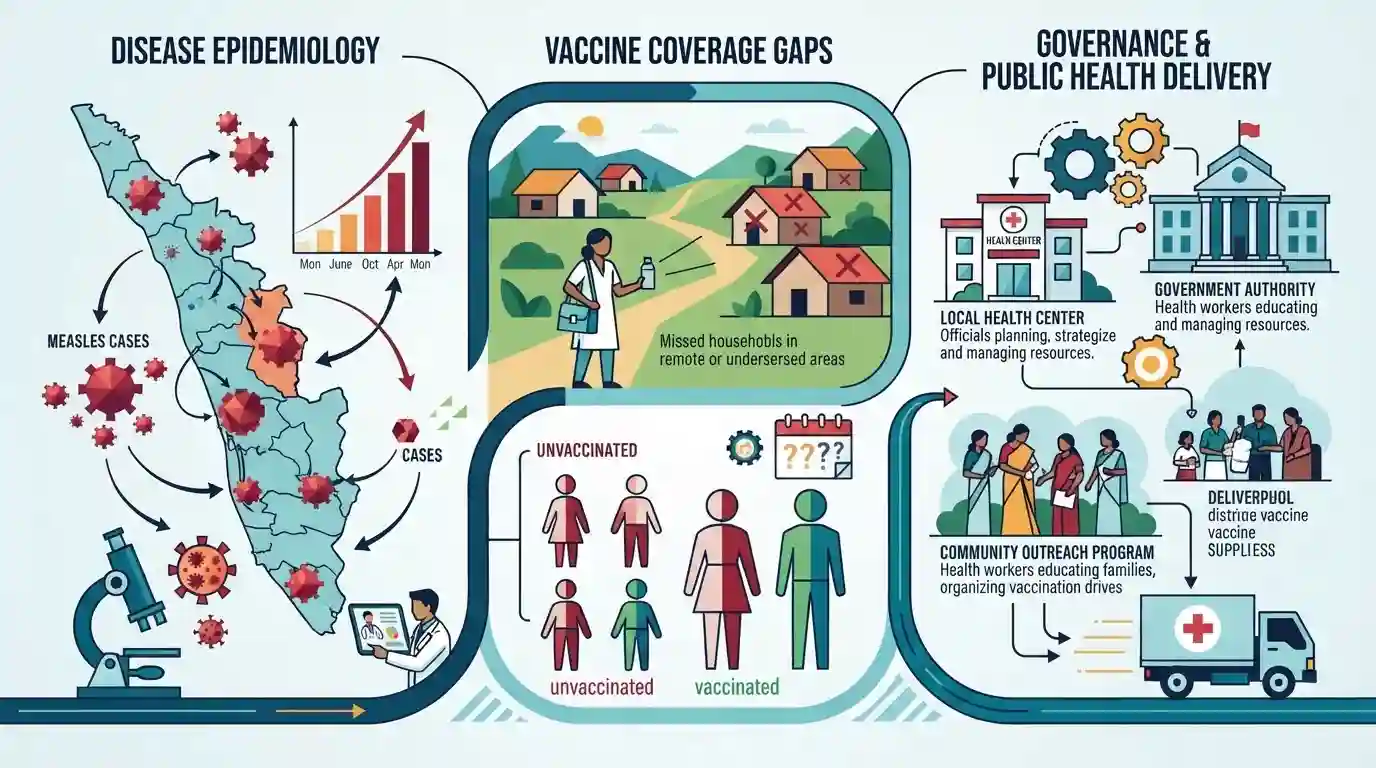
Recent measles outbreaks in Kerala have highlighted the need to re-examine disease epidemiology, vaccine coverage gaps, and public health delivery mechanisms to combat vaccine-preventable diseases effectively.
Key Points
- Recent measles outbreaks in Kerala highlight gaps in vaccine coverage and shifts in disease epidemiology.
- Declining vaccine hesitancy mitigation and robust surveillance are vital to prevent resurgence of vaccine-preventable diseases.
- Public health response requires strengthening primary healthcare delivery, tracking migrant and mobile populations, and reinforcing catch-up immunisation campaigns.
Important Terms
Universal Immunization Programme

A flagship public health initiative by the Government of India providing free vaccination against several life-threatening diseases, including measles, to infants and pregnant women across the country.
UPSC context
UPSC Mains GS Paper II (Health & Social Sector Schemes). Evaluates public health delivery, vaccine coverage gaps, and child mortality interventions.
World Health Organization
A specialized agency of the United Nations responsible for international public health, setting global standards, tracking disease outbreaks, and guiding national elimination strategies for vaccine-preventable diseases.
UPSC context
UPSC Mains GS Paper II (International Organizations & Global Health Governance). Tests multilateral cooperation, health frameworks, and disease control targets.
Prelims Trap
The Measles-Rubella (MR) vaccine under India's Universal Immunization Programme is administered as a single dose during infancy.
Aspirants often assume the MR vaccine is single-dose under UIP or administered only up to 12 months, missing the crucial second dose at 16-24 months.
Static Concepts Connected
What are the key operational features and vaccine schedule of India's Universal Immunization Programme (UIP)?
- Nodal Ministry: Nodal agency managed by the Ministry of Health and Family Welfare, providing free vaccines against 12 preventable diseases nationally.
- MR Schedule: MR vaccine is administered in a two-dose schedule: the first dose at 9-12 months and the second at 16-24 months of age.
- Mission Indradhanush: Intensified Mission Indradhanush (IMI) targets missed children and pregnant women in urban slums and hard-to-reach pockets.
Cross-Topic Patterns
Public Health + Migrant Governance Integration
Measles outbreaks in progressive states reveal urban migration governance blind spots, linking public health delivery to inter-state labor mobility and urban local body accountability.
UIP Schedule Evolution + Epidemiological Shifts
Shift in disease epidemiology toward older age groups tests the adaptability of India's legacy UIP framework beyond routine infant cohorts.

Measles epidemiology shift (under-9-months & older cohorts) plus UIP 2-dose schedule likely to feature in a statement-based health Q.
Linked PYQs · 3
Linked PYQs · 3
- 2023PrelimsGS1
Consider the following statements: Statement-I: India's public sector health care system largely focuses on curative care with limited preventive, promotive and rehabilitative care. Statement-II: Under India's decentralized approach to health care delivery, the States are primarily responsible for organizing health services. Which one of the following is correct in respect of the above statements?
- 2024MainsGS2
In a crucial domain like the public healthcare system the Indian State should play a vital role to contain the adverse impact of marketisation of the system. Suggest some measures through which the State can enhance the reach of public healthcare at the grassroots level.
- 2018MainsGS2
Appropriate local community-level healthcare intervention is a prerequisite to achieve 'Health for All' in India. Explain.
