Food Safety Regulations and Waterborne Disease Risks During Heatwaves
Source:The Hindu ↗
Why It Matters
This article illustrates the intersection of climate extremes (heatwaves) and public health governance. It provides practical context on the enforcement mechanisms of the Food Safety and Standards Act (FSSA), 2006, and the role of state bodies in preventing waterborne diseases during summer months—key themes in UPSC GS2 (Health) and GS3 (Disaster Management).
Summary
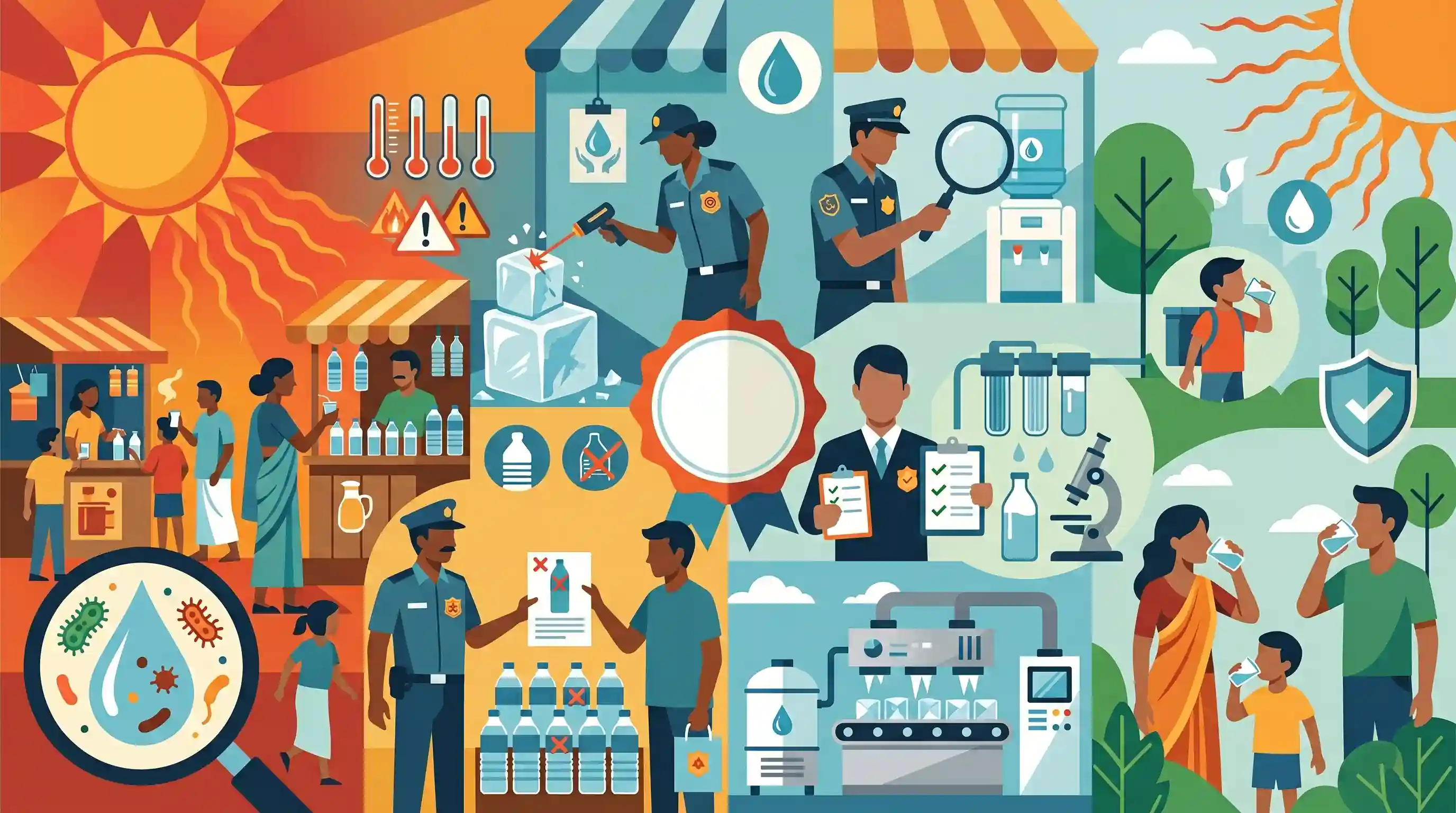
In response to soaring summer temperatures and heatwave alerts across Kerala, the State Health and Food Safety Departments have stepped up inspections to prevent waterborne disease outbreaks. Authorities are particularly focused on the quality of ice and drinking water used in local beverage shops, as contaminated ice can lead to illnesses like cholera, typhoid, and hepatitis. The Food Safety Department is strictly enforcing the Food Safety and Standards Act, 2006, mandating that all ice manufacturing units and drinking water vendors maintain valid FSSAI licenses, use safe water sources, and undergo regular water quality audits. Warning notices have also been issued against the distribution of counterfeit bottled water.
Key Points
- The Kerala Food Safety Department has intensified inspections of juice shops, ice manufacturing units, and drinking water sources due to soaring temperatures.
- Authorities are concerned about the use of contaminated, non-edible ice in cold beverages, which can trigger outbreaks of waterborne diseases like cholera, typhoid, and hepatitis.
- Under the Food Safety and Standards Act (FSSA) 2006, ice manufacturing units must possess an FSSAI license and conduct mandatory water quality testing every six months.
- Public warnings have been issued against counterfeit bottled drinking water and unauthorized food vendors violating food safety regulations during the summer heat.
Important Terms
Food Safety and Standards Authority of India (FSSAI)

A statutory body under the Ministry of Health & Family Welfare that regulates food safety in India by setting science-based standards for manufacture, storage, distribution, and sale.
UPSC context
GS Paper 2: Statutory/Regulatory Bodies; GS Paper 3: Food Security and processing. Tests understanding of apex regulatory frameworks.
Food Safety and Standards Act (FSSA), 2006
A consolidated law that repealed older food acts (like PFA 1954) to create a single-point regulatory framework and establish the FSSAI to ensure food safety nationwide.
UPSC context
GS Paper 2: Government Policies and Interventions. Important for understanding the shift from multi-level to unified food regulation.
Heatwave (IMD Criteria)
A period of abnormally high temperatures. The IMD declares one when maximum temperatures reach ≥40°C in plains or ≥30°C in hills, or when temperatures depart 4.5°C–6.4°C from normal.
UPSC context
GS Paper 1: Geography (Geophysical phenomena); GS Paper 3: Disaster Management. Vital for climate change and public health impact analysis.
Waterborne Diseases
Diseases caused by pathogens like bacteria and viruses transmitted via contaminated water, including cholera and typhoid. They pose a major public health risk during summers and floods.
UPSC context
GS Paper 2: Issues relating to Health and Sanitation. Tests knowledge of public health challenges and government interventions like WASH.
Commissionerate of Food Safety
The state-level enforcement body established under Section 30 of the FSSA 2006, responsible for implementing food safety laws, issuing licenses, and conducting surveillance within the state.
UPSC context
GS Paper 2: Statutory Bodies and State Administration. Relevant for understanding the decentralised implementation of central food laws.
Prelims Trap
Heatwaves are currently classified as a nationally notified disaster eligible for National Disaster Response Fund (NDRF) allocations.
Heatwaves are not nationally notified. The 15th Finance Commission recommended states use up to 10% of their State Disaster Response Fund (SDRF) for such local disasters.
Static Concepts Connected
What is the statutory framework and mandate of the FSSAI?
- Nodal Ministry: Operates under the Ministry of Health and Family Welfare (not the Ministry of Consumer Affairs).
- Consolidating Law: Established under the FSSA 2006, subsuming older laws like the Prevention of Food Adulteration Act, 1954.
- Import Regulation: Has the statutory mandate to regulate the safety and standards of food articles imported into India.
How is state-level disaster relief financed in India?
- SDRF Corpus: Constituted under the DM Act 2005; Centre contributes 75% for general states and 90% for special category states.
- State Flex Funds: As per the 15th Finance Commission, states can use up to 10% of SDRF for 'local disasters' not on the national notified list (e.g., heatwaves, lightning).
Cross-Topic Patterns
Fiscal federalism & disaster relief
The 15th Finance Commission's refusal to notify heatwaves nationally highlights the shifting financial burden of climate adaptation onto state-level SDRF allocations.
Climate change & public health crises
Extreme heat doesn't just cause heatstroke; it triggers secondary outbreaks of waterborne diseases (cholera, typhoid) by stressing safe water infrastructure and increasing reliance on unregulated vendors.

Expect a 2026 prelims question blending FSSAI’s safety mandates (like blue-colored industrial ice) with SDRF funding rules for heatwaves.
Linked PYQs · 4
Linked PYQs · 4
- 2018PrelimsGS1
Consider the following statements: 1. The Food Safety and Standards Act, 2006 replaced the Prevention of Food Adulteration Act, 1954. 2. The Food Safety and Standards Authority of India (FSSAI) is under the charge of Director General of Health Services in the Union Ministry of Health and Family Welfare. Which of the statements given above is/are correct?
- 2017MainsGS2
To ensure effective implementation of policies addressing water, sanitation and hygiene needs the identification of the beneficiary segments is to be synchronized with the anticipated outcomes." Examine the statement in the context of the WASH scheme.
- 2024MainsGS2
In a crucial domain like the public healthcare system the Indian State should play a vital role to contain the adverse impact of marketisation of the system. Suggest some measures through which the State can enhance the reach of public healthcare at the grassroots level.
- 2023MainsGS1
Discuss the consequences of climate change on the food security in tropical countries.
