Kerala Urban Policy Framework for Climate Resilience and Local Bodies
Source:Indian Express ↗
Why It Matters
With rapid urbanization across India and increasing instances of urban flooding, Kerala's pioneering approach offers a model for other states. It touches upon core UPSC themes like the empowerment of Urban Local Bodies (74th Amendment), climate-resilient infrastructure, and the management of rural-urban transitions.
Summary
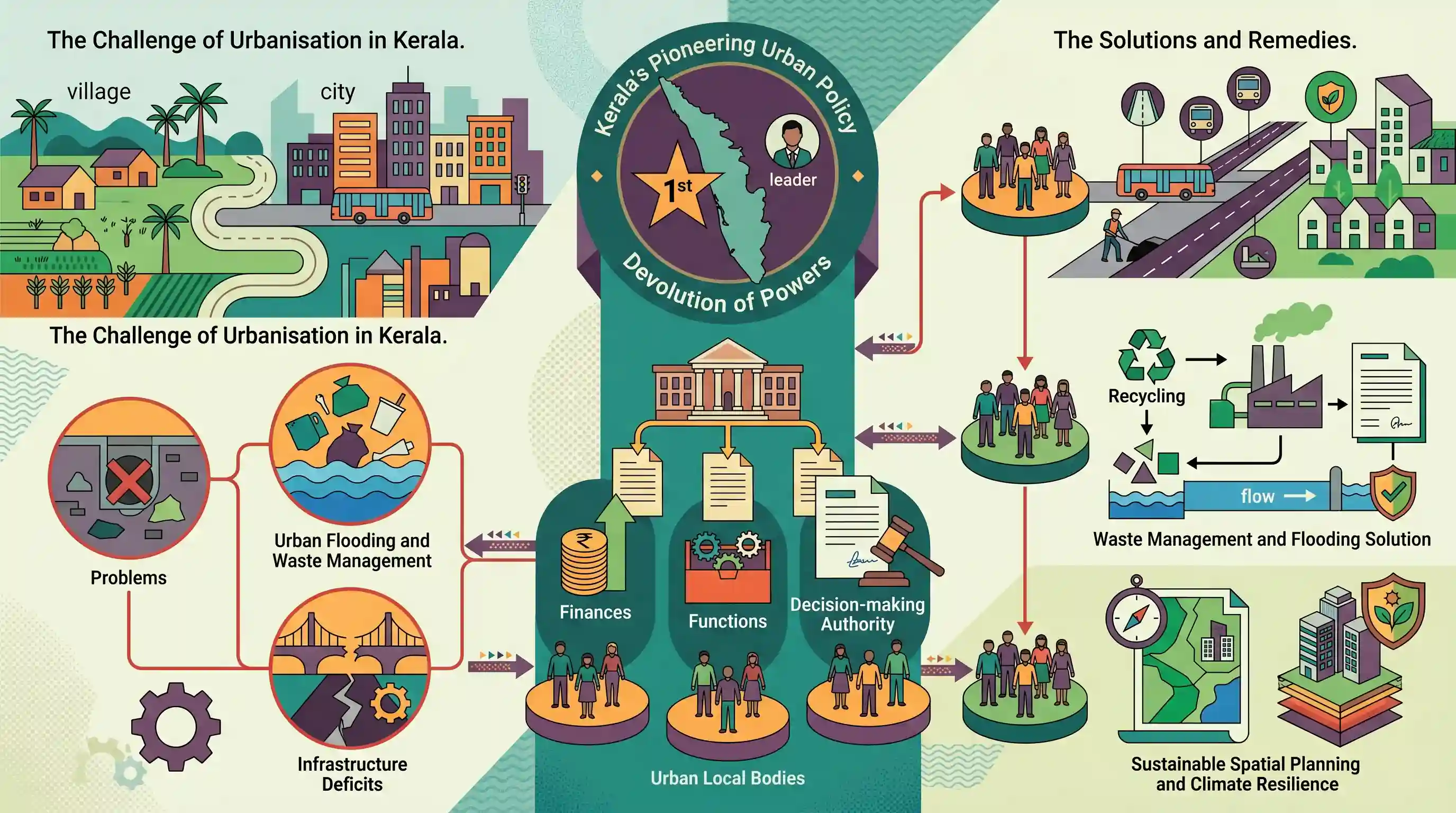
Kerala has introduced a pioneering Urban Policy, becoming the first state in India to draft a comprehensive framework to guide its urbanization journey. The policy is designed to address the state's unique rural-urban continuum and rapid urban growth by focusing on climate resilience, sustainable spatial planning, and the functional empowerment of civic bodies. It aims to equip Urban Local Bodies (ULBs) with the necessary tools and funds to tackle emerging challenges such as urban flooding, waste management, and infrastructure deficits.
Key Points
- Kerala has become the first state in India to introduce a dedicated and comprehensive State Urban Policy.
- The policy emphasizes climate-resilient urban planning to mitigate the impacts of climate-induced disasters such as urban flooding and extreme weather.
- It seeks to structurally and financially empower civic bodies (Urban Local Bodies) to better manage the state's rapid and unique pattern of urbanization.
- The framework addresses Kerala's distinct rural-urban continuum, aiming for sustainable spatial planning, infrastructure development, and efficient waste management.
Important Terms
Kerala Urban Policy

India's first comprehensive state-level framework (2026) for scientific urbanization, targeting 80% urban growth by 2050. It emphasizes climate-smart cities, decentralization, and social equity.
UPSC context
GS Paper 2 (Governance) and GS Paper 1 (Urbanization). Tests knowledge of pioneering state-level urban governance models.
Rural-Urban Continuum
A continuous settlement pattern where rural and urban characteristics merge without distinct boundaries. In Kerala, it describes high-density development bridging villages and towns.
UPSC context
GS Paper 1 (Urbanization) and Geography Optional. Tests recognition of unique Indian settlement patterns and planning challenges.
Urban Local Bodies (ULBs)
Constitutionalized third-tier government institutions (Municipalities) responsible for local urban governance, planning, and service delivery under the 74th Constitutional Amendment Act.
UPSC context
GS Paper 2 (Polity/Governance). Evaluates knowledge of the 3-tier federal structure and devolution of powers.
74th Constitutional Amendment Act
1992 legislation that granted constitutional status to ULBs, introducing Part IXA and the Twelfth Schedule (18 subjects) to promote democratic urban decentralization.
UPSC context
GS Paper 2 (Constitutional Amendments). Core topic for local self-government and urban reform questions.
Climate-Resilient Urban Planning
An integrated approach to city design incorporating risk assessments for disasters like flooding, sustainable drainage systems, and green infrastructure to mitigate climate impacts.
UPSC context
GS Paper 3 (Environment/Disaster Management). Tests ability to link urbanization with climate adaptation and mitigation.
Spatial Planning
The scientific organization of land use and physical infrastructure to guide long-term urban growth, ensuring efficient resource distribution and environmental preservation.
UPSC context
GS Paper 1 (Urbanization) and GS Paper 3 (Infrastructure). Tests knowledge of sustainable urban management and resource optimization.
Prelims Trap
"Kerala is the first Indian state to allow its Urban Local Bodies to issue Municipal Bonds."
Bangalore issued the first in 1997, and cities like Indore use them today. Kerala has the first comprehensive State Urban Policy, not the first municipal bonds.
Static Concepts Connected
What are the key provisions of the 74th Amendment Act regarding ULBs?
- Constitutional Status: Added Part IX-A and the 12th Schedule, containing 18 functional items devolved to municipalities.
- Wards Committees: Mandated for municipalities with a population of over 3 lakhs to ensure decentralized grassroots planning.
- Planning Committees: Mandates District and Metropolitan Planning Committees (DPC/MPC) to consolidate plans prepared by panchayats and municipalities.
What are Municipal Bonds and how are they regulated?
- Definition: Debt instruments issued by municipal corporations or associated bodies to raise funds for capital-intensive civic infrastructure projects.
- SEBI Regulation: Regulated by SEBI under the Issue and Listing of Municipal Debt Securities Regulations, 2015.
- Pooled Bonds: Smaller ULBs pool their resources to jointly issue bonds, enhancing their creditworthiness and reducing borrowing costs.
Cross-Topic Patterns
Rural-Urban Continuum and SPMRM
Kerala’s intermediate settlement geography aligns with the Shyama Prasad Mukherji Rurban Mission (SPMRM), which develops village clusters preserving rural life while providing urban facilities and infrastructure.
Hazard-based zoning and Disaster Management
Integrates GS1 urbanization with GS3 disaster management. Mandating hazard mapping in master plans is a direct response to rising urban flooding incidents and climate vulnerabilities in Indian cities.

Expect a 2026 Mains question linking Kerala's 'City Cabinet' model and hazard-based zoning to systemic deficits in the 74th Amendment.
Linked PYQs · 5
Linked PYQs · 5
- 2024MainsGS2
Analyse the role of local bodies in providing good governance at local level and bring out the pros and cons merging the rural local bodies with the urban local bodies.
- 2023MainsGS2
“The states in India seem reluctant to empower urban local bodies both functionally as well as financially.” Comment.
- 2024MainsGS3
Flooding in urban areas is an emerging climate-induced disaster. Discuss the causes of this disaster. Mention the features of two such major floods in the last two decades in India. Describe the policies and frameworks in India that aim at tackling such floods.
- 2020MainsGS1
Account for the huge flooding of million cities in India including the smart ones like Hyderabad and Pune. Suggest lasting remedial measures.
- 2015MainsGS1
Smart cities in India cannot sustain without smart villages. Discuss this statement in the backdrop of rural urban integration.
