Kerala Carbon Neutrality Target and Ramsar Wetland Proposals
Source:The Hindu ↗
Why It Matters
Provides excellent fodder for GS3 Mains answers (sub-national climate action, technology in disaster management like IoT, and decentralised approaches to human-wildlife conflict). Ramsar wetlands and carbon neutrality targets are high-yield areas for Prelims.
Summary
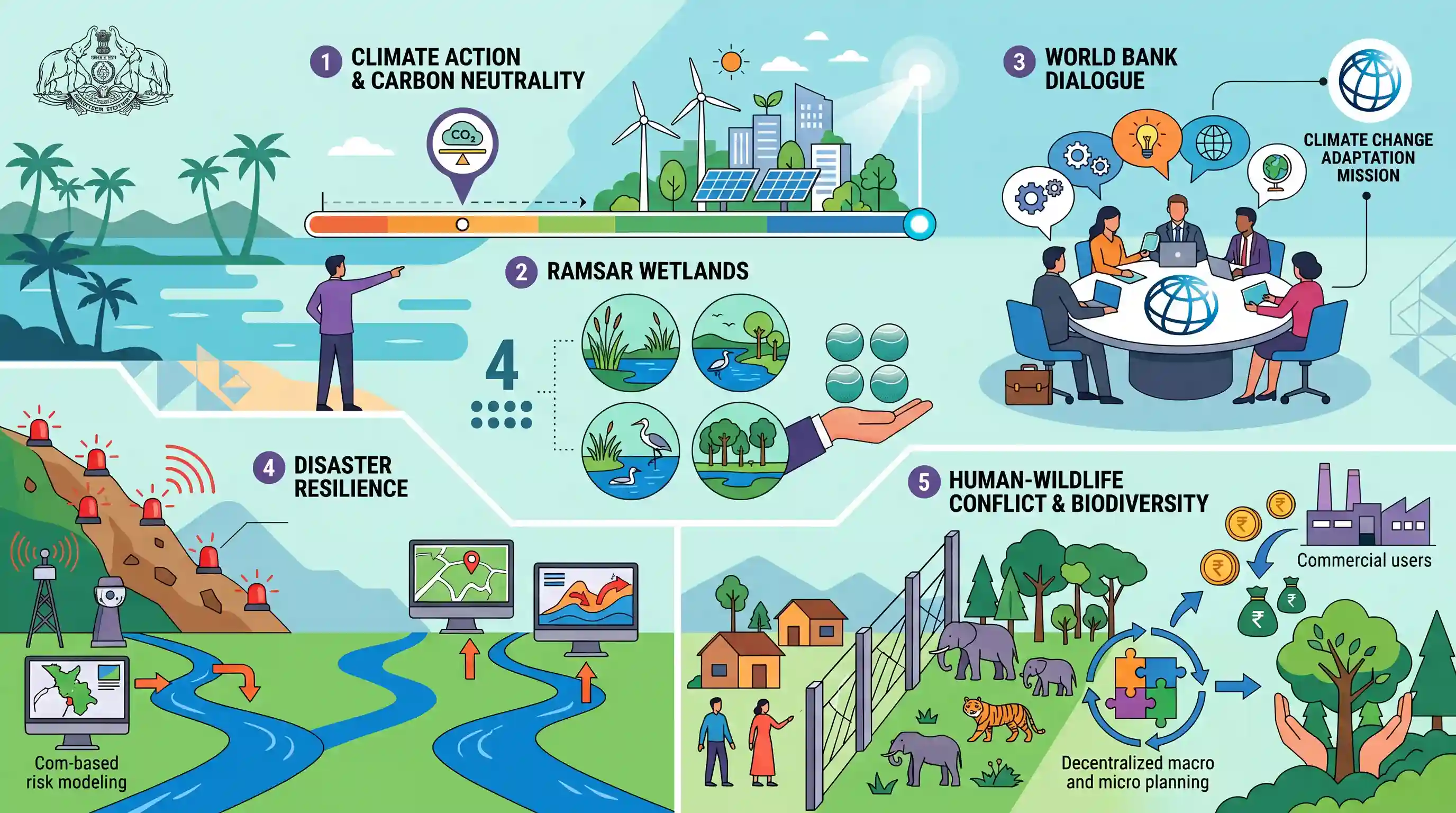
The Kerala government has unveiled a comprehensive roadmap focused on climate action, disaster management, and biodiversity conservation. Key announcements include a target to achieve carbon neutrality by 2050, the proposal of four new wetlands as Ramsar sites, and a World Bank-backed climate dialogue series by the Climate Change Adaptation Mission. To strengthen disaster resilience, Kerala is introducing IoT-based landslide monitoring in Pathanamthitta and advanced risk modelling for the Pampa and Chaliyar river basins. The state also seeks to address human-wildlife conflict through decentralised macro and micro planning, alongside mobilising resources from commercial users of biological wealth.
Key Points
- The Kerala government formulated an action plan to achieve carbon neutrality by 2050 and launch an online climate literacy platform.
- Kerala proposes to add four new wetlands for designation under the Ramsar Convention to boost environmental conservation.
- Disaster preparedness measures include an alternate Emergency Operations Centre, IoT-based landslide monitoring in Pathanamthitta, and advanced risk modelling for Pampa and Chaliyar river basins.
- The state plans to mitigate human-wildlife conflict via panchayat-level micro plans and landscape-level macro plans.
- Decentralised resource mobilisation will be encouraged from commercial users of biological resources through local self-government institutions.
Important Terms
Ramsar Convention

An international treaty (1971) for the conservation and sustainable use of wetlands. Sites designated under it are 'Wetlands of International Importance' and require specific management to maintain their ecological character.
UPSC context
GS Paper III: Environment. Tests knowledge of international conservation treaties and India's wetland protection efforts (e.g., SWAK’s new proposals).
Carbon Neutrality
A state of balance where greenhouse gas emissions are countered by their removal from the atmosphere. Kerala’s 2050 roadmap focuses on renewable energy, green hydrogen, and electric mobility to reach net-zero.
UPSC context
GS Paper III: Climate Change. Vital for questions on India's 'Panchamrit' goals and sub-national climate action roadmaps.
Climate Change Adaptation Mission (CCAM)
A governance framework (often involving the World Bank) that coordinates multisectoral strategies to enhance resilience against climate impacts, such as flood risk modelling and localized adaptation planning.
UPSC context
GS Paper III: Environment & Governance. Relevant for discussing state-level institutional mechanisms for climate resilience and international funding.
Human-Wildlife Conflict (HWC)
Negative interactions between humans and wild animals causing loss of life or property. Kerala recently categorized this as a 'state-specific disaster' to enable faster relief and decentralized micro-planning.
UPSC context
GS Paper III: Biodiversity & Disaster Management. Tests understanding of ecological crisis management and innovative policy responses.
Access and Benefit Sharing (ABS)
A legal framework under the Biological Diversity Act, 2002, ensuring that benefits from the commercial use of genetic resources or traditional knowledge are shared fairly with local communities.
UPSC context
GS Paper III: Environment/Legislation. Critical for questions on biodiversity conservation and resource mobilization for local bodies.
IoT-based Landslide Monitoring
The use of interconnected geotechnical sensors (measuring soil moisture, tilt, and vibration) and machine learning to provide real-time early warnings for landslides in vulnerable terrains like Pathanamthitta.
UPSC context
GS Paper III: Disaster Management. Relates to the use of technology (Early Warning Systems) to mitigate natural hazards.
Every Child a Scientist and Artist Programme
An educational initiative aimed at fostering scientific temper and creativity among students, integrated into climate dialogues to involve the younger generation in environmental sustainability.
UPSC context
GS Paper II: Social Justice/Education. Tests awareness of state programmes promoting scientific awareness as a Fundamental Duty.
Prelims Trap
"India aims to achieve net-zero carbon emissions by the year 2050 to align with global climate action goals."
India's official national target for Net Zero (Panchamrit) is 2070. Kerala setting a 2050 target is an accelerated state-level initiative, not a reflection of the national commitment.
Static Concepts Connected
How does the Biological Diversity Act, 2002 mandate Access and Benefit Sharing (ABS)?
- NBA Approval: Foreign individuals and entities must obtain approval from the National Biodiversity Authority before accessing India's biological resources.
- State Boards: Indian entities must give prior intimation to State Biodiversity Boards for the commercial utilization of local bio-resources.
- Local BMCs: Local Biodiversity Management Committees (BMCs) hold statutory power to levy charges on extractors, ensuring benefits reach the traditional knowledge holders.
What is the formal designation process for Ramsar wetland sites in India?
- State Identification: State governments or UT administrations identify potential wetlands, compile data, and submit formal proposals to the MoEFCC.
- MoEFCC Vetting: The central ministry evaluates the proposal against the nine Ramsar criteria before officially recommending the site internationally.
- Ramsar Secretariat: The final designation is granted by the Ramsar Convention Secretariat, placing the site on the List of Wetlands of International Importance.
Cross-Topic Patterns
Sub-national climate federalism
Kerala’s 2050 Net-Zero goal contrasting with India's 2070 target exemplifies "sub-national climate action," linking environmental policy with cooperative federalism and global initiatives like the Under2 Coalition.
IoT in Western Ghats disaster management
Using IoT for landslide monitoring in Pathanamthitta integrates emerging tech with disaster mitigation, addressing long-standing vulnerabilities highlighted by the Gadgil and Kasturirangan committees in the Western Ghats.

Expect a 2026 prelims statement contrasting national (2070) vs state (2050) Net-Zero targets, or testing BMCs' role in ABS fee collection.
Linked PYQs · 5
Linked PYQs · 5
- 2019PrelimsGS1
Consider the following statements: 1. Under Ramsar Convention, it is mandatory on the part of the Government of India to protect and conserve all the wetlands in the territory of India. 2. The Wetlands (Conservation and Management) Rules, 2010 were framed by the Government of India based on the recommendations of Ramsar Convention. 3. The Wetlands (Conservation and Management) Rules, 2010 also encompass the drainage area or catchment regions of the wetlands as determined by the authority. Which of the statements given above is/are correct?
- 2021PrelimsGS1
'R2 Code of Practices' constitutes a tool available for promoting the adoption of
- 2025PrelimsGS1
Consider the following statements : Statement I: Article 6 of the Paris Agreement on climate change is frequently discussed in global discussions on sustainable development and climate change. Statement II: Article 6 of the Paris Agreement on climate change sets out the principles of carbon markets. Statement III : Article 6 of the Paris Agreement on climate change intends to promote inter-country non-market strategies to reach their climate targets. Which one of the following is correct in respect of the above statements?
- 2019MainsGS3
Disaster preparedness is the first step in any disaster management process. Explain how hazard zonation mapping will help disaster mitigation in the case of landslides.
- 2021MainsGS3
Describe the various causes and the effects of landslides. Mention the important components of the National Landslide Risk Management Strategy.
