Kerala Aims to Clear Waste Heaps Within One Year
Source:The Hindu ↗
Why It Matters
Kerala's decentralized model of solid waste management offers a highly replicable case study for GS2 (Local Governance/SHGs) and GS3 (Environment/Waste Management). The integration of Haritha Karma Sena demonstrates the efficacy of grassroots mobilization in achieving public sanitation goals and resolving legacy waste challenges.
Summary
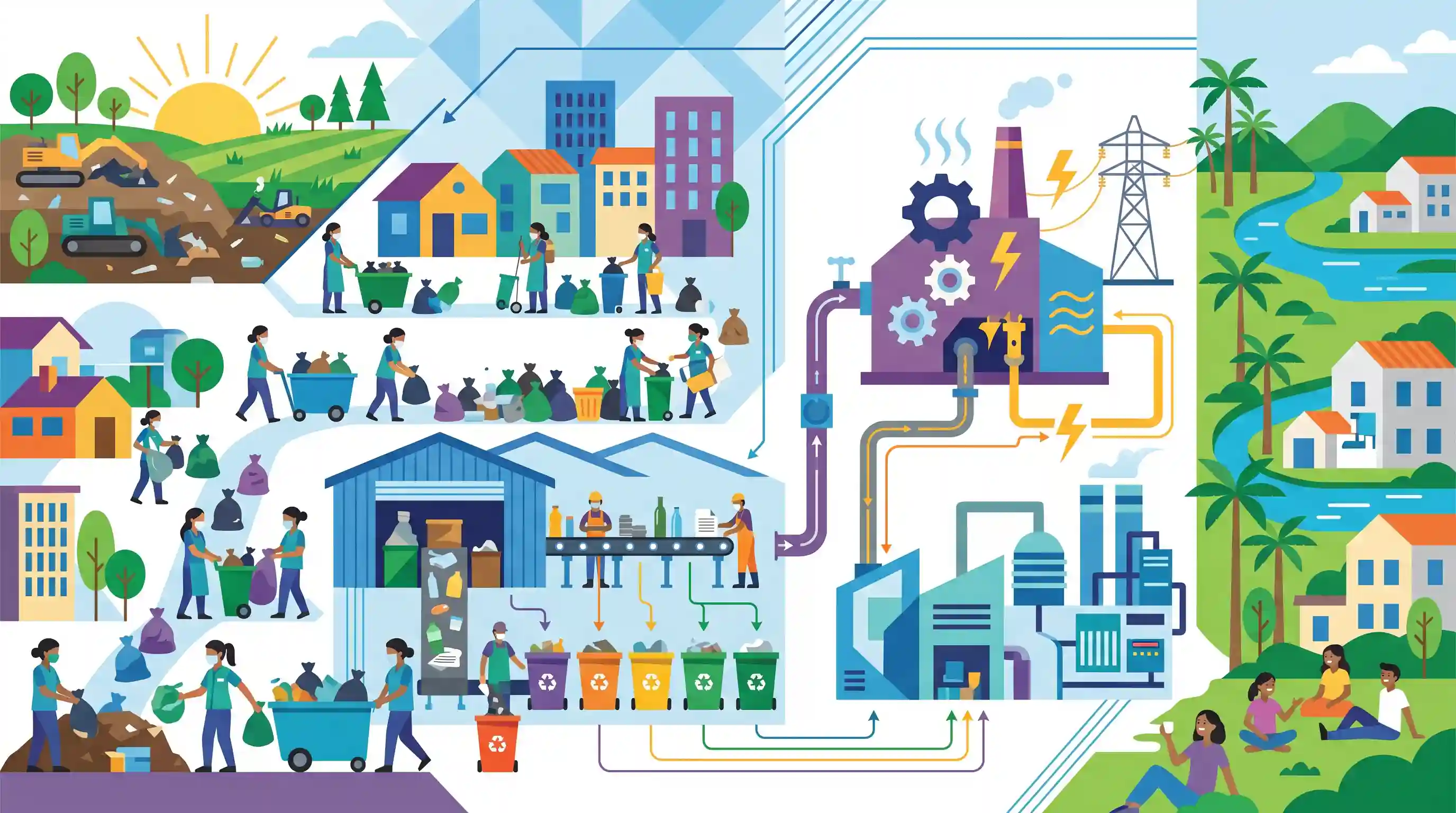
Kerala is set to become free of waste heaps within a year under the 'Malinyamuktha Navakeralam' (Waste-Free New Kerala) campaign, according to Local Self-Government Minister M.B. Rajesh. The initiative heavily relies on grassroots efforts, notably the Haritha Karma Sena volunteers who collected 1.52 lakh tonnes of waste in 2024-25. The state is scaling up its decentralized waste processing infrastructure by ensuring nearly all local bodies have Material Collection Facilities (MCFs). Additionally, Kerala plans to launch six waste-to-energy plants and four sanitary waste treatment facilities shortly, having already successfully cleared 25 major legacy dump yards.
Key Points
- Kerala aims to eliminate all waste heaps within one year under the 'Malinyamuktha Navakeralam' (Waste-Free New Kerala) campaign.
- Grassroots volunteers from the Haritha Karma Sena collected 1.52 lakh tonnes of waste in 2024-25, highlighting effective community participation.
- Decentralized infrastructure is robust, with 1,020 of the 1,034 local bodies operating their own Material Collection Facilities (MCFs).
- The state is constructing six plants to convert solid waste to fuel within three months, and four plants for treating sanitary waste within six months.
- Local bodies have been empowered to issue fines for littering, and 25 major waste dump yards have already been cleared.
Important Terms
Malinyamuktha Navakeralam campaign

A statewide campaign in Kerala aiming to achieve "garbage-free" status through decentralized management, public participation, and scientific processing of both biodegradable and non-biodegradable waste.
UPSC context
GS3: Pollution and SWM; GS2: Role of LSGs in grassroots development.
Haritha Karma Sena
An all-women volunteer force, primarily from Kudumbashree SHGs, responsible for door-to-door collection, segregation, and public awareness regarding non-biodegradable waste in Kerala.
UPSC context
GS2: SHGs and community-led governance; GS3: Waste management models.
Material Collection Facilities (MCFs)
Local hubs where dry waste collected by volunteers is sorted into categories (plastic, glass, e-waste) and temporarily stored before being sent for recycling or further processing.
UPSC context
GS3: Urban infrastructure and decentralized solid waste management logistics.
Legacy Waste
Accumulated municipal solid waste dumped in landfills or open sites over many years; its remediation (via biomining) is a priority under Swachh Bharat Mission (Urban) 2.0.
UPSC context
GS3: Environmental hazards and remediation technologies like biomining.
Waste-to-Energy (WtE) Technology
Plants that convert non-recyclable, high-calorific waste (Refuse-Derived Fuel) into electricity or heat, helping reduce landfill dependency while contributing to the energy mix.
UPSC context
GS3: Science and Technology (Energy) and Circular Economy.
Adat Grama Panchayat
A model local body in Thrissur, Kerala, recognized for its "Adat Model" which integrates organic farming, water conservation, and zero-waste management through community planning.
UPSC context
GS2: Panchayati Raj institutions; Case study for effective local governance.
Prelims Trap
Local bodies are solely responsible for the segregation of municipal solid waste.
The SWM Rules 2016 mandate 'source segregation' by the waste generators (households, institutions) into three distinct streams before handing it over to collectors.
Static Concepts Connected
What are the key mandates of the Solid Waste Management Rules, 2016?
- Source Segregation: Mandates waste generators to separate waste into wet (biodegradable), dry (plastic/paper/metal), and domestic hazardous (diapers/medicines) streams.
- User Fees & Fines: Empowers local bodies to collect user fees for waste collection and levy spot fines for littering or non-segregation.
- Extended Producer Responsibility: Manufacturers of non-biodegradable packaging products must establish a system to collect back the packaging waste generated due to their production.
What is the process of Biomining for legacy waste?
- Scientific Extraction: The scientific excavation, biological stabilization, and segregation of aged municipal solid waste from old dump sites.
- Resource Recovery: It recovers combustible fractions for refuse-derived fuel (RDF) and soil-enricher fractions, effectively reclaiming the land.
- Alternative to Capping: Favored by CPCB guidelines over traditional 'capping' (covering with soil), as it permanently eliminates the risk of landfill fires and groundwater leachate.
Cross-Topic Patterns
SHGs executing core municipal functions
Kerala's Haritha Karma Sena shows SHGs transitioning from micro-credit to executing core municipal services like sanitation, serving as an excellent case study for GS2 decentralization and governance answers.
Subsidiarity and the 11th/12th Schedules
Decentralized Material Collection Facilities (MCFs) at the Panchayat level demonstrate the principle of subsidiarity and functional devolution in public health under the 73rd and 74th Constitutional Amendments.

Expect a Prelims question on SWM Rules 2016 mixing waste generator duties with Extended Producer Responsibility and Biomining processes.
Linked PYQs · 2
Linked PYQs · 2
- 2018MainsGS3
What are the impediments in disposing the huge quantities of discarded solid wastes which are continuously being generated? How do we remove safely the toxic wastes that have been accumulating in our habitable environment?
- 2019PrelimsGS1
As per the Solid Waste Management Rules, 2016 in India, which one of the following statements is correct?
