Kerala Single Dwelling Place Protection Bill countering SARFAESI Act
Source:The Hindu ↗
Why It Matters
The legislation is a prime example of a state government intervening to protect vulnerable citizens from the adverse impacts of national financial recovery laws (SARFAESI Act). It highlights the intersection of social justice (Right to Shelter), centre-state legislative dynamics, and post-disaster economic rehabilitation.
Summary
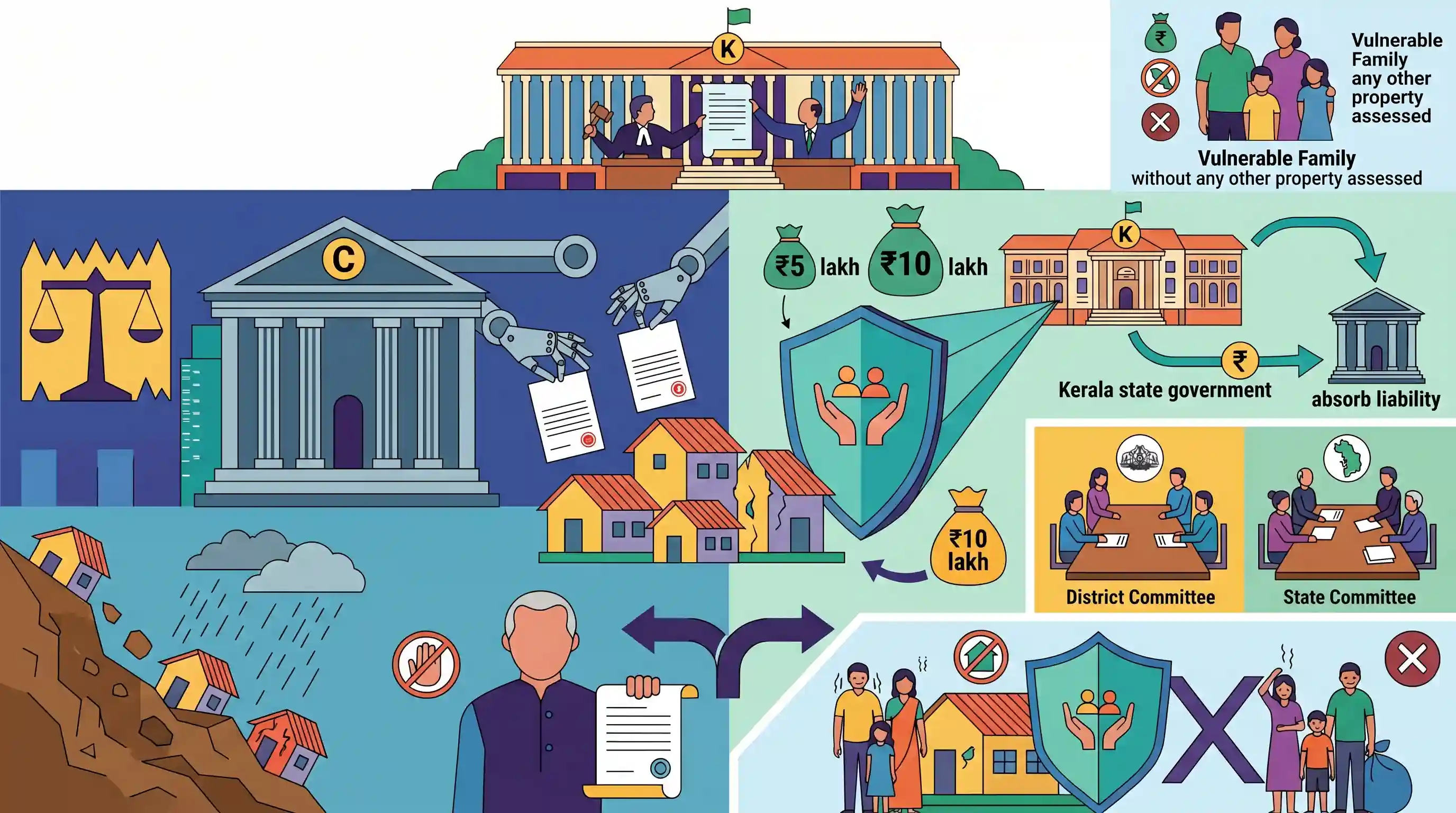
The Kerala Legislative Assembly has passed the Kerala Single Dwelling Place Protection Bill, 2025, an unprecedented social welfare measure aimed at safeguarding poor and marginalized families from eviction. Designed to counter stringent loan recovery procedures under the central SARFAESI Act, the Bill protects families defaulting on loans up to ₹5 lakh, provided they have no alternative means of repayment. The state will absorb the liability, capped at ₹10 lakh, through district and state committees. This move is additionally framed as a response to the Union government's recent amendments to the Disaster Management Act, which restricted loan waivers for victims of major disasters like the Wayanad landslides, highlighting ongoing centre-state divergences over disaster relief and economic vulnerability.
Key Points
- The Kerala Assembly passed the Kerala Single Dwelling Place Protection Bill, 2025, a social welfare measure to prevent the eviction of vulnerable families due to loan defaults.
- The legislation covers loans up to ₹5 lakh and caps the total repayment liability (including principal and interest) at ₹10 lakh, provided the debtor has no other property or means to repay.
- If a debtor qualifies, the state government will assume the liability through designated district and state-level 'dwelling place protection committees'.
- The Bill serves as a state-level countermeasure to the Union government's SARFAESI Act, 2002, which mandates strict asset recovery for loan defaults above ₹1 lakh.
- The move is also positioned as a response to recent changes in the central Disaster Management (DM) Act, which allegedly restricted the scope of loan waivers for victims of severe disasters like the Wayanad landslides.
Important Terms
Kerala Single Dwelling Place Protection Bill, 2025

A 2025 Kerala legislation safeguarding low-income families (income <₹3L) from eviction for defaulting on small loans (up to ₹5L) secured against their only residence.
UPSC context
GS II: Government Policies/Welfare Schemes; GS III: Centre-State relations regarding legislative competence over banking and property rights.
SARFAESI Act, 2002
The Securitisation and Reconstruction of Financial Assets and Enforcement of Security Interest Act allows banks to seize and sell mortgaged assets without court intervention to recover NPAs.
UPSC context
GS III: Indian Economy (Banking & NPAs). Crucial for understanding debt recovery frameworks and legal challenges to state-level borrower protection.
Section 13 of the Disaster Management Act
A provision in the Disaster Management Act, 2005 (repealed in 2025) that empowered the NDMA to recommend loan waivers or relief for victims of severe disasters.
UPSC context
GS III: Disaster Management. Highlights recent legal shifts in the Union's role in financial relief for disaster-affected populations.
Dwelling Place Protection Committees
Statutory bodies at district and state levels in Kerala tasked with verifying borrower eligibility, facilitating bank conciliation, and recommending state-funded debt relief under the 2025 Bill.
UPSC context
GS II: Statutory bodies and mechanisms for welfare implementation. Tests knowledge of state-level institutional frameworks for social security.
Article 254 (Repugnancy)
Constitutional provision stating that if a State law conflicts with a Central law on a Concurrent List subject, the Central law prevails unless the State law gets Presidential assent.
UPSC context
GS II: Indian Constitution (Federalism). Vital for analyzing the legal validity of state welfare laws that conflict with Central recovery acts.
Prelims Trap
The Kerala Bill exempts marginalized families from the purview of the central SARFAESI Act.
Banking is a Union List subject. The state cannot legally exempt citizens from SARFAESI; it avoids eviction by using state funds to absorb the borrower's debt liability.
Static Concepts Connected
Is the Right to Shelter a fundamental right under the Indian Constitution?
- Article 21: The Supreme Court ruled in the Chameli Singh case (1996) that the Right to Life encompasses the right to shelter.
- Beyond a roof: It implies adequate living space, safe structure, clean surroundings, and basic civic amenities, not merely a roof over one's head.
- Eviction safeguards: Courts often mandate that the state must provide rehabilitation or alternative accommodation before executing forced evictions of vulnerable groups.
What are the core asset recovery powers under the SARFAESI Act, 2002?
- No court intervention: Empowers banks and financial institutions to seize and auction collateral for secured loans without approaching civil courts.
- Key exclusions: The Act does not apply to unsecured loans, loan defaults below ₹1 lakh, or agricultural land.
- NPA prerequisite: These severe recovery mechanisms can only be invoked after the loan account is officially classified as a Non-Performing Asset (NPA).
Cross-Topic Patterns
Fiscal Federalism vs Disaster Relief
Amendments to the Disaster Management Act centralized relief and restricted loan waivers. States are now using state-funded welfare legislation to bypass central limits on disaster financial aid.
Macro-Prudence vs Social Welfare
Central banking laws like SARFAESI prioritize rapid NPA recovery and bank health, while state policies focus on Article 21 shelter protections, creating a recurring center-state policy friction point.

Expect a 2026 question linking Article 21 (Right to Shelter) with the limitations of state legislation against Union List banking laws.
Linked PYQs · 3
Linked PYQs · 3
- 2019MainsGS2
Performance of welfare schemes that are implemented for vulnerable sections is not so effective due to absence of their awareness and active involvement at all stages of policy process. Discuss.
- 2020MainsGS3
Discuss the recent measures initiated in disaster management by the Government of India departing from the earlier reactive approach.
- 2022MainsGS2
Besides the welfare schemes, India needs deft management of inflation and unemployment to serve the poor and the underprivileged sections of the society. Discuss.
