National Green Tribunal and Marine Pollution Accountability
Source:The Hindu ↗
Why It Matters
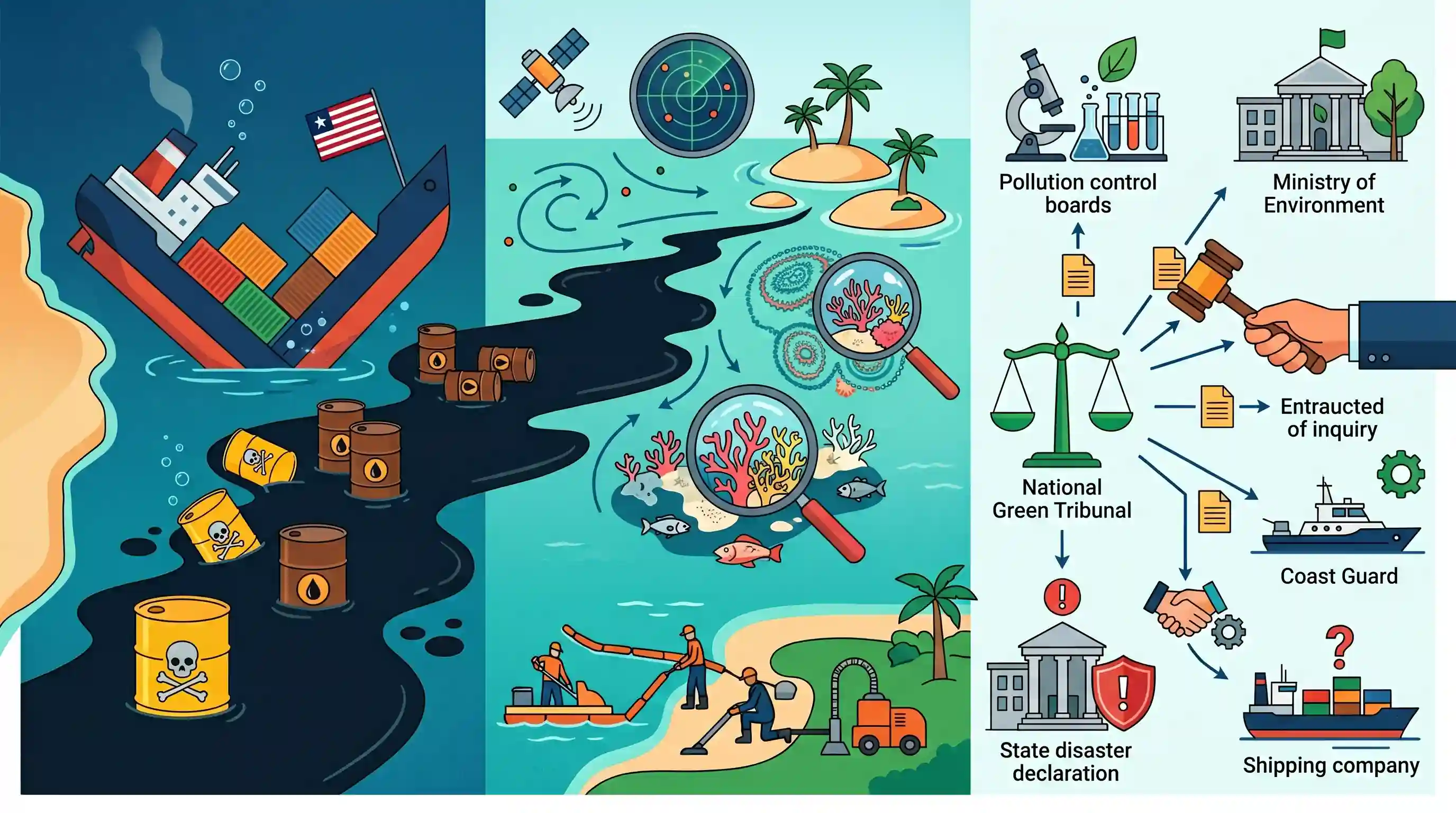
Highlights the critical issue of marine pollution stemming from shipping accidents and illustrates the role of environmental jurisprudence (NGT) in holding international shipping companies accountable for hazardous cargo under domestic environmental laws.
Summary
The National Green Tribunal (NGT) has taken suo motu cognisance of a maritime environmental crisis involving the sinking of a Liberia-flagged container ship, MSC Elsa 3, off the Kochi coast. The vessel was carrying hazardous materials, including calcium carbide and significant quantities of diesel and furnace oil, which pose a severe threat of marine pollution. Authorities are concerned that ocean currents, monitored by INCOIS, could carry toxic spills toward the ecologically sensitive coral reefs of Lakshadweep. The Kerala government has declared the shipwreck a State disaster due to its implications under the Biodiversity Act, Water Act, and Environment Protection Act. The NGT has sought detailed disclosures regarding the hazardous cargo and the proposed mitigation strategies from the shipping company, as well as coordinated responses from the Coast Guard, pollution control boards, and the Ministry of Environment.
Key Points
- The NGT took suo motu cognisance of the sinking of the Liberia-flagged vessel MSC Elsa 3 off the Kochi coast.
- The sunken ship was carrying hazardous materials, including calcium carbide, along with large quantities of diesel and furnace oil, creating severe marine pollution risks.
- Ocean currents, analyzed by INCOIS, could drift the toxic spill towards the ecologically fragile coral reefs of the Lakshadweep islands.
- The Kerala government has declared the shipwreck a State disaster, as the incident involves violations of the Biodiversity Act, Water Act, and Environment Protection Act.
- The NGT has directed the Mediterranean Shipping Company to disclose the exact nature of its hazardous cargo and mitigation plans, while seeking reports from key environmental and maritime agencies.
Important Terms
National Green Tribunal (NGT)

A statutory quasi-judicial body established under the NGT Act 2010 for the expeditious disposal of cases involving environmental protection, forest conservation, and the enforcement of legal rights relating to the environment.
UPSC context
GS Paper 2 (Quasi-judicial bodies) and GS Paper 3 (Environment). Tests knowledge of environmental adjudication and the "Polluter Pays" principle.
Indian National Centre for Ocean Information Services (INCOIS)
An autonomous institution under the Ministry of Earth Sciences providing mission-critical ocean information and advisory services, including tsunami early warnings and ocean state forecasts for maritime stakeholders.
UPSC context
GS Paper 3 (Science & Technology, Disaster Management). Evaluates the role of specialized agencies in maritime safety and disaster risk reduction.
Indian Coast Guard
A maritime force under the Ministry of Defence responsible for maritime security, search and rescue, and serving as the Central Coordinating Authority for marine pollution response in Indian waters.
UPSC context
GS Paper 3 (Security/Disaster Management). Tests institutional frameworks for protecting maritime zones and responding to environmental disasters like oil spills.
Environment (Protection) Act, 1986
An umbrella legislation empowering the Central Government to coordinate actions of various authorities and frame rules to protect and improve environmental quality across India.
UPSC context
GS Paper 3 (Environment). Fundamental for understanding regulatory frameworks, Environment Impact Assessments (EIA), and the government's role in ecological conservation.
Biodiversity Act, 2002
Law enacted to implement the Convention on Biological Diversity, focusing on the conservation of biological resources and ensuring fair and equitable benefit-sharing through a three-tier institutional structure.
UPSC context
GS Paper 3 (Environment). Tests knowledge of conservation mechanisms and the roles of National/State Biodiversity Boards and Management Committees.
Water (Prevention and Control of Pollution) Act, 1974
The first major environmental law in India, establishing the Central and State Pollution Control Boards to regulate water quality and prevent pollution in aquatic resources.
UPSC context
GS Paper 3 (Environment). Focuses on the legal history and regulatory powers of pollution control boards in maintaining water quality standards.
Prelims Trap
"The NGT Act, 2010 explicitly grants suo motu powers to the Tribunal to act on environmental violations."
The NGT Act does not explicitly mention suo motu powers. However, the Supreme Court (2021) affirmed that the Tribunal possesses suo motu powers to effectively execute its environmental protection mandate.
Static Concepts Connected
Which agencies are responsible for managing and monitoring marine oil spills in India?
- Indian Coast Guard: Acts as the Central Coordinating Authority for marine oil spill response in Indian waters under the National Oil Spill Disaster Contingency Plan (NOSDCP).
- INCOIS: An autonomous body under the Ministry of Earth Sciences that provides ocean state forecasting and predicts oil spill trajectories using ocean current data.
What are the key biological mechanisms used to mitigate marine oil spills?
- Hydrocarbonoclastic bacteria: Naturally occurring microbes, such as Alcanivorax, use petroleum hydrocarbons as their sole carbon and energy source, metabolizing the oil into less toxic byproducts.
- Oilzapper technology: A bacterial consortium developed by TERI and the Department of Biotechnology that degrades crude oil and oil sludge, accelerating the natural bioremediation process.
Cross-Topic Patterns
Marine spills & seasonal ocean currents
The movement of toxic spills from the mainland towards Lakshadweep links environmental disasters with physical geography, specifically the seasonal reversal of monsoon drift currents in the Arabian Sea.
Calcium Carbide: Shipping to FSSAI
Calcium carbide, highly reactive with water to produce flammable acetylene gas, links marine hazardous cargo rules with public health, as it is strictly banned by FSSAI for artificial fruit ripening.

NGT's suo motu powers + Coast Guard's NOSDCP role + INCOIS ocean forecasting make a prime multi-statement marine disaster question in 2026.
Linked PYQs · 1
Linked PYQs · 1
- 2023MainsGS3
What is oil pollution? What are its impacts on the marine ecosystem? In what way is oil pollution particularly harmful for a country like India?
