IMD Red Alert Issued for Kerala Districts Amid Early Monsoon
Source:The Hindu ↗
Why It Matters
Familiarity with the IMD's color-coded alert system (Red, Orange, Yellow) and the factors dictating the onset of the Indian monsoon are standard requirements for Prelims geography and Mains disaster management questions.
Summary
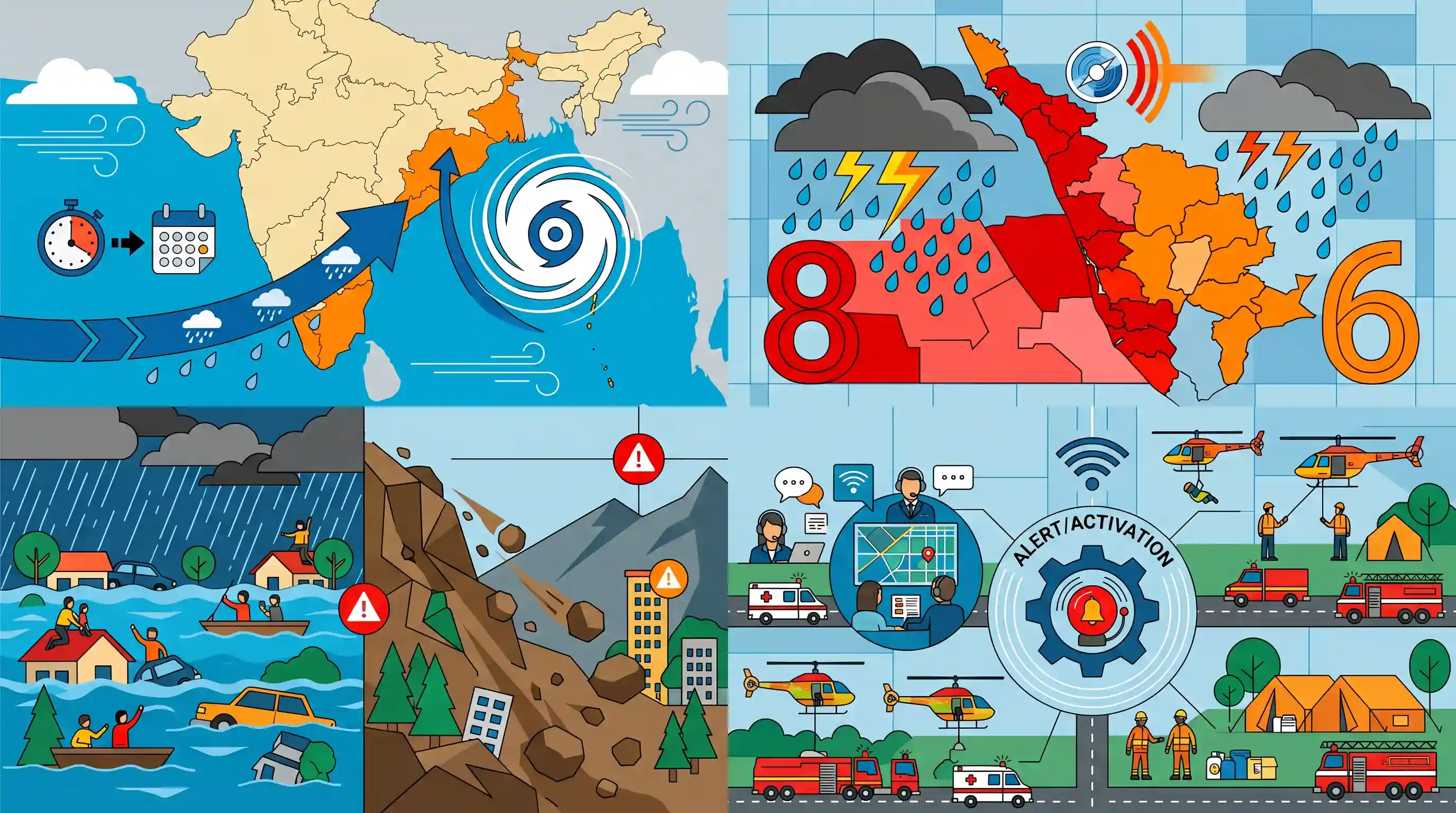
The India Meteorological Department (IMD) issued a red alert for eight districts in Kerala, predicting extremely heavy rainfall exceeding 20 cm in a 24-hour period. The remaining six districts were placed under an orange alert. The intense weather is driven by the early onset of the southwest monsoon, which reached Kerala on May 24 instead of the normal June 1, exacerbated by a deep depression over the coasts of West Bengal and Bangladesh. Authorities have activated disaster management measures to mitigate potential flooding and landslides.
Key Points
- The IMD declared a red alert (over 20 cm of rain in 24 hours) for eight districts in Kerala and an orange alert for the remaining six districts.
- The extreme rainfall is linked to the early onset of the southwest monsoon on May 24, well ahead of the normal June 1 date.
- A deep depression located over the West Bengal and Bangladesh coasts has significantly influenced the monsoon dynamics and rainfall intensity.
- In response to the early warnings, local authorities have implemented disaster management protocols, including banning night travel in hilly areas and restricting access to waterbodies.
Important Terms
India Meteorological Department (IMD)

The principal national agency under the Ministry of Earth Sciences responsible for meteorological observations, weather forecasting, and seismology. It serves as a Regional Specialized Meteorological Centre for tropical cyclones.
UPSC context
GS Paper I (Geography) and GS Paper III (Disaster Management) regarding early warning systems and natural hazards.
Southwest Monsoon
A seasonal wind system from June to September that provides the majority of India's annual rainfall. It typically enters the Indian mainland via the Kerala coast around June 1.
UPSC context
GS Paper I (Geography: Indian Climate) and GS Paper III (Agriculture) for its impact on food security and economy.
Color-coded Weather Alerts
A standardized four-tier warning system (Green, Yellow, Orange, Red) used by the IMD to communicate the severity of weather events and the level of preparedness required by authorities.
UPSC context
GS Paper III (Disaster Management) for understanding early warning mechanisms and administrative response protocols.
Red Alert
The IMD's highest alert level, signifying "Take Action." It indicates extremely severe weather with high potential for life-threatening conditions and significant disruption to transport and power.
UPSC context
GS Paper III (Disaster Management) for emergency response and hazard mitigation strategies during extreme weather.
Deep Depression
An intensified tropical low-pressure system with sustained wind speeds between 52-61 kmph. It is a transitional stage between a depression and a full-fledged cyclonic storm.
UPSC context
GS Paper I (Physical Geography) for the study of cyclogenesis and tropical weather systems.
Orange Alert
A "Be Prepared" warning issued for extremely bad weather that could cause significant disruptions like road closures and power outages, posing a potential risk to life and property.
UPSC context
GS Paper III (Disaster Management) regarding preparedness and precautionary measures for severe meteorological disturbances.
Prelims Trap
IMD declares the monsoon onset over Kerala solely based on two consecutive days of widespread rainfall exceeding 2.5 mm.
Rainfall is only one factor. IMD also strictly requires matching wind fields (westerlies up to 600 hPa depth) and Outgoing Longwave Radiation (OLR) below 200 W/m².
Static Concepts Connected
What are the IMD's three criteria for declaring monsoon onset over Kerala?
- Widespread Rainfall: 60% of 14 designated stations in Kerala and Lakshadweep must report rainfall of 2.5 mm or more for two consecutive days.
- Wind Field: The depth of westerlies must be maintained up to 600 hPa, with specific wind speeds mapping from the equator to 10ºN latitude.
- OLR Drops: Outgoing Longwave Radiation (OLR) must drop below 200 W/m² over the defined area, indicating deep and sustained cloud cover.
How do IMD color-coded weather alerts dictate administrative response?
- Red Alert: Indicates extremely heavy rain (>204.5 mm/24 hrs). Mandates authorities to "Take Action," activating evacuations and enforcing disaster protocols like travel bans.
- Orange Alert: Indicates heavy to very heavy rain (115.6 - 204.4 mm). Mandates authorities to "Be Prepared" and keep emergency and relief machinery on standby.
- Yellow Alert: Indicates severely bad weather spanning across several days. Serves as a "Be Updated" warning to the public to stay informed about worsening conditions.
Cross-Topic Patterns
Pre-Monsoon Cyclones & Wind Dynamics
Deep depressions in the Bay of Bengal can accelerate monsoon onset. Their counterclockwise back-winds physically pull the Southwesterly monsoon trough toward the Indian landmass.
Geology & Landslide Vulnerability
Kerala's Western Ghats face massive debris flows due to a geological trap: a highly porous, thick lateritic soil cap sitting abruptly over impermeable hard rock, causing rapid pore-water pressure spikes.

Expect a 2026 Prelims multi-statement question combining IMD's exact monsoon onset criteria (OLR, westerlies) with BoB cyclone dynamics.
Linked PYQs · 5
Linked PYQs · 5
- 2024MainsGS3
Flooding in urban areas is an emerging climate-induced disaster. Discuss the causes of this disaster. Mention the features of two such major floods in the last two decades in India. Describe the policies and frameworks in India that aim at tackling such floods.
- 2020MainsGS1
Account for the huge flooding of million cities in India including the smart ones like Hyderabad and Pune. Suggest lasting remedial measures.
- 2016MainsGS1
Major cities of India are becoming more vulnerable to flood conditions. Discuss.
- 2017PrelimsGS1
With reference to 'Indian Ocean Dipole (IOD)' sometimes mentioned in the news while forecasting Indian monsoon, which of the following statements is/are correct? 1. IOD phenomenon is characterised by a difference in sea surface temperature between tropical Western Indian Ocean and tropical Eastern Pacific Ocean. 2. An IOD phenomenon can influence an El Nino's impact on the monsoon. Select the correct answer using the code given below:
- 2013MainsGS3
How important are vulnerability and risk assessment for pre-disaster management ? As an administrator, what are key areas that you would focus on in a Disaster Management System.
