Kozhikode Nipah Case Triggers Public Health Surveillance Protocols
Source:The Hindu ↗
Why It Matters
The recurring outbreaks of the Nipah virus in Kerala highlight the critical intersection of environmental changes, zoonotic spillovers, and public health preparedness. Understanding viral transmission mechanisms and disease containment strategies is essential for civil servants handling health crises.
Summary
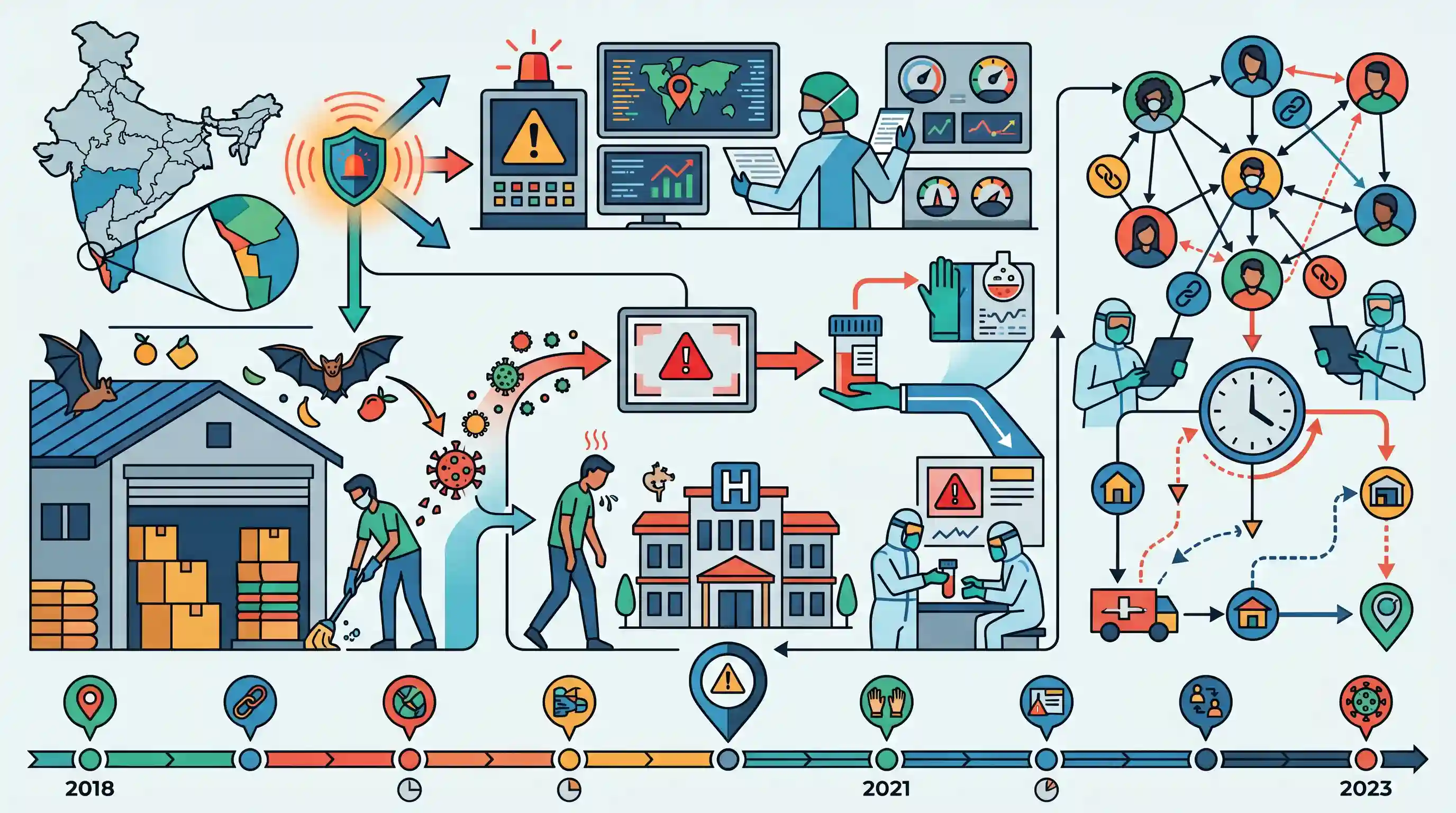
Kerala is on high alert after a 43-year-old man from Kozhikode returned a preliminary positive test for the Nipah virus at the local Government Medical College Hospital. His samples have been sent to the National Institute of Virology (NIV) in Pune for final confirmation. In response, health officials have fast-tracked contact tracing and mapped his route over the past few days. Preliminary investigation suggests the patient may have been exposed to the virus while cleaning a rented godown, likely due to contact with fruit bats, the virus's natural reservoir. Kozhikode has a history of Nipah outbreaks, having recorded cases in 2018, 2021, and 2023, underscoring the region's vulnerability to this high-mortality zoonotic disease.
Key Points
- A 43-year-old man from Kozhikode, Kerala, tested positive for the Nipah virus in preliminary examinations.
- Samples have been forwarded to the National Institute of Virology (NIV), Pune, for definitive confirmation.
- The state health department has commenced outbreak management protocols, including intensive contact tracing and route mapping.
- Suspected exposure occurred while the patient was cleaning a rented godown, potentially bringing him into contact with fruit bats, the natural reservoir of the virus.
- Kozhikode has a recurring history of Nipah virus outbreaks, with previous incidents recorded in 2018, 2021, and 2023.
Important Terms
Nipah Virus (NiV)

A highly fatal zoonotic virus (40–75% mortality) transmitted to humans by fruit bats (Pteropus species). It causes severe respiratory illness and fatal encephalitis (brain inflammation).
UPSC context
GS Paper III (Science & Technology) and GS Paper II (Health). Tests knowledge of viral characteristics and public health threats.
Zoonotic Disease
Infectious diseases that naturally spread from vertebrate animals to humans. They account for approximately 75% of emerging infectious diseases globally.
UPSC context
GS Paper III (Environment & S&T). Critical for understanding the human-animal-environment interface and pandemic prevention.
One Health Approach
A collaborative, multisectoral approach that recognizes the interconnectedness of human, animal, and environmental health to achieve optimal health outcomes and prevent pandemics.
UPSC context
GS Paper II (Public Health/Governance). A key policy framework for managing zoonotic outbreaks like Nipah and COVID-19.
National Institute of Virology (NIV)
The premier institute under the Indian Council of Medical Research (ICMR), Pune, responsible for the diagnosis, research, and surveillance of viral diseases in India.
UPSC context
GS Paper III (S&T Institutions). Important as India's lead agency for confirming high-risk viral pathogens.
Biosafety Level-4 (BSL-4)
The highest level of biological safety containment used for researching dangerous and exotic pathogens (like Nipah or Ebola) that pose a high risk of life-threatening disease.
UPSC context
GS Paper III (Science & Technology). Relates to laboratory infrastructure and indigenous capacity for handling deadly viruses.
Contact Tracing
The public health process of identifying, assessing, and managing people who have been exposed to a disease to prevent further transmission.
UPSC context
GS Paper II (Governance/Health). A fundamental disaster management and public health tool for breaking the chain of infection.
Prelims Trap
"Nipah virus is a mosquito-borne DNA virus for which an indigenous vaccine was recently approved."
Nipah is a zoonotic RNA virus transmitted by fruit bats (not mosquitoes), and there is currently no approved vaccine or specific antiviral treatment available.
Static Concepts Connected
What are the core biological and transmission characteristics of the Nipah virus?
- Pathogen type: It is a highly fatal zoonotic RNA virus belonging to the Paramyxoviridae family.
- Natural reservoir: Fruit bats (flying foxes) of the Pteropodidae family act as its natural asymptomatic hosts.
- Transmission modes: Spreads via direct contact with infected bats, pigs, contaminated food (e.g., raw date palm sap), or human-to-human transmission.
- Clinical severity: It lacks approved vaccines/drugs and causes severe acute respiratory illness and fatal encephalitis, with a 40-75% fatality rate.
What is the 'One Health' approach relevant to zoonotic disease management?
- Core philosophy: An integrated, unifying strategy recognizing that human health is intricately linked to animal health and the shared environment.
- Zoonotic focus: Essential for preventing and predicting zoonotic spillovers (like Nipah or COVID-19) at the human-animal-ecosystem interface.
- Ecological drivers: Addresses ecological drivers of disease emergence such as deforestation, habitat encroachment, and climate change.
Cross-Topic Patterns
Zoonoses and Western Ghats ecology
Recurring Nipah outbreaks in Kerala highlight the critical link between ecological fragmentation—such as land-use changes in the Western Ghats—and increased zoonotic spillovers, blending Environment and Public Health syllabi.
Biosecurity and institutional infrastructure
The role of apex institutes like NIV Pune in confirming outbreaks ties into India's biological disaster management protocols and the strategic need for more BSL-4 laboratories.

Expect a multi-statement Prelims question comparing Nipah, Zika, and Dengue based on viral families, reservoirs, and vaccine availability.
Linked PYQs · 3
Linked PYQs · 3
- 2013PrelimsGS1
Which of the following statements is/are correct?
- 2021PrelimsGS1
Consider the following : 1. Bacteria 2. Fungi 3. Virus Which of the above can be cultured in artificial/synthetic medium?
- 2024MainsGS2
In a crucial domain like the public healthcare system the Indian State should play a vital role to contain the adverse impact of marketisation of the system. Suggest some measures through which the State can enhance the reach of public healthcare at the grassroots level.
