IMD Predicts Southwest Monsoon Onset Over Kerala on June 4
Source:The Hindu ↗
Why It Matters
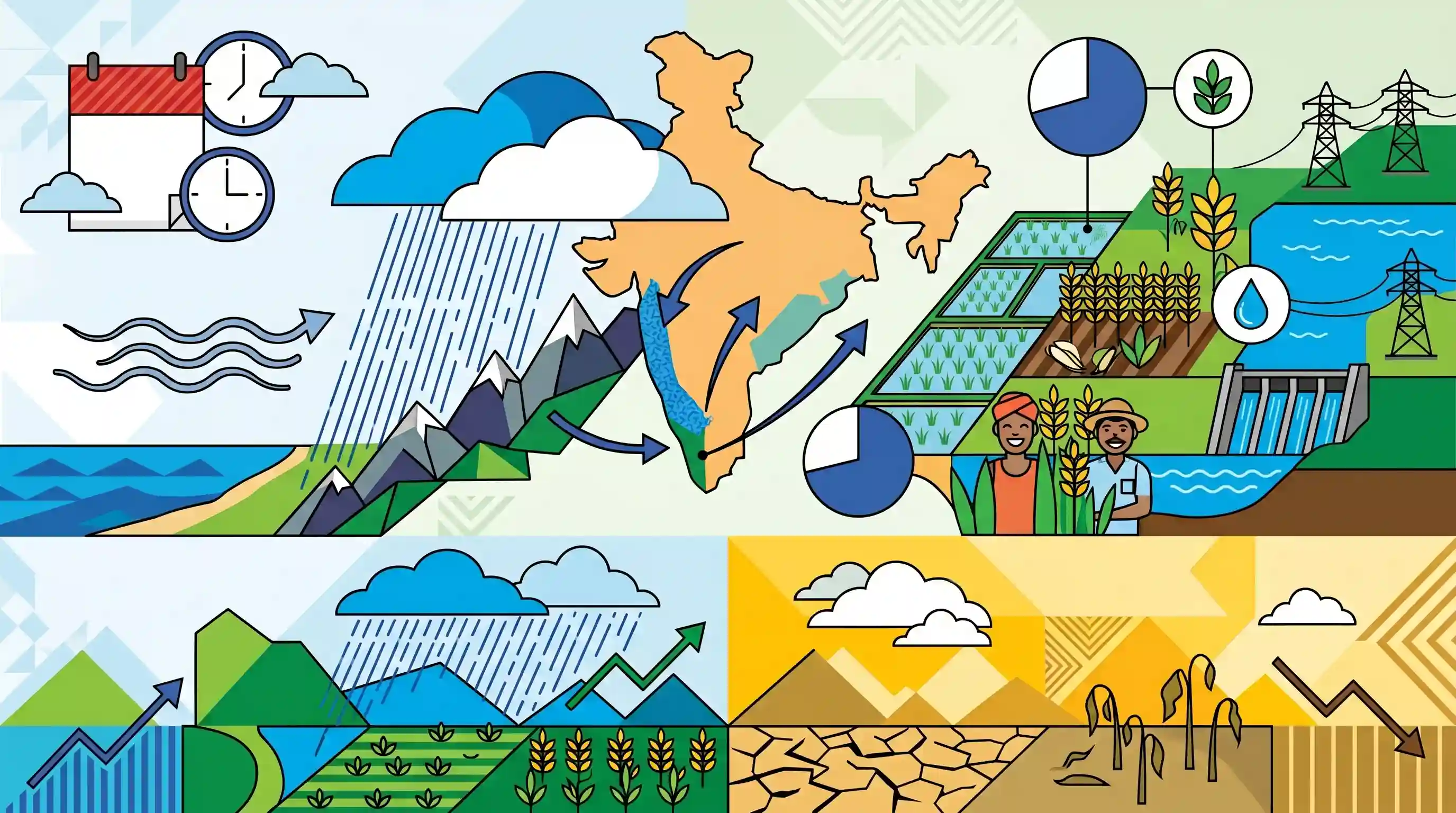
The southwest monsoon is the backbone of India's agriculture and water security. A solid grasp of monsoon mechanics (like orographic rainfall over the Western Ghats) and the influence of global climate phenomena (El Niño/La Niña) is foundational for UPSC aspirants, forming a recurrent theme in Prelims and Mains (GS1 & GS3).
Summary
The India Meteorological Department (IMD) announced that the southwest monsoon is expected to make its onset over Kerala on June 4. The article explains the geographical mechanics behind the monsoon's arrival, noting how the moisture-laden Arabian Sea winds strike the Western Ghats, leading to heavy orographic precipitation. It emphasizes the monsoon's critical role in India's agrarian economy, as it delivers over 70% of the country's annual rainfall required for agriculture, food security, and replenishing reservoirs for drinking water and hydroelectricity. Additionally, it highlights the potential negative impact of the El Niño phenomenon on monsoon rainfall, contrasting it with the favorable conditions usually brought by La Niña.
Key Points
- The IMD forecasts the southwest monsoon onset over Kerala on June 4, slightly delayed from the normal June 1 onset.
- Kerala is the first state to receive the monsoon as the Arabian Sea branch of monsoon winds hits the Western Ghats, causing heavy orographic rainfall via adiabatic cooling.
- The southwest monsoon contributes over 70% of India's annual rainfall, which is vital for kharif sowing, food security, and driving rural consumption.
- Monsoon rains replenish reservoirs crucial for drinking water supply and hydroelectric power generation.
- El Niño conditions typically weaken the Indian monsoon and raise temperatures, whereas La Niña generally promotes stronger rainfall.
Important Terms
India Meteorological Department (IMD)

India's principal government agency under the Ministry of Earth Sciences responsible for meteorological observations, weather forecasting, and seismology. Established in 1875, it issues critical monsoon predictions and cyclone warnings.
UPSC context
GS Paper 1 (Geography) and GS Paper 3 (Disaster Management); tests knowledge of institutional frameworks for weather monitoring and disaster preparedness.
Southwest Monsoon
A seasonal reversal of winds (June–September) that brings moisture from the Indian Ocean, delivering over 70% of India's annual rainfall, essential for agriculture, food security, and hydroelectricity.
UPSC context
GS Paper 1 (Physical Geography) and GS Paper 3 (Agriculture); core topic for understanding India's climate, agrarian economy, and water resources.
Western Ghats
A 1,600 km mountain range along India's western coast that acts as a climatic barrier, intercepting southwest monsoon winds to cause heavy rainfall on its windward slopes.
UPSC context
GS Paper 1 (Geography) and GS Paper 3 (Environment); significant for biodiversity hotspots and its role in regulating the Indian monsoon.
Orographic Precipitation
Rainfall produced when moisture-laden air is forced to rise over a physical barrier, such as a mountain range, causing it to cool, condense, and precipitate on the windward side.
UPSC context
GS Paper 1 (Geography); tests understanding of precipitation mechanisms and the "rain shadow" effect on the leeward side of mountains.
El Niño
The warm phase of the El Niño-Southern Oscillation (ENSO) characterized by unusual warming of surface waters in the central and eastern Pacific Ocean, often leading to monsoon deficits in India.
UPSC context
GS Paper 1 (Climatology); critical for analyzing global climate impacts and their specific adverse effects on Indian agricultural productivity.
La Niña
The cold phase of the El Niño-Southern Oscillation (ENSO) involving the cooling of sea surface temperatures in the equatorial Pacific, generally associated with stronger-than-normal Indian monsoon rainfall.
UPSC context
GS Paper 1 (Climatology); essential for understanding inter-annual climate variability and its beneficial impacts on India's water replenishment.
Prelims Trap
Kerala is the first territory in India to receive the southwest monsoon winds.
The Andaman and Nicobar Islands actually receive the monsoon first, usually around mid-May, about two weeks before the mainland onset in Kerala.
Static Concepts Connected
How does the Western Ghats' topography influence monsoon rainfall distribution?
- Windward side: Arabian Sea winds hit western slopes, causing rapid adiabatic cooling and heavy orographic rainfall.
- Leeward side: Winds descending on eastern slopes undergo adiabatic warming, creating a dry rain-shadow effect over the Deccan plateau.
What is the mechanism linking El Niño to a deficient Indian monsoon?
- Pacific warming: Warm waters in the eastern equatorial Pacific shift the Walker Circulation, altering global weather patterns.
- High pressure shift: It causes descending air and high pressure over the Indian Ocean, weakening the crucial low-pressure system needed to draw monsoon winds into India.
Cross-Topic Patterns
Monsoon delays and food inflation
Delayed onset or El Niño-induced deficits impact Kharif sowing, squeezing supply chains and prompting the RBI to maintain hawkish repo rates to combat food-driven CPI inflation.
Reservoir levels and energy transition
Deficient monsoons deplete major dams, forcing higher reliance on coal-fired thermal power to meet peak demands, temporarily derailing India's short-term green energy mix targets.

Expect a 2026 multi-statement Q linking El Niño to Walker Cell shifts, Indian Ocean Dipole, and cascading impacts on Kharif inflation.
Linked PYQs · 5
Linked PYQs · 5
- 2014PrelimsGS1
The seasonal reversal of winds is the typical characteristic of
- 2011PrelimsGS1
La Nina is suspected to have caused recent floods in Australia. How is La Nina different from El Nino? 1. La Nina is characterised by unusually cold ocean temperature in equatorial Indian Ocean whereas El Nino is characterised by unusually warm ocean temperature in the equatorial Pacific Ocean. 2. El Nino has adverse effect on south-west monsoon of India, but La Nina has no effect on monsoon climate. Which of the statements given above is/are correct?
- 2017PrelimsGS1
With reference to 'Indian Ocean Dipole (IOD)' sometimes mentioned in the news while forecasting Indian monsoon, which of the following statements is/are correct? 1. IOD phenomenon is characterised by a difference in sea surface temperature between tropical Western Indian Ocean and tropical Eastern Pacific Ocean. 2. An IOD phenomenon can influence an El Nino's impact on the monsoon. Select the correct answer using the code given below:
- 2002PrelimsGS1
For short-term climate prediction, which one of the following events, detected in the last decade, is associated with occasional weak monsoon rains in the India subcontinent?
- 2014MainsGS1
Most of the unusual climatic happenings are explained as an outcome of the El-Nino effect. Do you agree?
