Minority Rights and Secularism Concerns During Christmas in India
Source:The Hindu ↗
Why It Matters
The article highlights the practical challenges and contemporary debates surrounding secularism, fundamental rights (such as Article 25), and minority protection in India. It underscores the responsibility of the State in curbing communal violence and maintaining social cohesion, which are core themes in UPSC GS1 (Indian Society) and GS2 (Polity and Governance).
Summary
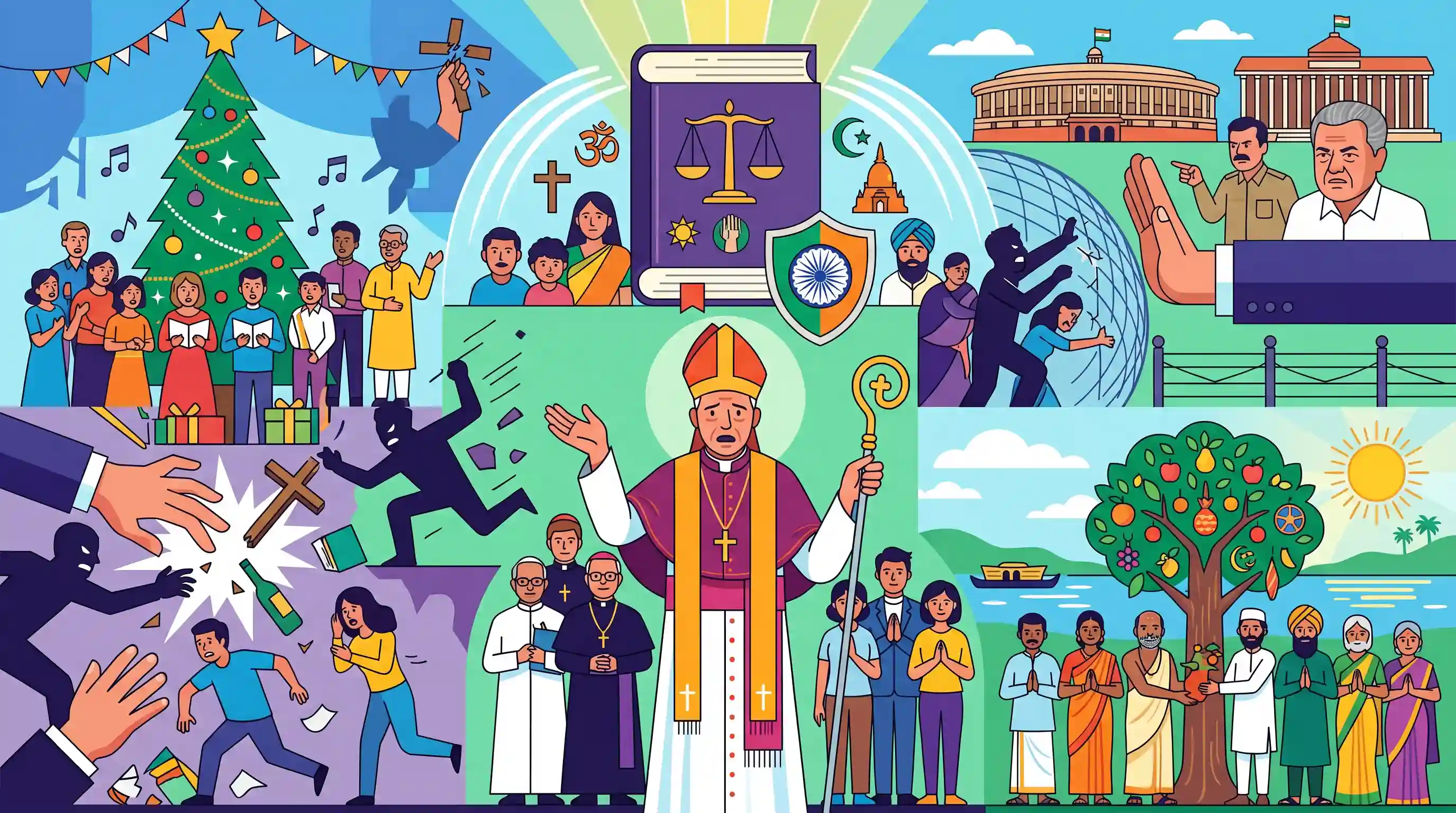
During Christmas celebrations in Kerala, senior Christian religious leaders expressed deep concern over recent attacks on Christians and disruptions of Christmas events in various parts of India. Leaders like Cardinal Baselios Cleemis emphasized that India is a secular nation where the Constitution guarantees the right to practice any religion. They called upon the Central and State governments to take decisive action against divisive forces to protect minority communities. The state's Chief Minister also warned against communal elements attempting to disrupt Kerala's social harmony.
Key Points
- Kerala observed Christmas with midnight masses and traditional celebrations, but religious leaders utilized the occasion to voice concerns over national incidents.
- Major Archbishop Cardinal Baselios Cleemis expressed alarm over the increasing attacks on Christians and disruptions of Christmas events in different parts of India.
- Christian leaders emphasized that the Constitution guarantees every Indian citizen the fundamental right to choose, practice, and propagate their religion without facing violence.
- The leaders urged both the Union and State governments to intervene effectively against divisive forces and ensure the safety of religious minorities.
- Kerala Chief Minister Pinarayi Vijayan echoed these sentiments, warning against attempts by communal forces to destroy social harmony and the state's secular fabric.
Important Terms
Constitution of India

The supreme law of India, establishing the political framework, fundamental rights, and duties of citizens. It was adopted on November 26, 1949, and came into effect on January 26, 1950.
UPSC context
GS Paper II (Polity & Governance). It is the foundational document for almost all constitutional and administrative questions.
Indian Secularism
A "positive" model of secularism (Sarva Dharma Sambhava) where the state maintains a principled distance from all religions while ensuring equal respect and protection for all faiths.
UPSC context
GS Paper I (Social Issues) and GS Paper II (Polity). Tests understanding of the Indian versus Western models of secularism.
Article 25
A Fundamental Right guaranteeing freedom of conscience and the right to freely profess, practice, and propagate religion, subject to public order, morality, and health.
UPSC context
GS Paper II (Fundamental Rights). High-priority topic for both Prelims and Mains regarding religious freedoms and state interference.
Syro-Malabar Church
The second-largest Eastern Catholic Church, in full communion with the Pope. It traces its origins to St. Thomas the Apostle and follows the East Syriac Rite.
UPSC context
GS Paper I (Art & Culture/Religious Diversity). Relevant for understanding the history of Christianity and communal structures in Kerala.
Syro-Malankara Catholic Church
An Eastern Catholic Church in full communion with Rome that follows the West Syriac Rite. It is headed by a Major Archbishop (currently Cardinal Baselios Cleemis).
UPSC context
GS Paper I (Diversity and Religion). Important for socio-religious movements and the history of St. Thomas Christians.
Minority Rights
Constitutional protections (Articles 29 and 30) for religious and linguistic groups to preserve their culture, language, and establish educational institutions.
UPSC context
GS Paper II (Social Justice/Polity). Tests knowledge of safeguards for vulnerable sections and the role of the Constitution.
Prelims Trap
"The right to propagate religion under Article 25 includes the fundamental right to convert another person."
The Supreme Court (Rev. Stainislaus case) ruled that 'propagate' means transmitting beliefs, but does not include the right to convert another person, as that may violate public order.
Static Concepts Connected
How does Indian Secularism differ from the strict Western model?
- Principled Distance: Unlike the strict US 'wall of separation', India follows a principled distance model allowing the state to intervene for social reform or to protect minority rights.
- Equal Respect: Rather than being irreligious, the Indian state promotes Sarva Dharma Sambhava, treating all religions with equal respect and supporting pluralism.
What are the specific Constitutional protections for minorities in India?
- Article 29: Grants any section of citizens the fundamental right to conserve their distinct language, script, or culture.
- Article 30: Guarantees all religious and linguistic minorities the fundamental right to establish and administer educational institutions of their choice.
- Article 350B: Provides for the appointment of a Special Officer for linguistic minorities to investigate safeguards provided under the Constitution.
Cross-Topic Patterns
State Anti-Conversion Laws & Article 25
Recent state-level anti-conversion bills are frequently challenged in the Supreme Court, creating a constant tension between state police powers (public order) and the fundamental right to practice and propagate religion.
Article 30 vs. RTE Exemptions
The constitutional protection of minority rights frequently intersects with education policy, notably how Article 30 exempts minority educational institutions from the Right to Education (RTE) Act's EWS quota mandates.

Expect a 2026 Prelims question mixing Art 25's scope (propagate vs. convert) with the statutory powers of the Minorities Commission.
Linked PYQs · 3
Linked PYQs · 3
- 2024MainsGS2
Discuss India as a secular state and compare with the secular principles of the US constitution.
- 2022MainsGS1
Are tolerance, assimilation and pluralism the key elements in the making of an Indian form of secularism? Justify your answer.
- 2019MainsGS1
What are the challenges to our cultural practices in the name of secularism?
