Kerala HC orders expert evaluation of Sabarimala temple valuables
Source:The Hindu ↗
Why It Matters
Highlights the recurring administrative challenges in state-controlled religious boards, the role of the judiciary in ensuring transparency, and the critical need to preserve India's cultural and artistic heritage through modern cataloging methods.
Summary
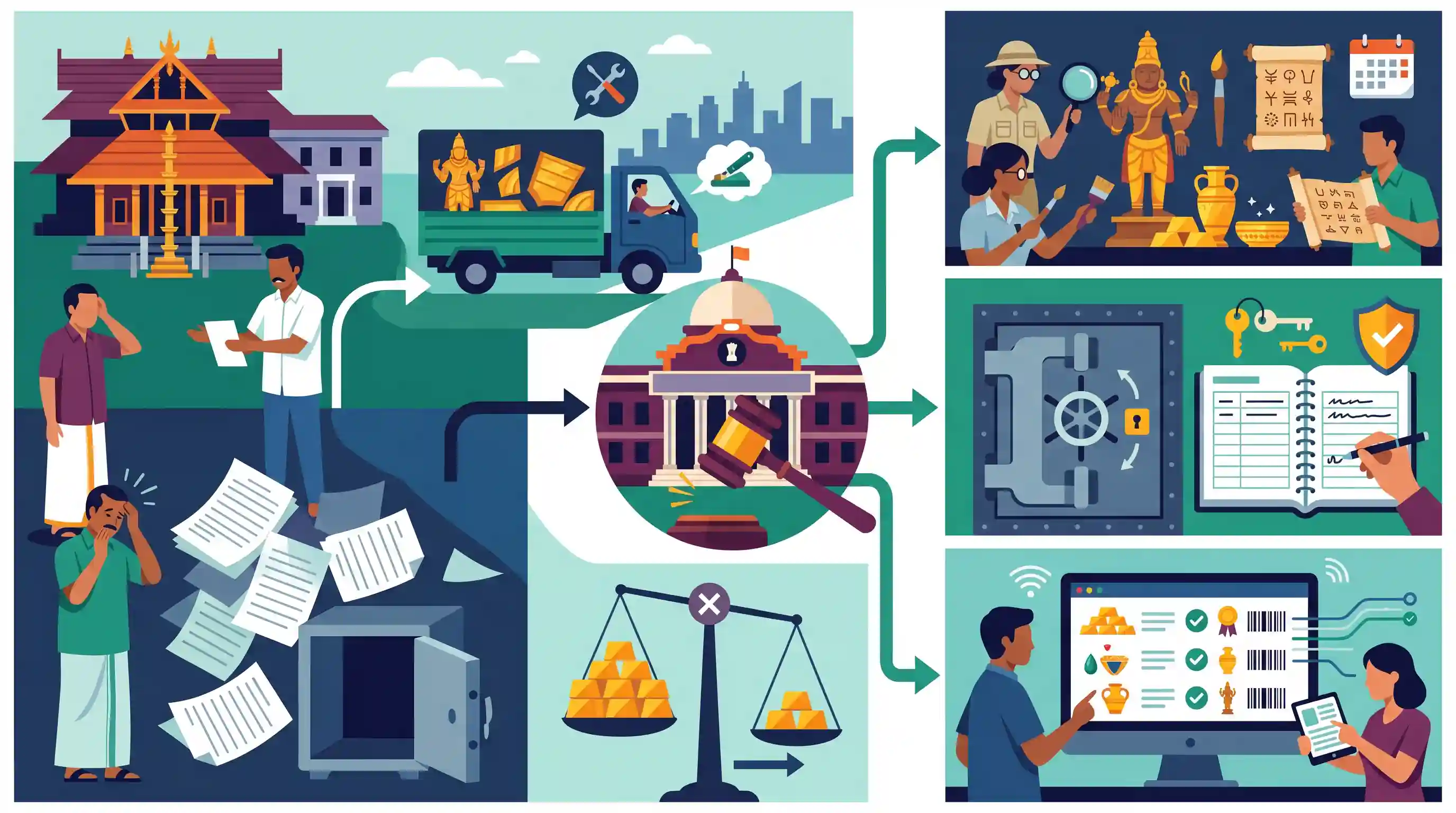
The Kerala High Court has directed a comprehensive inventory and expert evaluation of Sabarimala temple's valuables due to the Travancore Devaswom Board's failure to maintain proper registers. The controversy stems from the alleged unauthorized removal of the gold-cladded copper coverings of the Dwarapalaka idols to Chennai for repairs, and a subsequent discrepancy in their recorded weight. In response, the court has mandated an evaluation by archaeological and historical experts to determine the items' antiquity and artistic value. Furthermore, the court has ordered the creation of a 'nilavara' (strongroom) register and a complete digital inventory of all valuables to ensure future transparency.
Key Points
- The Kerala High Court has ordered a comprehensive inventory and expert evaluation of the Sabarimala temple's valuables.
- The directive was issued following reports that the Travancore Devaswom Board (TDB) failed to maintain proper asset registers.
- The issue centers on the unauthorized transfer of gold-cladded copper coverings of the Dwarapalaka idols to Chennai for repairs, alongside a reported discrepancy in their weight.
- The court has mandated that archaeological and historical experts assess the antiquity and artistic value of the coverings.
- A 'nilavara' (strongroom) register must be established, and a digital inventory of all temple valuables must be created to ensure accountability.
Important Terms
Travancore Devaswom Board (TDB)

An autonomous statutory body established under the Travancore-Cochin Hindu Religious Institutions Act, 1950. It manages over 1,200 temples in southern Kerala, including the Sabarimala shrine.
UPSC context
GS Paper II: Statutory Bodies; GS Paper I: Temple Administration. Tests knowledge of state-managed religious endowments.
Dwarapalaka
Guardians of the gate or door, typically portrayed as warriors or semi-divine beings flanking the entrance to a temple's sanctum sanctorum (garbhagriha) to ward off evil.
UPSC context
GS Paper I: Indian Heritage and Culture. Tests understanding of Dravidian and Nagara temple architectural elements.
Nilavara
A regional term in Kerala for a temple's subterranean strongroom or secure vault used to store precious ornaments, gold, and other temple valuables.
UPSC context
GS Paper I & II: Cultural Heritage/Governance. Relevant to temple asset management and transparency in religious institutions.
Article 25(2)
A constitutional provision that empowers the State to regulate or restrict economic, financial, political, or other secular activities associated with religious practices.
UPSC context
GS Paper II: Indian Constitution. Fundamental to the debate on State intervention in religious affairs and secularism.
Public Trust Doctrine
A legal principle establishing that certain resources are preserved for public use, and the State acts as a trustee to manage these assets on behalf of the public/devotees.
UPSC context
GS Paper II: Judiciary & Governance. Invoked by courts to ensure accountability in the management of public religious endowments.
Prelims Trap
Religious denominations have absolute immunity under Article 26 to administer movable and immovable property without judicial interference.
Article 26(d) grants property administration rights strictly "in accordance with law." Article 25(2)(a) explicitly permits State regulation of economic, financial, and secular activities.
Static Concepts Connected
How does the Constitution balance religious freedom with state regulation of temple property?
- Article 25(2)(a): Empowers the State to regulate financial, economic, or secular activities associated with religious practices.
- Article 26(d): Grants religious denominations the right to administer property, but explicitly mandates it must be done "in accordance with law."
- Essential Religious Practices: State interventions (like mandating inventories or audits) are constitutionally valid as long as they regulate secular administration and do not interfere with core theology.
What are the key geographical and architectural elements related to the Sabarimala shrine?
- Periyar Tiger Reserve: The Ayyappa temple is located on a hilltop surrounded by 18 hills deep within this protected reserve in the Western Ghats of Kerala.
- Dwarapalakas: The temple features life-sized guardian or door-keeper sculptures at sanctum entrances, characteristic of South Indian (Pallava, Chola, Hoysala) architectural styles.
Cross-Topic Patterns
Padmanabhaswamy and Sabarimala precedents
The HC directive echoes the Supreme Court's earlier interventions in the Sree Padmanabhaswamy Temple, highlighting a judicial trend of enforcing financial transparency over statutory temple boards.
Eco-sensitive Pilgrimage Zones
Sabarimala's location inside the Periyar Tiger Reserve frequently links environment and culture in prelims, contrasting massive seasonal human footfall with core wildlife conservation mandates.

Expect a 2026 multi-statement question pitting Article 26 property rights against Article 25(2) State regulation of secular temple affairs.
Linked PYQs · 4
Linked PYQs · 4
- 2024MainsGS2
Discuss India as a secular state and compare with the secular principles of the US constitution.
- 2018MainsGS1
Safeguarding the Indian art heritage is the need of the moment. Discuss.
- 2017MainsGS4
Examine the relevance of the following in the context of civil service: Transparency, Accountability, Fairness and justice, Courage of conviction, Spirit of service.
- 2024MainsGS4
“The 'Code of Conduct' and 'Code of Ethics' are the sources of guidance in public administration. There is code of conduct already in operation, whereas code of ethics is not yet put in place. Suggest a suitable model for code of ethics to maintain integrity, probity and transparency in governance.”
