Kerala Government to Launch Second Phase of Digital Literacy Programme
Source:The Hindu ↗
Why It Matters
Provides an excellent case study of digital capacity building at the grassroots level. It highlights how states can bridge the digital divide while simultaneously addressing modern technological challenges like cyber fraud and AI-generated misinformation, directly tying into GS-2 (Governance) and GS-3 (Cyber Security).
Summary
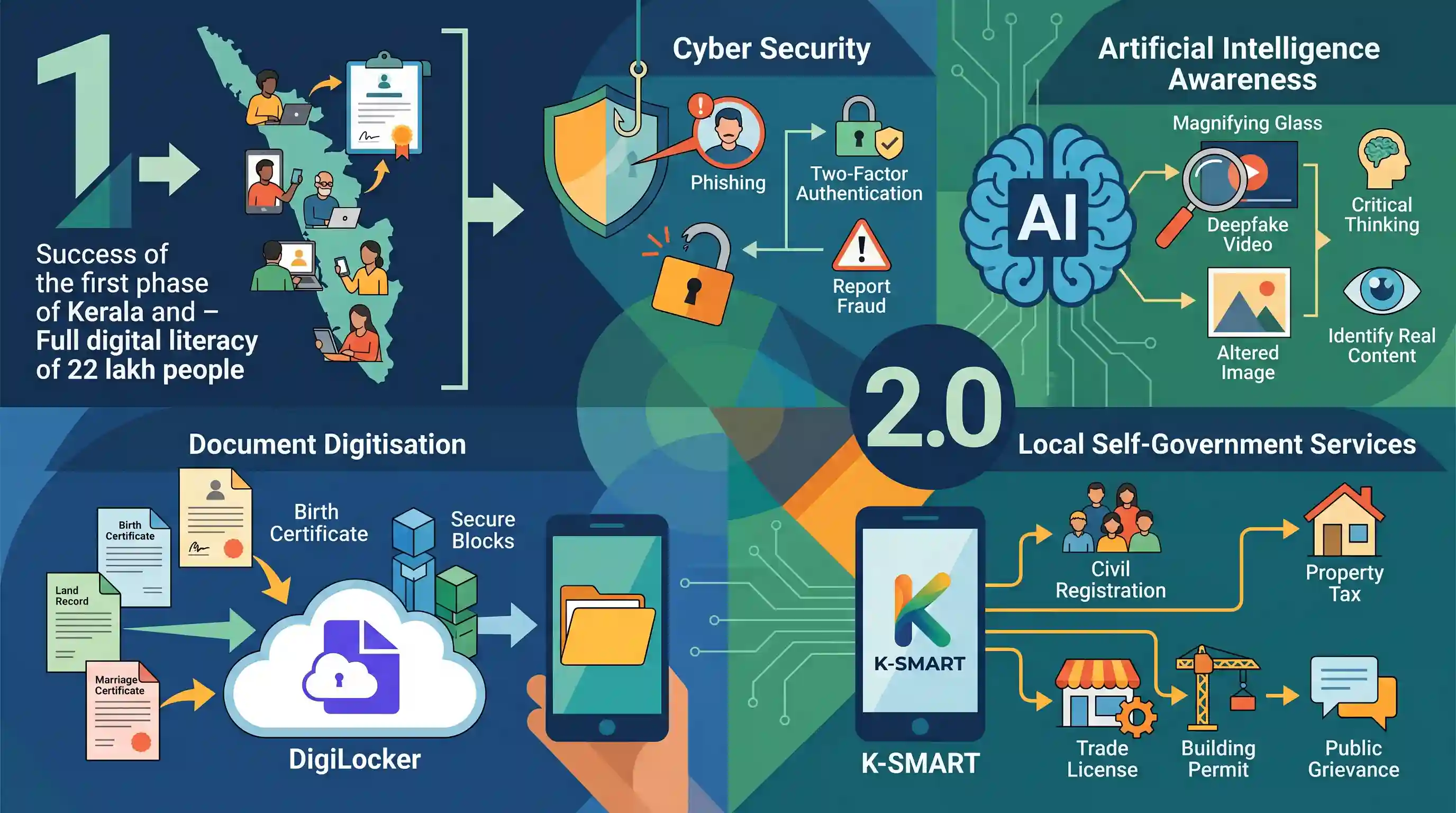
The Kerala government is set to launch 'Digi Kerala 2.0', the second phase of its digital literacy campaign. Having achieved full digital literacy in its first phase by training nearly 22 lakh people, the state is now focusing on advanced digital empowerment. The new phase will impart training on cyber security to combat rising cyber frauds and artificial intelligence (AI) awareness to help citizens identify fake content. Additionally, it will educate people on using DigiLocker for document digitisation and the K-SMART app, which provides uniform digital access to local self-government services.
Key Points
- The Kerala government is launching "Digi Kerala 2.0," the second phase of its digital literacy programme, shifting focus from basic smartphone usage to cyber security and AI awareness.
- This follows the completion of the first phase in August 2025, which trained 21.87 lakh people and made Kerala the first fully digitally literate State in India.
- The new phase aims to equip citizens against rising cyber frauds and teach them how to identify AI-generated fake content.
- Trainees will learn to use DigiLocker for document digitisation and the K-SMART application to seamlessly access local self-government services.
Important Terms
Digi Kerala 2.0

The second phase of Kerala's digital literacy mission, focusing on advanced skills like Artificial Intelligence (AI) awareness, cyber security (Zero Cyber Crime Kerala), and the universal digitization of essential documents.
UPSC context
GS Paper II (e-governance) and GS Paper III (Cyber Security). Tests knowledge of state-led digital inclusion models.
Digi Kerala
A comprehensive grassroots campaign that trained over 21.87 lakh individuals, enabling Kerala to be declared India’s first fully digitally literate state in August 2025.
UPSC context
GS Paper II (Social Sector-Education) and GS Paper III (Digital Divide). Highlights successful decentralized governance and digital literacy outcomes.
K-SMART
(Kerala Solution for Managing Administrative Reformation and Transformation) A unified digital platform providing paperless, uniform access to services from all local self-government institutions in Kerala, including permits and registrations.
UPSC context
GS Paper II (Devolution of powers to local bodies/PRIs and e-governance). Tests understanding of digital service delivery at the grassroots level.
DigiLocker
A flagship Digital India initiative by MeitY that provides citizens with a secure cloud-based platform for the storage, sharing, and verification of authentic digital documents and certificates.
UPSC context
GS Paper II and III (Digital India). Crucial for questions on paperless governance, Digital Public Infrastructure (DPI), and administrative efficiency.
Kerala State IT Mission (KSITM)
The autonomous nodal agency under Kerala's Department of Electronics and Information Technology responsible for the implementation of e-governance projects and ICT infrastructure development in the state.
UPSC context
GS Paper II (Role of institutional frameworks in e-governance). Relevant for studying state-specific implementing agencies in digital transformation.
DEED (Digitalization of Every Essential Document)
An ambitious project under Digi Kerala 2.0 aimed at creating a comprehensive digital database of essential documents (birth/land records) for all citizens, integrated with DigiLocker and unique K-SMART IDs.
UPSC context
GS Paper II (Citizen Centric Administration). Focuses on transparency, reducing corruption, and innovative data-centric governance.
Prelims Trap
"Digi Kerala 2.0 aims to impart basic smartphone training to make Kerala fully digitally literate."
Kerala already achieved 100% basic digital literacy in Phase 1 (August 2025). Phase 2 (Digi Kerala 2.0) focuses on advanced empowerment like AI awareness and cybersecurity.
Static Concepts Connected
What is the legal status of documents issued in DigiLocker?
- IT Act 2000: Provides foundational legal recognition to electronic records and digital signatures in India.
- IT Rules 2016: Under Rule 9A, authentic digital documents in DigiLocker are legally treated at par with original physical documents.
- MeitY Initiative: It is a flagship cloud-based platform by MeitY, requiring Aadhaar linkage for verifying and hosting authentic citizen documents.
How do unified e-governance platforms transform Local Self-Governments (PRIs)?
- Centralised Access: Overcomes fragmented departmental silos by providing a single digital window for three-tier local bodies (like K-SMART).
- Emerging Tech: Integrates GIS for spatial planning and Blockchain for tamper-proof records (e.g., building permits and civil registries).
- Service Delivery: Enhances transparency, reduces bureaucratic delays, and minimises rent-seeking in grass-root level public administration.
Cross-Topic Patterns
Digital Literacy vs. Deepfakes
As basic smartphone penetration peaks, the e-governance challenge shifts from solving the digital divide (access) to ensuring cyber safety against AI-generated deepfakes and financial frauds.
Blockchain in Local Governance
Integrating Blockchain, GIS, and IoT in municipal apps like K-SMART represents a qualitative leap in implementing the 73rd/74th Constitutional Amendments via decentralised data governance.

Expect a multi-statement question interlinking DigiLocker's legal parity under IT Rules with state-led AI/cyber literacy programs in 2026.
Linked PYQs · 5
Linked PYQs · 5
- 2024MainsGS2
e-governance is not just about the routine application of digital technology in service delivery process. It is as much about multifarious interactions for ensuring transparency and accountability. In this context evaluate the role of the 'Interactive Service Model' of e-governance.
- 2023MainsGS2
e-governance, as a critical tool of governance, has ushered in effectiveness, transparency and accountability in governments. What inadequacies hamper the enhancement of these features ?
- 2020MainsGS3
Discuss different types of cyber crimes and measures required to be taken to fight the menace.
- 2022MainsGS2
To what extent, in your opinion, has the decentralisation of power in India changed the governance landscape at the grassroots?
- 2024MainsGS2
Analyse the role of local bodies in providing good governance at local level and bring out the pros and cons merging the rural local bodies with the urban local bodies.
