Kerala Human Wildlife Conflict Mitigation and AI Surveillance
Source:The Hindu ↗
Why It Matters
Human-wildlife conflict is a recurring theme in UPSC Mains GS3 (Environment) and Prelims. Mitigation strategies such as habitat enrichment, technological interventions (AI, early warning systems), and innovative biological deterrents (like mimicking bee sounds, conceptually linked to Project RE-HAB) are vital case studies for answers on biodiversity conservation and sustainable co-existence.
Summary
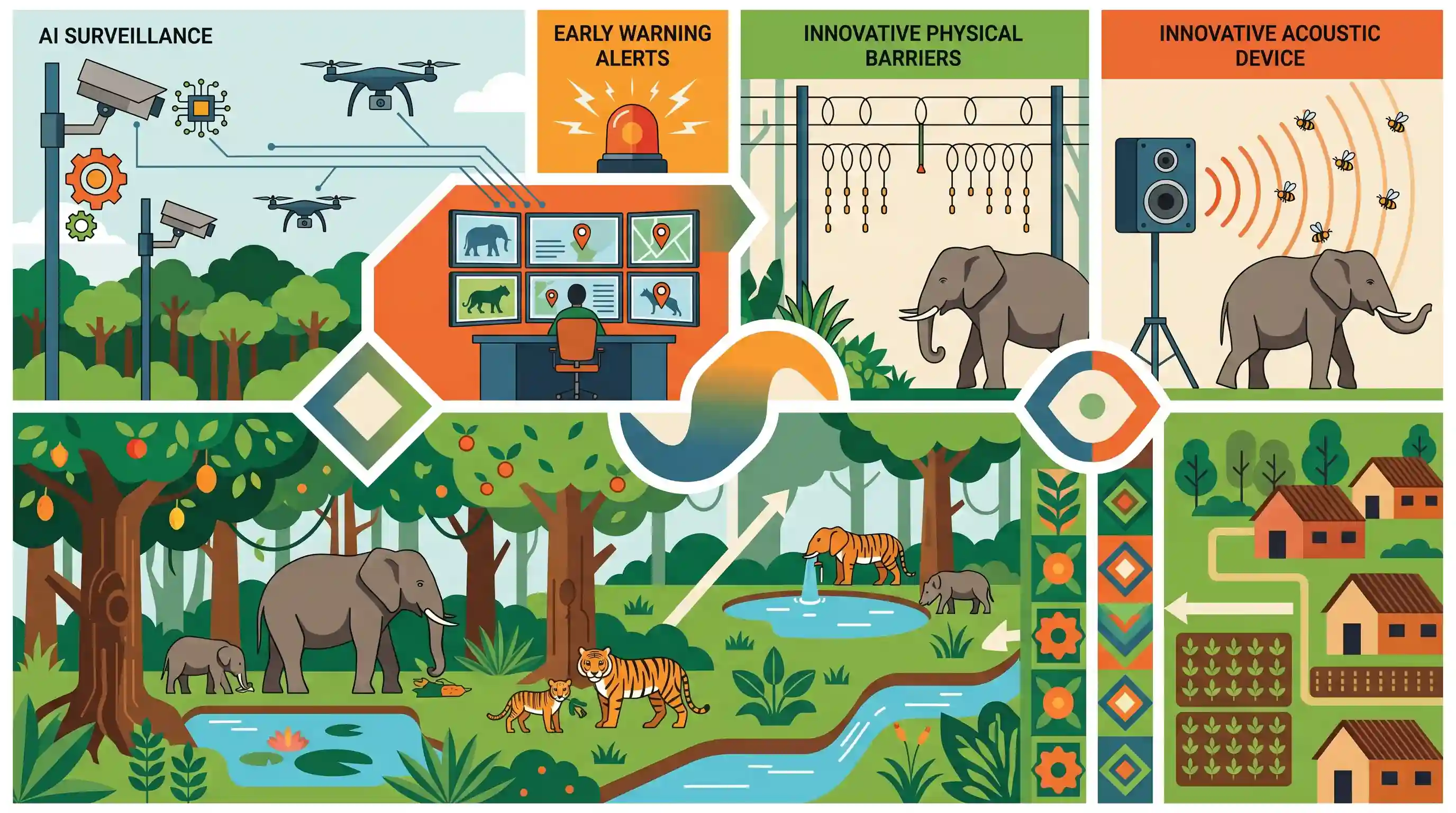
The Kerala government is planning a comprehensive, multi-layered strategy to address escalating human-wildlife conflicts. Forest Minister Shibu Baby John highlighted that the approach will combine advanced technology, such as AI-based surveillance and early-warning tools, with physical barriers like hanging fences. Recognizing that elephants and other wildlife adapt to traditional deterrents, the state will implement innovative measures, including acoustic devices that mimic the buzzing of bees—a natural deterrent for elephants. Additionally, long-term mitigation efforts will focus on habitat enrichment to ensure adequate food and water availability inside forests, thereby reducing the necessity for wild animals to encroach on human settlements.
Key Points
- The Kerala government is introducing a multi-layer defence system to mitigate human-wildlife conflict in high-risk areas.
- The strategy integrates AI-based surveillance, early-warning systems, hanging fences, and robust physical barriers.
- A core focus is on habitat enrichment, aiming to improve food and water availability within forest boundaries to prevent animals from venturing into human settlements.
- Innovative deterrents will be deployed, such as devices emitting the buzzing sound of bees to repel elephants by exploiting their natural fear of bee swarms.
Important Terms
Human-Wildlife Conflict (HWC)

Negative interactions between humans and wild animals resulting in loss of life, crop damage, or retaliatory killing of wildlife.
UPSC context
GS Paper III: Environment & Biodiversity; tests understanding of conservation-development trade-offs and mitigation policies.
Hanging Power Fence
A non-lethal physical barrier where electric wires are suspended from 15-20ft pillars, allowing smaller animals to pass beneath while deterring elephants from breaking through.
UPSC context
GS Paper III: Technology/Infrastructure in Conservation; relevant for innovative mitigation of elephant-human conflict.
Habitat Enrichment
The process of improving forest quality—such as increasing food plants and water sources—to ensure wildlife remain within their natural habitats rather than encroaching on settlements.
UPSC context
GS Paper III: Ecosystem Restoration; tests long-term, non-structural solutions for biodiversity management.
Early Warning System (EWS)
Integrated technological systems (sensors, AI, SMS) designed to detect wildlife movement near human settlements and provide real-time alerts to prevent encounters.
UPSC context
GS Paper III: Disaster Management/Science & Tech; focuses on tech-led preventive measures for public safety.
Project RE-HAB
An initiative using honey bee colonies or acoustic deterrents to create a natural barrier against elephants, exploiting their innate fear of bees.
UPSC context
GS Paper III: Environment/Science; specifically tests innovative, eco-friendly, and cost-effective conflict resolution models.
Prelims Trap
Project RE-HAB and 'Plan Bee' are core conservation schemes launched directly by the Ministry of Environment, Forest and Climate Change (MoEFCC).
Project RE-HAB is an initiative of the Khadi and Village Industries Commission (KVIC) under the Ministry of MSME, not the MoEFCC.
Static Concepts Connected
How do Project RE-HAB and Plan Bee mitigate human-elephant conflict?
- Project RE-HAB: Uses bee boxes as 'bio-fences' to thwart elephant attacks. It is implemented by the Khadi and Village Industries Commission (KVIC).
- Plan Bee: Uses devices playing amplified buzzing sounds of honey bees to keep elephants away from railway tracks. Initiated by the Northeast Frontier Railway.
- Non-Lethal Mechanism: Both exploit the elephant's natural fear of bee stings to their sensitive trunks and eyes, achieving deterrence without using lethal force.
How is 'vermin' categorized under the amended Wild Life (Protection) Act?
- Schedule Reduction: The 2022 Amendment reduced schedules from 6 to 4, effectively eliminating the dedicated 'Vermin' Schedule (formerly Schedule V).
- Central Government Power: The Central Government retains the power to declare specific animals as vermin for a specified area and period, bypassing standard hunting restrictions.
- HWC Mitigation Option: When declared vermin, animals causing unmitigated conflict (like wild boars in some states) can be legally culled to prevent extensive agricultural damage.
Cross-Topic Patterns
HWC + Invasive Alien Species
Invasive flora like Lantana camara and Senna spectabilis destroy native fodder in the Western Ghats. This forces herbivores into human settlements, escalating human-wildlife conflict and necessitating habitat enrichment.
AI and Technology in Forest Governance
Kerala's AI surveillance mirrors broader tech adoption in conservation, such as M-STrIPES for tiger monitoring, TrailGuard AI, and IoT sensors for forest fire early warnings.

Expect a multi-statement question on bio-fencing, linking Project RE-HAB, KVIC's mandate, and the WPA 2022 amendments regarding vermin.
Linked PYQs · 2
Linked PYQs · 2
- 2023PrelimsGS1
Which of the following organisms perform waggle dance for others of their kin to indicate the direction and the distance to a source of their food?
- 2023MainsGS3
Introduce the concept of Artificial Intelligence (AI). How does Al help clinical diagnosis? Do you perceive any threat to privacy of the individual in the use of Al in healthcare?
