Kerala Decentralised Strategy for Human Wildlife Conflict
Source:The Hindu ↗
Why It Matters
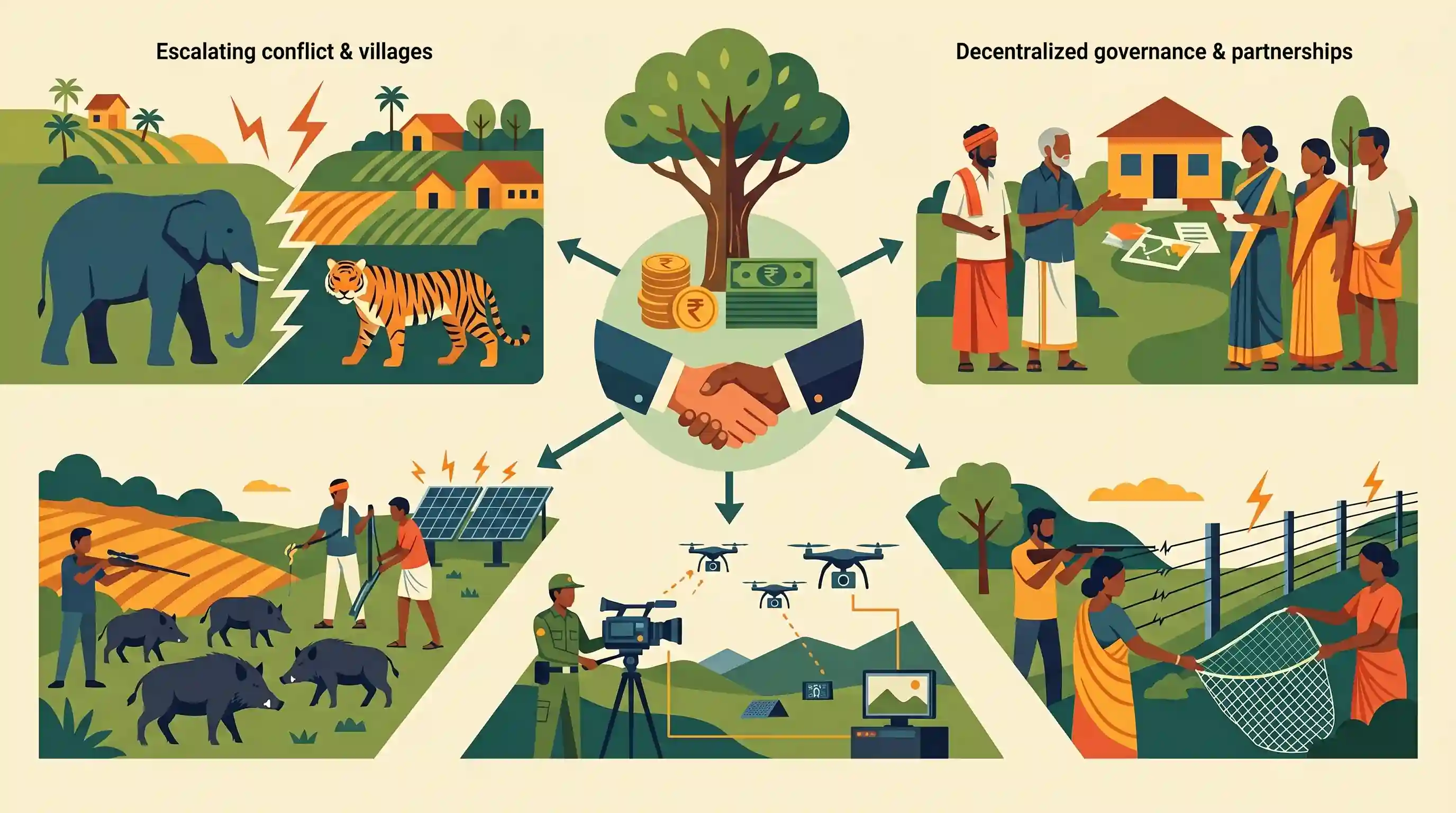
Provides a successful case study of decentralization in environmental governance. The transfer of responsibility for managing vermin (wild boars) and infrastructure maintenance (solar fences) to Panchayati Raj Institutions illustrates collaborative community-based conservation strategies.
Summary
The Kerala government is implementing a decentralized strategy to address escalating human-wildlife conflict by partnering with farmers and local self-government institutions. The Forest Department will involve local bodies in maintaining mitigation infrastructure, such as solar fences, supported by an allocation of Rs 192 crore in the State Budget. The strategy also includes modernizing Rapid Response Teams (RRTs) with drones and surveillance tools, alongside a targeted drive to control the wild boar population by empowering local bodies with trained shooters.
Key Points
- The Kerala government is shifting towards a collaborative approach to manage human-wildlife conflict by involving farmers and local self-government institutions.
- Local communities will be entrusted with monitoring and maintaining mitigation infrastructure, including nearly 2,000 km of solar fencing.
- A sum of Rs 192 crore has been earmarked in the revised State Budget for conflict mitigation measures.
- The state is strengthening its Rapid Response Teams (RRTs) with modern equipment such as drones and surveillance technology.
- A special drive has resulted in the culling of 225 wild boars since June 15, with trained shooters redeployed to local bodies to control the population.
Important Terms
Wildlife (Protection) Act, 1972

India's primary legislation for protecting wild species and their habitats. It establishes schedules of protection and the legal framework for National Parks and Sanctuaries.
UPSC context
GS Paper III (Environment). Essential for legal conservation frameworks and species protection schedules.
Human-Wildlife Conflict
Negative interactions between humans and wildlife resulting from overlapping requirements, causing damage to property, livelihoods, or lives and threatening species conservation.
UPSC context
GS Paper III (Environment). A core conservation challenge testing mitigation and management strategies.
Rapid Response Teams (RRTs)
Specialized Forest Department units trained for immediate intervention in wildlife emergencies, such as animal straying, using surveillance tools and modern equipment for mitigation.
UPSC context
GS Paper III (Security/Environment). Relevant for administrative disaster response and frontline conflict management.
Local Self-Government Institutions (LSGIs)
Grassroots governing bodies (Panchayats/Municipalities) empowered under the 73rd and 74th Amendments, now being integrated into wildlife management and local conflict resolution.
UPSC context
GS Paper II (Governance). Tests decentralization and community-led solutions for environmental governance.
Solar Fencing
A non-lethal electrified barrier that deters animals via safe, high-voltage shocks; it is a primary infrastructural tool for crop and settlement protection.
UPSC context
GS Paper III (Environment/Tech). Key mitigation infrastructure for human-wildlife coexistence.
Vermin
Any wild animal in Schedule II of the WPA 1972 that the Centre declares unprotected for a specific area/period to allow controlled culling.
UPSC context
GS Paper III (Environment). Critical for species management debates and Section 62 legalities.
Prelims Trap
State Governments hold the exclusive power to declare wild animals like the wild boar as 'vermin' to permit culling.
Under Section 62 of the WPA 1972, only the Central Government declares vermin. States merely authorize specific culling via the Chief Wildlife Warden (Section 11).
Static Concepts Connected
How is the culling of wild animals regulated under the Wildlife (Protection) Act?
- Central Power (Sec 62): Only the Central Government can notify a species (excluding Schedule I) as vermin for a specific area and period.
- State Power (Sec 11): The Chief Wildlife Warden can authorize the hunting of specific animals if they pose a direct, immediate threat to human life or property.
- 2022 Amendment: Reduced schedules to four and eliminated the distinct 'Schedule V' (vermin), streamlining how species are legally stripped of protection.
What role do local self-governments play in grassroots environmental governance?
- Subsidiarity Principle: Decentralizing the maintenance of infrastructure (like solar fences) prevents top-down failure by instilling community ownership and ensuring rapid local repair.
- Statutory BMCs: Under the Biological Diversity Act 2002, local bodies constitute Biodiversity Management Committees (BMCs) to prepare People's Biodiversity Registers.
- Constitutional Mandate: The 11th Schedule of the Constitution empowers Panchayats to manage social forestry, minor forest produce, and local ecological infrastructure.
Cross-Topic Patterns
HWC as a State-Specific Disaster
By declaring human-wildlife conflict a state-specific disaster, states can unlock State Disaster Response Fund (SDRF) mechanisms to rapidly finance mitigation infrastructure and victim relief.
Tech integration in forest surveillance
The integration of drones by Rapid Response Teams links GS3 biodiversity conservation with technology modules, highlighting the growing overlap between conservation and electronic surveillance.

Expect a 2026 prelims question contrasting the Centre's power to declare 'vermin' against the State's power to cull under the WPA 1972.
Linked PYQs · 3
Linked PYQs · 3
- 2024PrelimsGS1
Consider the following statements : Statement-I: The Indian Flying Fox is placed under the "vermin" category in the Wild Life (Protection) Act, 1972. Statement-II : The Indian Flying Fox feeds on the blood of other animals. Which one of the following is correct in respect of the above statements ?
- 2022PrelimsGS1
With reference to Indian laws about wildlife protection, consider the following statements : 1. Wild animals are the sole property of the government. 2. When a wild animal is declared protected, such animal is entitled for equal protection whether it is found in protected areas or outside. 3. Apprehension of a protected wild animal becoming a danger to human life is sufficient ground for its capture or killing. Which of the statements given above is/are correct?
- 2024MainsGS2
Analyse the role of local bodies in providing good governance at local level and bring out the pros and cons merging the rural local bodies with the urban local bodies.
