Kerala Coastal Black Sand Mining Audit and Ecological Concerns
Source:The Hindu ↗
Why It Matters
This issue is highly relevant as beach sand mining intersects critical UPSC topics: energy security (thorium/monazite extraction), economic geography of strategic minerals (ilmenite/rutile), disaster management (coastal erosion, ecological conservation of below-sea-level farming systems like Kuttanad), and local resource governance.
Summary
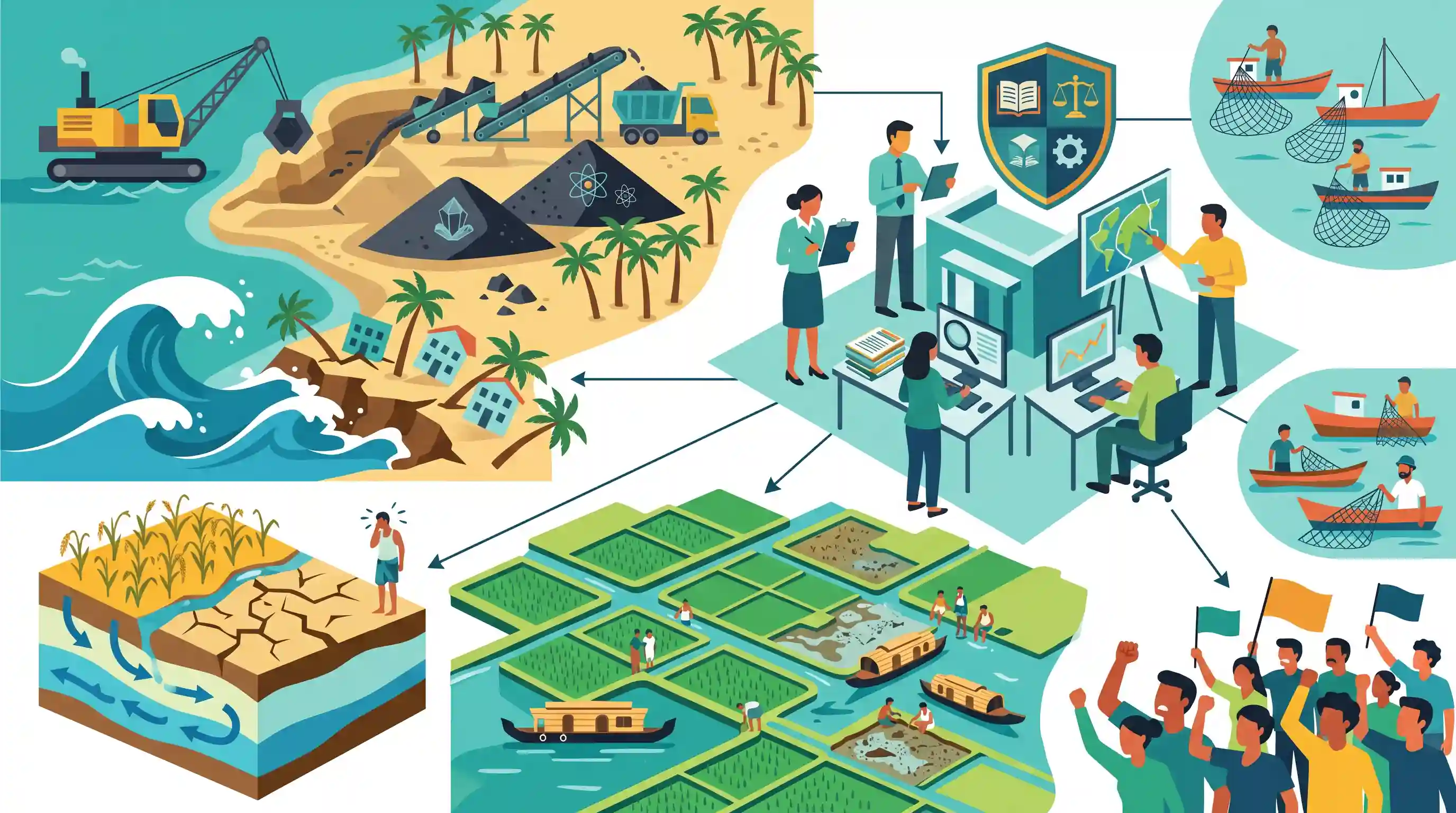
The Kerala Government is set to establish an expert committee to audit coastal black sand (mineral sand) mining. Driven by intense local protests and environmental hazards in regions like Thottappally and Kuttanad, the audit will evaluate the ecological damage (including coastal erosion and saltwater intrusion in paddy fields), livelihood impacts on the local fishing community, and resource extraction volumes by public sector undertakings like IREL and KMML.
Key Points
- The Kerala Government has decided to constitute an expert committee to audit black sand (mineral sand) mining along the state's coast, especially focusing on Thottappally in Alappuzha and Upper Kuttanad.
- The decision comes in response to local protests highlighting the severe ecological, social, and economic damage caused by dredging and sand mining carried out by public sector undertakings like IREL and KMML.
- Major environmental concerns raised include rapid coastal erosion, destruction of coastal dwellings, livelihood loss for fishermen, and the threat of saltwater intrusion into the low-lying paddy fields of Kuttanad (famous for below-sea-level farming).
- Activists also pointed out that local Grama Panchayats do not receive any share of the profits or royalties generated from black sand extraction, despite bearing the ecological brunt.
- The proposed audit will scientifically assess the quantum of available mineral sand resources and the precise environmental and livelihood impacts of mining activities to guide future policy.
Important Terms
IREL (India) Limited

A Central Public Sector Undertaking (CPSE) under the Department of Atomic Energy (DAE) engaged in mining, processing, and refining atomic minerals, rare earths, and monazite beach sands.
UPSC context
GS Paper III (Energy and Nuclear Power); tests knowledge of strategic mineral regulations and state monopolies in processing critical radioactive resources.
Kerala Minerals and Metals Limited (KMML)
A Kerala government-owned public sector undertaking specializing in mining heavy mineral sands and processing titanium dioxide, operating the world's first fully integrated titanium dioxide facility.
UPSC context
GS Paper III (Industrial Policy and Resources); tests knowledge of state-level PSUs and strategic heavy metal processing industries.
Monazite
A reddish-brown phosphate mineral rich in rare earth elements and thorium. Found in Indian coastal sands, it is a "prescribed substance" regulated under the Atomic Energy Act, 1962.
UPSC context
GS Paper I (Mineral Distribution) and GS Paper III (Nuclear Energy); tests understanding of nuclear fuel cycle and critical resource governance.
Kuttanad Wetland Agriculture System
A unique agricultural region in Kerala famous for below-sea-level paddy farming, recognized as a Globally Important Agricultural Heritage System (GIAHS) by the FAO.
UPSC context
GS Paper I (Geography) and GS Paper III (Agriculture & Environment); tests sustainable farming models and climate adaptation in fragile ecosystems.
Thottappally Spillway
A major flood-control structure in Alappuzha, Kerala, designed to drain floodwaters. It is controversial due to heavy mineral sand dredging conducted under the guise of desiltation.
UPSC context
GS Paper III (Disaster Management and Environment); tests the balance between emergency flood mitigation measures and ecological protection.
Prelims Trap
Monazite sands are uniformly distributed across the entire Indian coastline, and private companies can freely mine them.
Monazite is concentrated only in specific states like Kerala, TN, and Odisha. Under the Atomic Energy Act, 1962, monazite mining is strictly restricted to government entities.
Static Concepts Connected
What are Heavy Mineral Sands and how is Monazite regulated in India?
- Composition: Group of seven minerals: ilmenite, rutile, leucoxene, monazite, zircon, sillimanite, and garnet, vital for industrial and nuclear sectors.
- Regulatory Regime: Classified as a 'prescribed substance' under the Atomic Energy Act, 1962, restricting mining and processing strictly to state-authorized public sector undertakings.
What is the Kuttanad Wetland Agricultural System and its global status?
- Unique Farming: Practices below-sea-level paddy cultivation (1.2 to 3 meters below sea level) using traditional bio-bunds in Kerala.
- Global Recognition: Designated as a Globally Important Agricultural Heritage System (GIAHS) by the FAO, highlighting indigenous climate-resilient farming.
Cross-Topic Patterns
Nuclear transition vs Coastal protection
India's thorium-based nuclear security relies on coastal monazite extraction, directly pitting national clean energy goals against local coastal ecosystems and fishing livelihoods.
GIAHS conservation vs Resource extraction
Below-sea-level farming in Kuttanad demonstrates indigenous climate resilience, but is highly vulnerable to salinity intrusion accelerated by coastal dredging and sand mining.

Expect a 2026 Prelims question mapping beach sand mineral regulations (Monazite/Thorium) with the ecological vulnerabilities of Kuttanad.
Linked PYQs · 4
Linked PYQs · 4
- 2019MainsGS3
Coastal sand mining, whether legal or illegal, poses one of the biggest threats to our environment. Analyze the impact of sand mining along the Indian coasts, citing specific examples.
- 2022PrelimsGS1
With reference to India, consider the following statements: 1. Monazite is a source of rare earths. 2. Monazite contains thorium. 3. Monazite occurs naturally in the entire Indian coastal sands in India. 4. In India, Government bodies only can process or export monazite. Which of the statements given above are correct?
- 2023PrelimsGS1
Ilmenite and rutile, abundantly available in certain coastal tracts of India, are rich sources of which one of the following?
- 2022MainsGS3
Explain the causes and effects of coastal erosion in India. What are the available coastal management techniques for combating the hazard?
