Kerala Joins PM SHRI Scheme Despite Internal Left Opposition
Source:The Hindu ↗
Why It Matters
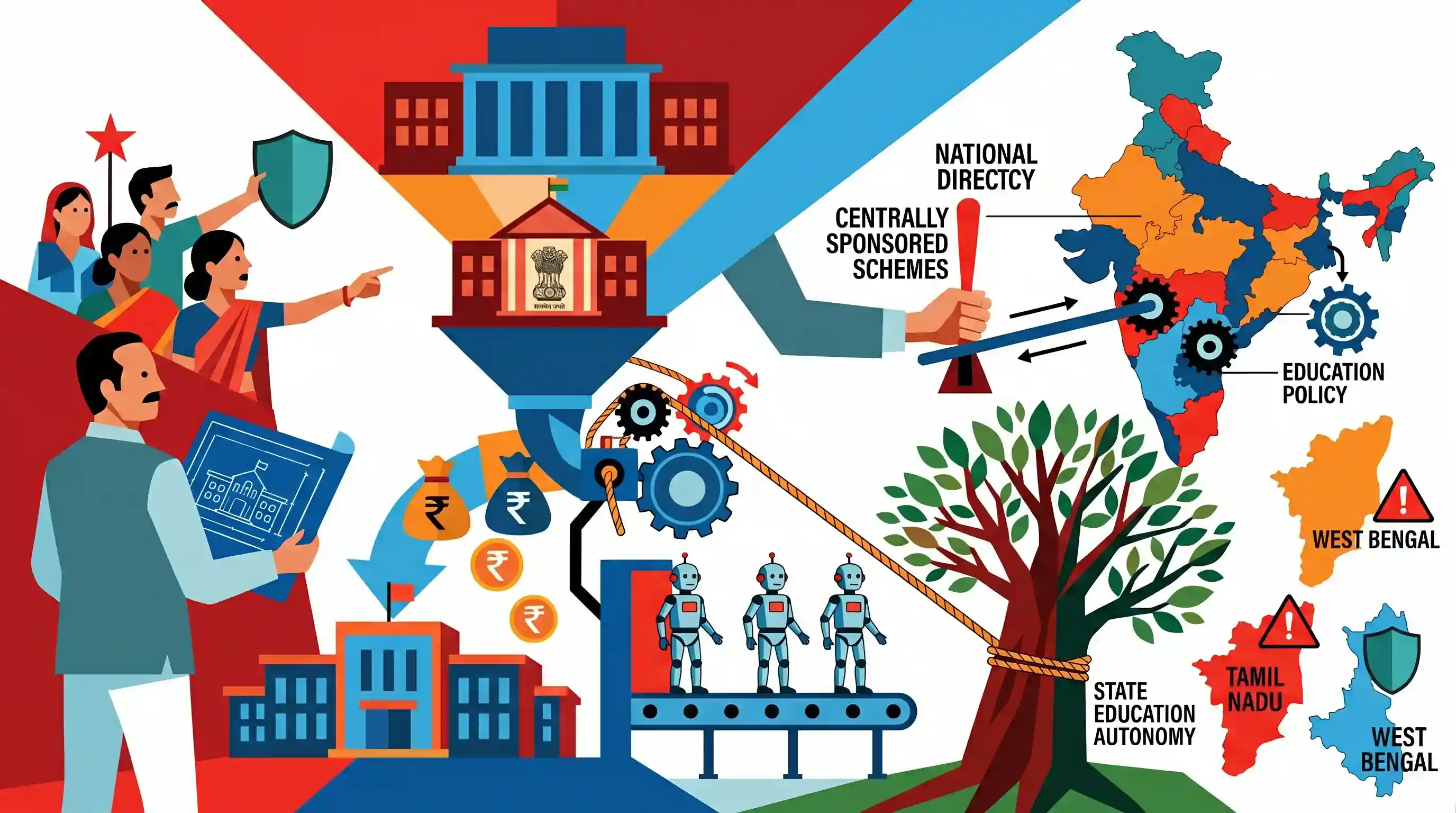
This article underscores a core GS2 theme: the friction between the Centre and States regarding Centrally Sponsored Schemes (CSS) and policy centralization. It serves as an excellent case study of how federal tensions manifest in social sectors like education, where States often resist national templates like the NEP in favor of maintaining regional autonomy and diversity.
Summary
The Kerala government's decision to enroll in the PM SHRI scheme to secure ₹1,446 crore for school modernization has triggered internal opposition within the ruling Left Democratic Front (LDF). The Communist Party of India (CPI) criticized the move, arguing that the scheme is a backdoor method to force states to adopt the "anti-federal" National Education Policy (NEP) 2020. The CPI maintains that the NEP undermines India's educational diversity by imposing a "one-size-fits-all" model, thereby eroding state autonomy. The debate highlights recurring tension in Centre-State relations, where Centrally Sponsored Schemes are leveraged to drive national policies, an issue similarly contested by other opposition-ruled states like Tamil Nadu and West Bengal.
Key Points
- The Kerala government (LDF) signed up for the PM SHRI scheme to secure ₹1,446 crore in Union funds for school modernization.
- The Communist Party of India (CPI), a key LDF ally, strongly opposed the move, labeling it a violation of coalition ethics.
- The CPI argues that PM SHRI enforces adherence to the National Education Policy (NEP), which it views as an "anti-federal" framework imposing a centralized, "one-size-fits-all" teaching template.
- The dispute highlights broader tensions over Centrally Sponsored Schemes, with other non-BJP-ruled states like Tamil Nadu and West Bengal also resisting the tying of funds to NEP adoption.
Important Terms
PM SHRI (Pradhan Mantri Schools for Rising India)

A Centrally Sponsored Scheme to upgrade 14,500 schools into 'exemplar' institutions showcasing the National Education Policy (NEP) 2020. It involves a 60:40 funding ratio between the Union and most States.
UPSC context
GS Paper II: Government policies and interventions; crucial for questions on education reforms and model school frameworks.
National Education Policy (NEP) 2020
A comprehensive framework for school and higher education aiming to transform India into a global knowledge superpower. It introduces a 5+3+3+4 structure, emphasizing holistic, multidisciplinary, and vocational learning.
UPSC context
GS Paper II: Social Justice/Education; tests understanding of systemic reforms and challenges in federal policy adoption.
Centrally Sponsored Schemes (CSS)
Schemes designed by the Union but implemented by States, with costs shared between them (typically 60:40). They focus on subjects in the State or Concurrent lists to achieve national goals.
UPSC context
GS Paper II & III: Fiscal federalism and Centre-State relations; tests knowledge of funding mechanisms and administrative cooperation.
Federalism (Centre-State Relations)
The constitutional distribution of power between the Union and States. In education (Concurrent List), it involves navigating the balance between national standards and the autonomous legislative powers of States.
UPSC context
GS Paper II: Constitutional features; central to discussions on state autonomy and centralizing tendencies in policy-making.
Cooperative Federalism
A administrative philosophy where the Union and States work together to solve common problems and implement national policies through mutual agreement and shared resources, often coordinated by NITI Aayog.
UPSC context
GS Paper II: Governance; tested via the implementation of joint initiatives and the resolution of inter-governmental disputes.
Prelims Trap
"PM SHRI is a Central Sector Scheme 100% funded by the Union Government to enforce NEP 2020."
PM SHRI is a Centrally Sponsored Scheme (60:40 funding ratio for general states), not a Central Sector Scheme. The Centre leverages its 60% share to mandate NEP adoption.
Static Concepts Connected
How does the Centre use Article 282 for Centrally Sponsored Schemes?
- Discretionary grants: Article 282 empowers the Centre (and States) to make grants for any public purpose, even outside their respective legislative competence.
- Tied funding: The Union uses this provision to channel tied funds via Centrally Sponsored Schemes (CSS), requiring states to meet specific policy conditions (like signing NEP MoUs).
- Bypassing Finance Commission: Unlike Article 275 statutory grants, Article 282 grants do not require Finance Commission recommendations, drawing criticism for bypassing fiscal federalism structures.
What is the constitutional status of Education in the Seventh Schedule?
- Original Status: Initially, Education was exclusively placed under the State List (Entry 11, List II).
- 42nd Amendment: The 42nd Constitutional Amendment Act of 1976 transferred Education to the Concurrent List (Entry 25, List III).
- Legislative Parity: While both Parliament and States can legislate on it, Central laws prevail in case of conflict, though implementation largely remains a State responsibility.
Cross-Topic Patterns
CSS conditionalities vs. Fiscal Autonomy
The linking of PM SHRI funds to NEP adoption mirrors ongoing debates on CSS rationalization and the 15th Finance Commission's concerns about tied grants shrinking states' fiscal space.
Concurrent List friction points
The struggle over the NEP implementation mirrors similar Centre-State standoffs in other Concurrent List domains, such as electricity distribution, forest conservation, and the repealed farm laws.

Mains 2026 will likely feature a question on how CSS conditionalities and Article 282 discretionary grants impact cooperative federalism.
Linked PYQs · 4
Linked PYQs · 4
- 2020MainsGS2
National Education Policy 2020 is in conformity with the Sustainable Development Goal-4 (2030). It intends to restructure and reorient education system in India. Critically examine the statement.
- 2024MainsGS2
What changes has the Union Government recently introduced in the domain of Centre-State relations ? Suggest measures to be adopted to build the trust between the Centre and the States and for strengthening federalism.
- 2022MainsGS2
“While the national political parties in India favour centralisation, the regional parties are in favour of State autonomy.” Comment.
- 2025MainsGS2
Examine the evolving pattern of Centre-State financial relations in the context of planned development in India. How far have the recent reforms impacted the fiscal federalism in India?
