Kerala appeals to Supreme Court over High Court stay on public survey
Source:The Hindu ↗
Why It Matters
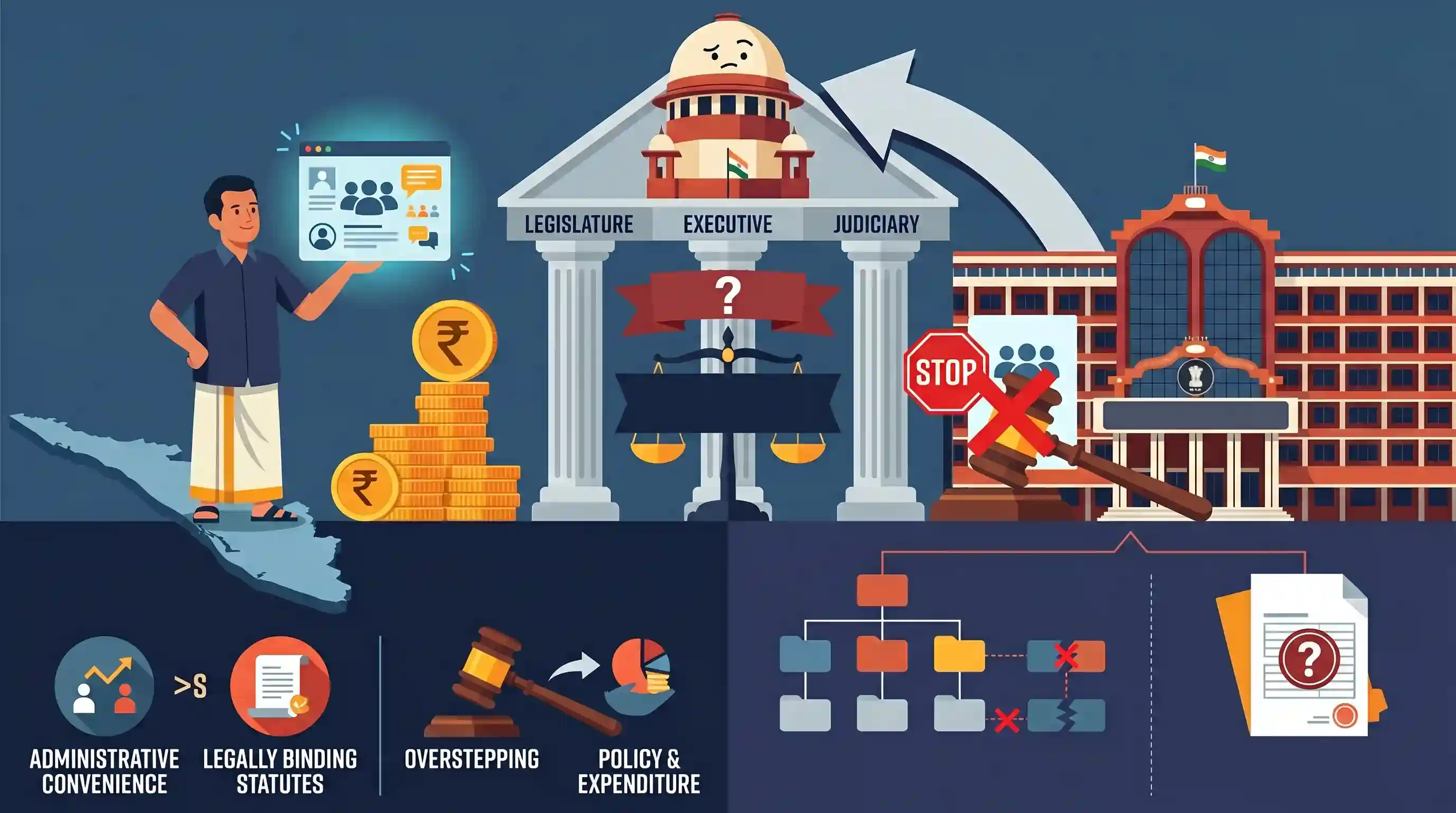
It illustrates the ongoing friction between the judiciary and the executive regarding the extent of judicial review over internal government administrative procedures (Rules of Business) and fiscal policy allocations.
Summary
The Kerala government has approached the Supreme Court to challenge a Kerala High Court decision that halted its 'Nava Keralam Citizen Response Programme'. The High Court stayed the initiative after petitioners alleged that assigning the program to the Information and Public Relations Department violated the state's Rules of Business under Article 166(3) of the Constitution, and that its ₹20 crore budget allocation lacked necessary legislative sanction under Articles 202 to 205. In its appeal, the Kerala government contended that the High Court overstepped its jurisdiction, arguing that internal fiscal guidelines and Rules of Business are purely executive instructions meant for administrative convenience, not legally binding statutes. The State maintains that the court's intervention disturbs the constitutional balance and separation of powers between the executive and the judiciary regarding public policy and expenditure.
Key Points
- The Kerala government filed a special leave petition in the Supreme Court against a High Court order stalling its 'Nava Keralam Citizen Response Programme'.
- The High Court halted the program on the grounds that it violated the Rules of Business under Article 166(3) because it was being handled by the Information and Public Relations Department instead of relevant line departments.
- Petitioners also argued that the ₹20 crore allocation for the program bypassed necessary legislative sanction under Articles 202 to 205, amounting to a diversion of public funds.
- The State government argued that the High Court's action disrupted the separation of powers by judicially reviewing internal executive instructions and fiscal norms that are not legally binding mandates.
Important Terms
Nava Keralam Citizen Response Programme

A Kerala government public outreach and feedback initiative designed to evaluate the impact of welfare schemes and gather development suggestions from the citizenry.
UPSC context
GS Paper II (Government Policies and Interventions for Development in various sectors). Tests knowledge of state-level governance initiatives.
Rules of Business (Article 166(3))
Procedures framed by the Governor under Article 166(3) for the efficient transaction of government business and the allocation of specific duties among ministers and departments.
UPSC context
GS Paper II (Structure, Organization and Functioning of the Executive). Crucial for understanding state administrative law and executive accountability.
Legislative Sanction
The constitutional requirement under Articles 202-205 that no money can be withdrawn from the Consolidated Fund without an Appropriation Act passed by the legislature.
UPSC context
GS Paper II (Public Finance and Parliament/State Legislature). Tests the 'Power of the Purse' and executive fiscal discipline.
Separation of Powers
A constitutional doctrine dividing government responsibilities into three branches—Executive, Legislature, and Judiciary—to prevent the concentration of power and ensure checks and balances.
UPSC context
GS Paper II (Constitutional Provisions). A core 'Basic Structure' concept often tested via judicial-executive conflicts.
Colourable Exercise of Power
A legal principle stating that an authority cannot do indirectly what it is prohibited from doing directly under the guise of an authorized power.
UPSC context
GS Paper II (Judicial Review). Important for understanding limits on executive and legislative authority.
Article 166
The constitutional article governing how a State Government conducts its business, mandating that all executive actions be formally expressed in the name of the Governor.
UPSC context
GS Paper II (Executive Power of the State). Essential for understanding the formal and functional role of the Governor.
Prelims Trap
Rules of Business under Article 166(3) are mandatory, and any deviation automatically invalidates the executive action.
Courts generally hold Rules of Business as directory, meant for administrative convenience. Minor deviations do not automatically render actions unconstitutional unless there is a specific legal violation.
Static Concepts Connected
What are the key constitutional provisions ensuring legislative control over State finances?
- Article 202: Mandates the Governor to lay the Annual Financial Statement (estimated receipts and expenditure) before the State Legislature.
- Article 204: Prohibits withdrawal of any money from the State's Consolidated Fund except under an explicit appropriation made by law.
- Article 205: Requires explicit legislative approval for any supplementary, additional, or excess grants not covered in the original budget.
How does Article 166 regulate the conduct of government business in a State?
- Governor's Name: All executive actions of the State government must be expressed to be taken in the name of the Governor.
- Rules of Business: The Governor makes rules for the convenient transaction of government business and the allocation of such business among Ministers.
Cross-Topic Patterns
Bypassing Legislature via Executive Action
Links to the Mains theme of executive overreach, where governments use administrative instructions or ordinances to implement significant policies and expend funds without rigorous legislative oversight.
Judicial Review vs. Separation of Powers
Connects to ongoing debates on judicial activism. Courts must balance reviewing potential unconstitutional bypasses of public finance norms against interfering in everyday administrative convenience.

Art 166 Rules of Business (mandatory vs directory) and Art 204 Appropriation requirements are prime targets for a 2026 Prelims statement.
Linked PYQs · 3
Linked PYQs · 3
- 2021PrelimsGS1
A legislation which confers on the executive or administrative authority an unguided and uncontrolled discretionary power in the matter of application of law violates which one of the following Articles of the Constitution of India?
- 2020MainsGS2
Judicial Legislation is antithetical to the doctrine of separation of powers as envisaged in the Indian Constitution. In this context justify the filing of large number of public interest petitions praying for issuing guidelines to executive authorities.
- 2025MainsGS2
"Constitutional morality is the fulcrum which acts as an essential check upon the high functionaries and citizens alike...." In view of the above observation of the Supreme Court, explain the concept of constitutional morality and its application to ensure balance between judicial independence and judicial accountability in India.
