Kerala Budget Neglect Highlights Fiscal Federalism Tensions
Source:The Hindu ↗
Why It Matters
The article is highly relevant for UPSC aspirants as it provides a practical case study of friction in Centre-State relations, particularly concerning fiscal federalism, tax devolution by the Finance Commission, and the privatization of strategic mineral resources like rare earths.
Summary
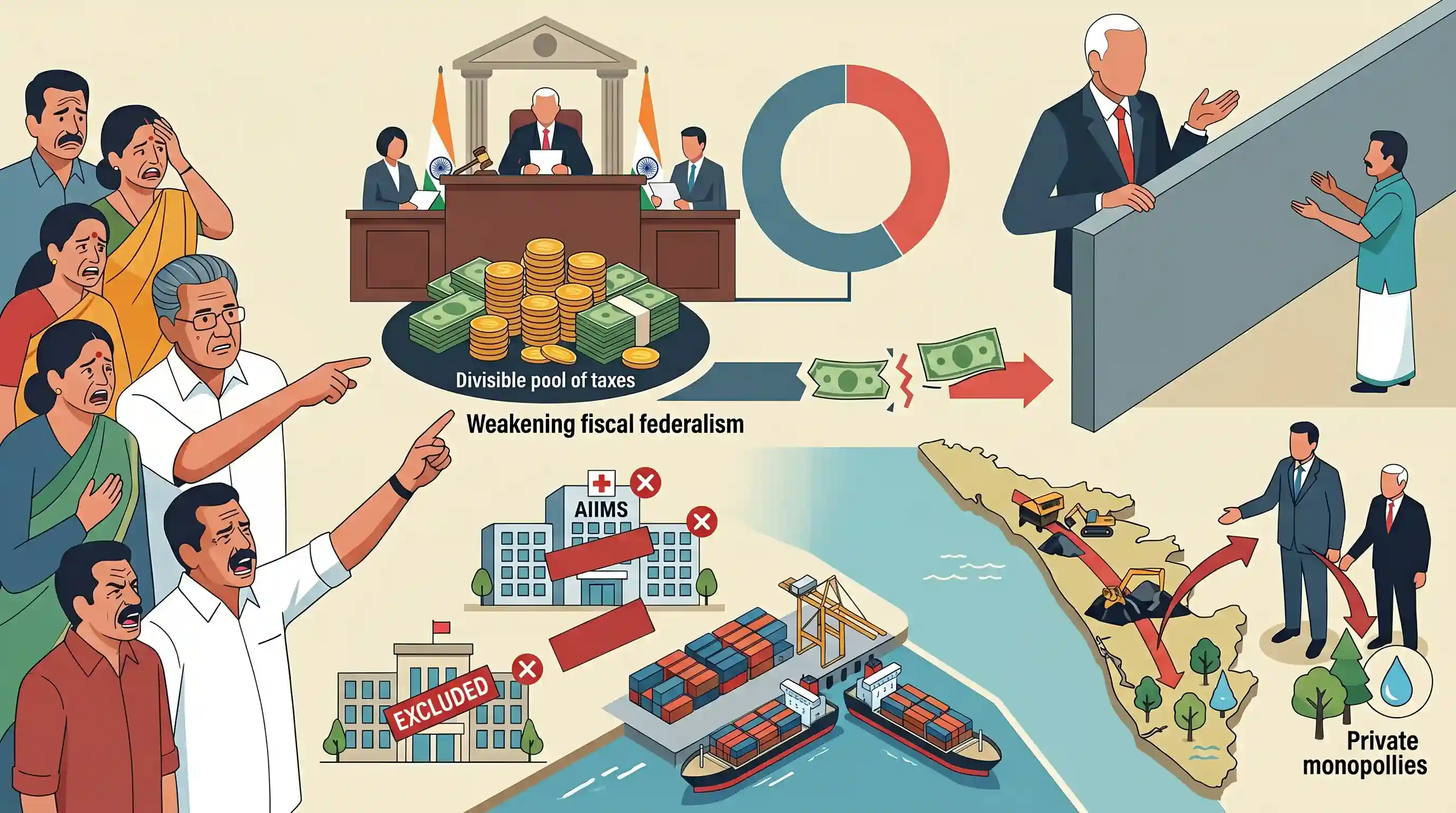
The political leadership of Kerala, barring the BJP, expressed profound disappointment with the Union Budget 2026-27, alleging that the Centre has neglected the state's major infrastructure and health demands, such as an AIIMS and a Vizhinjam port package. The state government specifically criticized the Finance Commission for maintaining the states' share of divisible taxes at 41% and discontinuing revenue deficit grants, moves perceived as weakening India's fiscal federalism. Additionally, the Centre's proposal for a 'rare earth corridor' drew sharp criticism, with the state viewing it as a mechanism to hand over mineral wealth to private monopolies while bypassing environmental safeguards.
Key Points
- Kerala leaders across the political spectrum (excluding the BJP) strongly criticized the Union Budget 2026-27 for allegedly neglecting the state's longstanding demands.
- Key omitted demands include the establishment of an AIIMS, funding for a high-speed rail corridor, and a special financial package for the development of Vizhinjam port.
- Chief Minister Pinarayi Vijayan argued that the Finance Commission's decision to maintain the states' tax devolution share at 41% and discontinue revenue deficit grants severely undermines fiscal federalism.
- The Centre's proposal for a 'rare earth corridor' was condemned as a neoliberal move to transfer Kerala's mineral wealth to private monopolies by bypassing environmental regulations, in contrast to the state's vision of a public-sector corridor.
Important Terms
Finance Commission

A constitutional body (Article 280) appointed every five years to recommend the distribution of tax revenues between the Union and the States.
UPSC context
GS Paper II (Polity/Governance); tests knowledge of vertical and horizontal devolution and constitutional mechanisms for resource sharing.
Fiscal Federalism
The financial relationship and division of taxing powers and spending responsibilities between different levels of government (Union, State, and Local).
UPSC context
GS Paper II & III; tests understanding of Centre-State relations and economic equity in a federal structure.
Rare Earth Corridor
A proposed integrated industrial chain in coastal states to mine, process, and manufacture products from rare earth elements like monazite.
UPSC context
GS Paper I (Resources) & III (Economy/Security); relevant for 'Critical Minerals' and reducing import dependence on China.
Divisible Pool of Taxes
The portion of gross tax revenue shared between the Union and States, excluding specific surcharges and cesses.
UPSC context
GS Paper III (Economy); tests knowledge of tax structures and the impact of cesses/surcharges on state revenues.
Revenue Deficit Grant
Grants-in-aid provided under Article 275 to states to bridge the gap between their projected revenue and essential expenditure.
UPSC context
GS Paper III (Economy); focuses on fiscal health of states and the role of Article 275.
AIIMS (Kerala Demand)
A demand for a premier national-level healthcare and research institute in Kerala, similar to the one in New Delhi.
UPSC context
GS Paper II (Social Justice/Health); highlights regional disparities in health infrastructure and state-specific demands in budgets.
Prelims Trap
All rare earth and atomic minerals found in India can exclusively be mined by public sector enterprises.
The MMDR Amendment Act 2023 removed specific critical minerals from the restricted 'atomic minerals' list, empowering the Centre to auction them to private entities.
Static Concepts Connected
What are Post-Devolution Revenue Deficit (PDRD) Grants?
- Constitutional Basis: Provided under Article 275 of the Constitution as statutory grants from the Consolidated Fund of India to the States.
- Core Purpose: Designed specifically to bridge the assessed gap in a State's revenue accounts after the vertical tax devolution has taken place.
- Recommending Authority: Exclusively recommended by the Finance Commission based on state-specific expenditure needs and revenue assessments.
What makes Monazite strategically significant for India?
- Thorium Source: A major beach sand mineral found heavily on Kerala's coast (e.g., Chavara), serving as India's primary domestic ore for Thorium.
- Rare Earths: Contains high concentrations of critical Rare Earth Elements (REEs) which are essential for manufacturing clean energy components and advanced defense technologies.
- Regulatory Status: Regulated under the Atomic Energy Act, 1962, due to its radioactive properties, keeping its handling under strict government oversight.
Cross-Topic Patterns
Critical minerals & fiscal federalism
The Centre's push to privatize rare earth mining intersects with federal disputes over resource ownership and environmental regulation, echoing past centre-state frictions over coal blocks and offshore mining.
Transshipment hubs & maritime strategy
Funding demands for Vizhinjam port link state-level infrastructure politics directly to India's strategic push to reduce its massive container transshipment dependency on foreign ports like Colombo and Dubai.

Expect a multi-statement question in Prelims 2026 linking MMDR Act amendments with state vs. central jurisdiction over rare earth elements.
Linked PYQs · 5
Linked PYQs · 5
- 2025MainsGS2
Examine the evolving pattern of Centre-State financial relations in the context of planned development in India. How far have the recent reforms impacted the fiscal federalism in India?
- 2021MainsGS2
How have the recommendations of the 14th Finance Commission of India enabled the States to improve their fiscal position?
- 2021MainsGS3
“Investment in infrastructure is essential for more rapid and inclusive economic growth.” Discuss in the light of India's experience.
- 2025PrelimsGS1
Consider the following statements : Statement I: Some rare earth elements are used in the manufacture of flat television screens and computer monitors. Statement II : Some rare earth elements have phosphorescent properties. Which one of the following is correct in respect of the above statements?
- 2012PrelimsGS1
Recently, there has been a concern over the short supply of a group of elements called 'rare earth metals'. Why? 1. China, which is the largest producer of these elements, has imposed some restrictions on their export. 2. Other than China, Australia, Canada and Chile, these elements are not found in any country. 3. Rare earth metals are essential for the manufacture of various kinds of electronic items and there is a growing demand for these elements. Which of the statements given above is/are correct?
