Kerala Final Electoral Roll Revision and Voter List Purification
Source:Indian Express ↗
Why It Matters
The preparation and maintenance of accurate electoral rolls are foundational to India's democratic process. This relates directly to the constitutional mandate of the Election Commission (Article 324) and provisions of the Representation of the People Act, which are key syllabus components in GS2 (Elections, Statutory/Constitutional Bodies, and Governance).
Summary
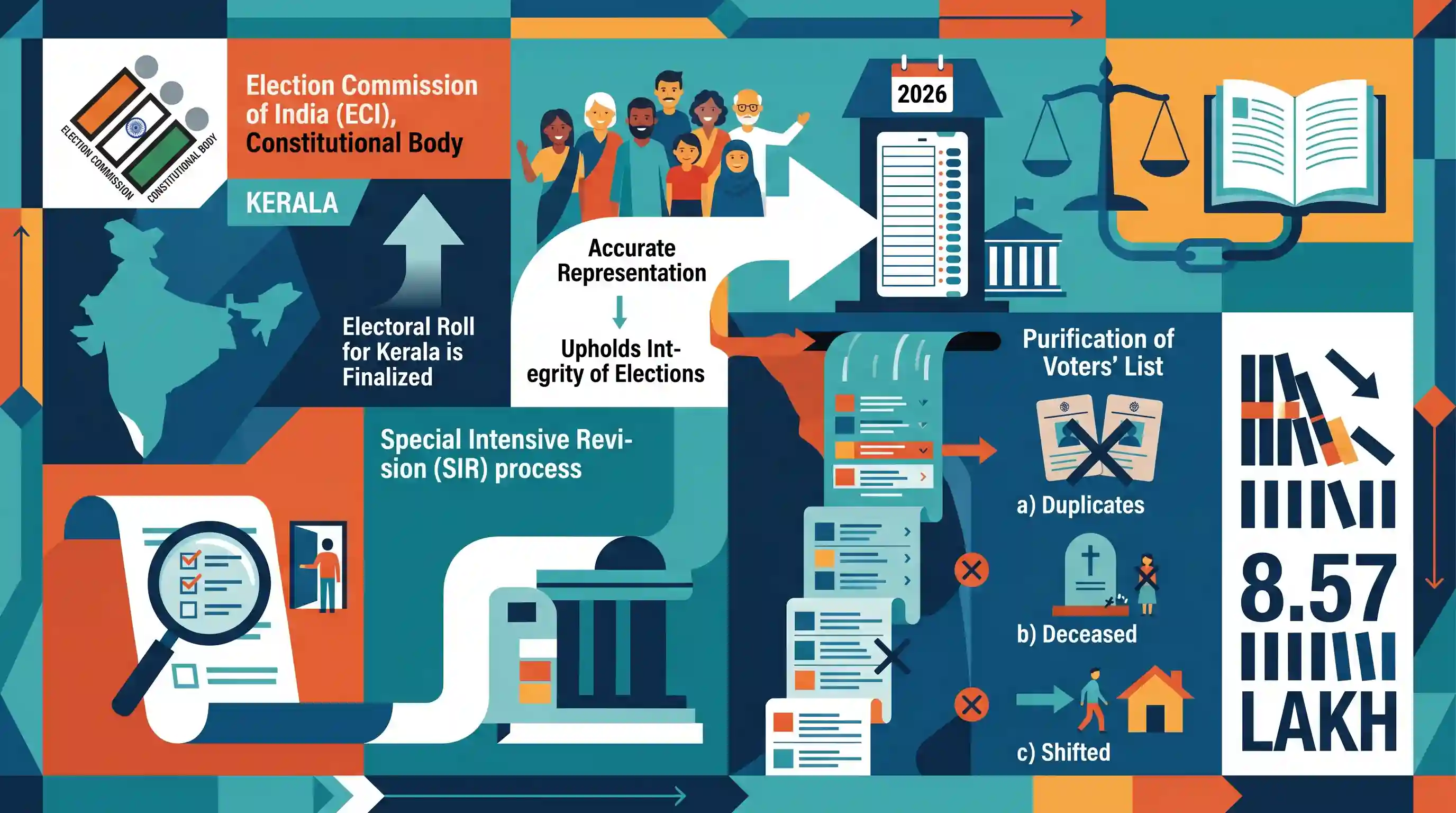
The Election Commission of India has released the final electoral roll for Kerala ahead of the 2026 state assembly elections, following a Special Intensive Revision (SIR) process. The exercise led to the deletion of 8.57 lakh names to purify the voters' list by removing duplicate, deceased, and shifted voters. This routine yet crucial electoral management process ensures accurate representation and upholds the integrity of elections under the Representation of the People Act.
Key Points
- The Election Commission of India (ECI) released the final electoral roll for Kerala ahead of the 2026 assembly elections.
- The list was finalized following a Special Intensive Revision (SIR) process, resulting in the deletion of 8.57 lakh voter entries.
- The SIR process aims to purify electoral rolls by identifying and removing deceased voters, duplicate entries, and individuals who have permanently shifted their residence.
- Maintaining accurate voter lists is a core mandate of the ECI under Article 324 and the Representation of the People Act, 1950, to ensure free and fair elections.
Important Terms
Representation of the People Act, 1950

Act of Parliament focused on the allocation of seats in legislatures, delimitation of constituencies, and the registration/qualification of voters for electoral rolls.
UPSC context
GS Paper 2: Salient features of the RPA; tests understanding of pre-election legal frameworks.
Representation of the People Act, 1951
Legislation regulating the actual conduct of elections, qualifications/disqualifications for membership, corrupt practices, and the machinery for resolving election disputes.
UPSC context
GS Paper 2: Electoral reforms; critical for questions on candidate eligibility and decriminalizing politics.
Election Commission of India (ECI)
An autonomous constitutional body established under Article 324, responsible for the superintendence, direction, and control of Union and State elections.
UPSC context
GS Paper 2: Constitutional bodies; tests powers, functions, and independence of the ECI.
Special Intensive Revision (SIR)
A comprehensive, door-to-door verification and update of voter lists by the ECI, conducted under Section 21(3) of the RPA 1950.
UPSC context
GS Paper 2: Electoral management; tests knowledge of administrative processes ensuring roll integrity.
Electoral Roll
The official register of all eligible citizens entitled to vote in a specific constituency, updated through summary or intensive revisions.
UPSC context
GS Paper 2: Basics of electoral democracy; linked to Articles 325 and 326.
Purification of Electoral Rolls
The administrative process of removing duplicate, deceased, shifted, or ineligible entries from the voter list to ensure accuracy and transparency.
UPSC context
GS Paper 2: Governance and electoral reforms; focuses on maintaining the sanctity of "one person, one vote."
Prelims Trap
Aadhaar linking is mandatory for voter registration to eliminate duplicate entries during Special Intensive Revisions.
Under the Election Laws (Amendment) Act, 2021, linking Aadhaar with voter ID is voluntary. No entry can be deleted solely due to the non-submission of Aadhaar.
Static Concepts Connected
What is the difference between RPA 1950 and RPA 1951?
- RPA 1950: Deals with the preparation and revision of electoral rolls, delimitation of constituencies, and qualification of voters.
- RPA 1951: Governs the actual conduct of elections, qualifications/disqualifications of candidates, corrupt practices, and election disputes.
What are the current qualifying dates for voter enrolment?
- Earlier norm: Previously, January 1 was the sole qualifying date in a calendar year, meaning citizens turning 18 later had to wait until the next year to register.
- New amendment: The Election Laws (Amendment) Act 2021 introduced four qualifying dates: January 1, April 1, July 1, and October 1, to accelerate youth voter enrolment.
Cross-Topic Patterns
ECI autonomy and CEC Act 2023
The purification of electoral rolls underscores ECI's vast powers under Article 324, connecting to recent controversies regarding the executive-dominated selection committee under the CEC and ECs Act, 2023.
Right to Privacy vs Voter ID
Voluntary linking of electoral rolls to Aadhaar touches upon Puttaswamy privacy guidelines, raising concerns over voter profiling and data security akin to targeted PDS authentication issues.

Expect a multi-statement question contrasting RPA 1950 (electoral rolls) vs RPA 1951 (conduct of elections) and recent 2021 amendments.
Linked PYQs · 4
Linked PYQs · 4
- 2017PrelimsGS1
Consider the following statements: 1. The Election Commission of India is a five-member body. 2. Union Ministry of Home Affairs decides the election schedule for the conduct of both general elections and bye-elections. 3. Election Commission resolves the disputes relating to splits/mergers of recognised political parties. Which of the statements given above is/are correct?
- 2024MainsGS2
Examine the need for electoral reforms as suggested by various committees with particular reference to "one nation one election" principle.
- 2020MainsGS2
There is a need for simplification of procedure for disqualification of persons found guilty of corrupt practices under the Representation of Peoples Act". Comment.
- 2022MainsGS2
Discuss the procedures to decide the disputes arising out of the election of a Member of the Parliament or State Legislature under The Representation of the People Act, 1951. What are the grounds on which the election of any returned candidate may be declared void ? What remedy is available to the aggrieved party against the decision ? Refer to the case laws.
