Kerala Declares Coastal Tidal Flooding as State Specific Disaster
Source:The Hindu ↗
Why It Matters
This development is highly relevant for GS-3 (Disaster Management and Environment) as it illustrates a proactive, localized approach to disaster classification under the DM Act, 2005. It highlights the expanding definition of disasters beyond sudden-onset events to include recurring environmental hazards exacerbated by climate change and human activities (like coastal erosion and tidal flooding).
Summary
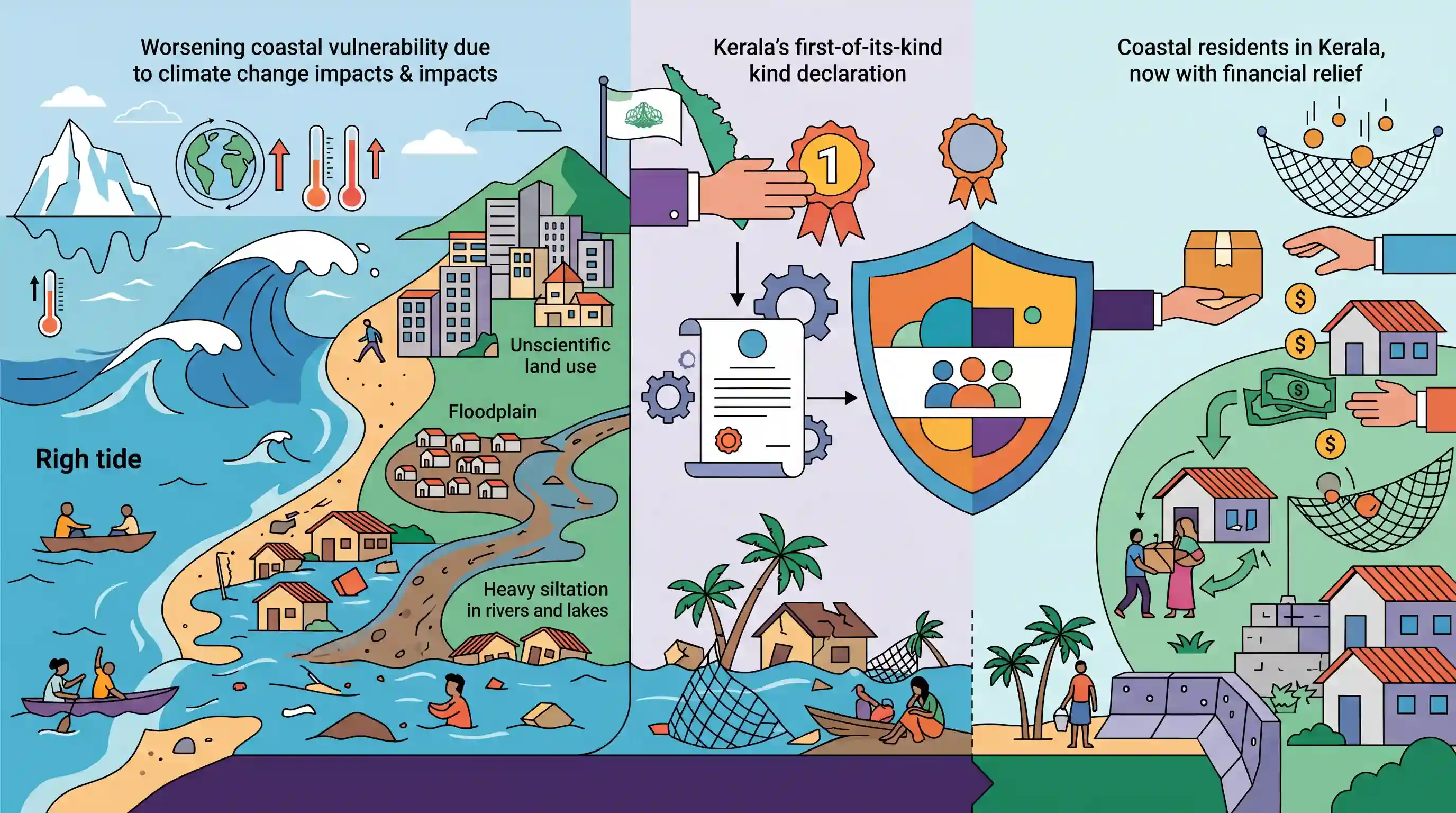
Kerala has become the first Indian state to formally declare coastal high-tide flooding and sea incursion as a 'State-specific disaster.' Although tidal rise is generally treated as a regular natural phenomenon ineligible for compensation under State Disaster Response Fund (SDRF) norms, Kerala invoked Section 2(d) of the Disaster Management Act, 2005. This section allows an event to be classified as a disaster if it causes substantial loss of life or livelihood. Consequently, residents of Kerala's vulnerable coastal districts along the Arabian Sea can now access much-needed financial relief. The perennial issue of tidal flooding, distinct from rainfall-induced floods, has been worsening due to both climate impacts like sea-level rise and anthropogenic factors including unscientific land-use, floodplain encroachment, and the heavy siltation of adjoining rivers and lakes.
Key Points
- Kerala has become the first state in India to declare tidal flooding and sea incursion a "State-specific disaster."
- Tidal rise is typically considered a routine natural event and does not automatically qualify for State Disaster Response Fund (SDRF) relief.
- By leveraging Section 2(d) of the Disaster Management Act, 2005, Kerala redefined the hazard as a disaster because it adversely impacts communities, causing loss of life and livelihood.
- This declaration enables affected populations in the coastal districts to receive financial assistance under SDRF norms.
- The severity of coastal flooding in Kerala is exacerbated by spring tides, sea-level rise, land-use changes, encroachment on floodplains, and the siltation of rivers and lakes.
Important Terms
Disaster Management Act, 2005

A legal framework enacted to ensure effective disaster management, establish institutional mechanisms (NDMA, SDMA, DDMA), and define 'disaster' under Section 2(d) as a catastrophe causing substantial loss.
UPSC context
GS Paper III (Disaster Management). Tests knowledge of administrative structures and legal powers during calamities.
State Disaster Response Fund (SDRF)
The primary fund available with State Governments to provide immediate relief for notified disasters, constituted under Section 48(1)(a) of the DM Act, 2005.
UPSC context
GS Paper III (Economy/Disaster Management). Essential for understanding fiscal federalism and disaster relief financing.
Coastal Regulation Zone (CRZ)
Regulatory guidelines notified under the Environment (Protection) Act, 1986, to protect coastal ecosystems and manage developmental activities within specific distances from the High Tide Line.
UPSC context
GS Paper III (Environment). Tests awareness of coastal conservation laws and sustainable development.
State-specific Disaster
Local natural calamities that a State government can notify to access up to 10% of its annual SDRF allocation for relief, even if not nationally listed.
UPSC context
GS Paper II/III. Concerns federal relations and local adaptation to climate change risks.
Tidal Flooding (Nuisance Flooding)
Also known as 'sunny day flooding,' it is the inundation of low-lying areas during high astronomical tides, often exacerbated by sea-level rise and land subsidence.
UPSC context
GS Paper I (Geography)/III (Environment). Relevant for climate change impacts and coastal vulnerability.
Prelims Trap
SDRF allocations can only be used for disasters explicitly notified by the Central Government.
States can legally utilize up to 10% of their SDRF corpus to provide immediate relief for localized "State-specific disasters" not included in the Centre's official list.
Static Concepts Connected
What are the funding and utilization rules for the State Disaster Response Fund (SDRF)?
- Statutory backing: It is the primary fund constituted under the Disaster Management Act, 2005, available with State Governments for immediate relief.
- Funding ratio: The Centre contributes 75% for general category states and 90% for special category states (hilly and North-Eastern states).
- 10% flexibility window: States can allocate up to 10% of their SDRF for local, state-specific disasters like Kerala's tide flooding, lightning, or snakebites.
How do Spring Tides differ from Neap Tides?
- Spring Tides: Occur during full moon and new moon when the Sun, Earth, and Moon align (syzygy), creating exceptionally high tides.
- Neap Tides: Occur during quarter moons when the Sun and Moon are at right angles, creating lower amplitude high tides.
- Nuisance flooding: Spring tides, when combined with global sea-level rise and local land subsidence, trigger severe "sunny day" coastal inundation.
Cross-Topic Patterns
SDRF Flexibility + Fiscal Federalism
Using the 10% SDRF window for state-specific disasters showcases fiscal autonomy, allowing states to legally fund relief for localized climate vulnerabilities that are absent from central disaster lists.
CRZ Norms + Climate Adaptation
Kerala's flooding intersects with Coastal Regulation Zone (CRZ) issues; static CRZ demarcations and unscientific land-use are failing to protect vulnerable communities against dynamic sea-level rise and tidal inundation.

SDRF rules (the 10% state-specific window) paired with the geography of 'sunny day flooding' is highly probable for 2026 Prelims.
Linked PYQs · 3
Linked PYQs · 3
- 2022MainsGS3
Explain the causes and effects of coastal erosion in India. What are the available coastal management techniques for combating the hazard?
- 2020MainsGS3
Discuss the recent measures initiated in disaster management by the Government of India departing from the earlier reactive approach.
- 2024MainsGS3
What is disaster resilience? How is it determined? Describe various elements of a resilience framework. Also mention the global targets of Sendai Framework for Disaster Risk Reduction (2015–2030).
