Kerala Becomes First State to Eradicate Extreme Poverty
Source:The Hindu ↗
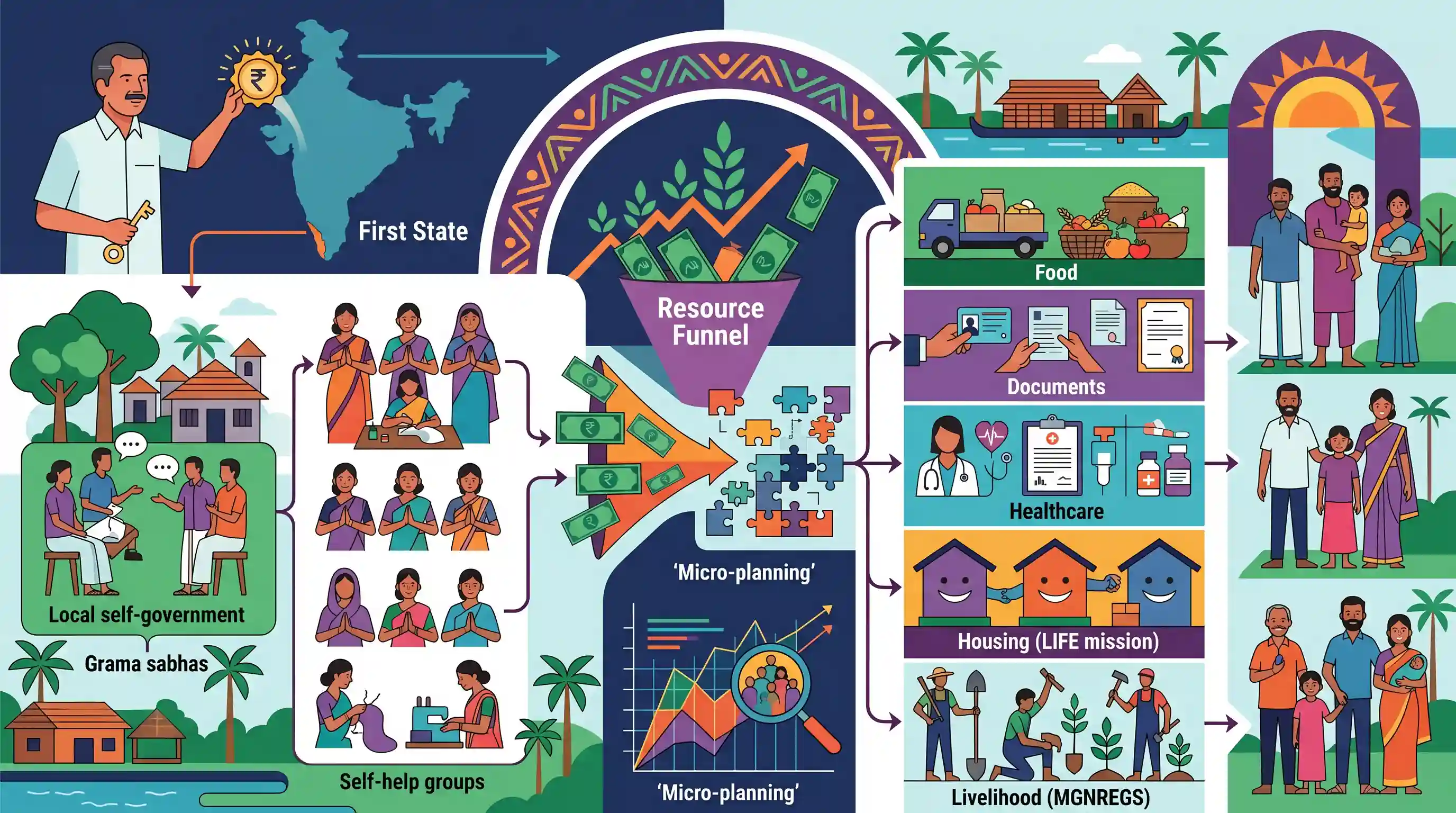
Why It Matters
It serves as a successful governance model for identifying and eradicating extreme poverty through decentralized micro-planning. The active involvement of local bodies and SHGs (Kudumbashree) highlights effective mechanisms for targeted welfare delivery, highly relevant to GS2 topics on poverty, governance, and decentralization.
Summary
Kerala Chief Minister Pinarayi Vijayan declared the State free from extreme poverty, making it the first in India to achieve this milestone. The achievement stems from the Extreme Poverty Alleviation Project (EPEP) initiated in 2021, which utilized local self-governments, grama sabhas, and the Kudumbashree network to identify over 1 lakh extremely poor individuals. Through localized micro-planning and an investment of over ₹1,000 crore, the government ensured targeted delivery of food, essential documents, healthcare, housing (LIFE mission), and livelihood support (MGNREGS) to vulnerable families.
Key Points
- Kerala became the first Indian State to declare itself free from extreme poverty on November 1, 2025 (Kerala Piravi).
- The Extreme Poverty Alleviation Project (EPEP), launched in 2021, successfully identified 64,006 extremely poor families through grassroots participation and micro-planning.
- Criteria for identifying extreme poverty included deficiencies in food, health, housing, and income.
- Interventions included providing essential documents (Ration/Aadhaar cards), housing under the LIFE mission, healthcare, regular food via Kudumbashree, and MGNREGS employment.
- The initiative cost over ₹1,000 crore and utilized local self-governments, ward committees, and grama sabhas to ensure targeted delivery.
Important Terms
Extreme Poverty Alleviation Project (EPEP)

Launched in 2021, this Kerala government initiative aims to identify and uplift the extremely poor through localized micro-planning and community participation within a five-year timeframe.
UPSC context
GS Paper II (Social Justice/Governance): Model for bottom-up development and targeted welfare delivery at the grassroots level.
LIFE Mission
Livelihood Inclusion Financial Empowerment is Kerala's flagship housing scheme providing free, modern homes to landless and homeless families while converging healthcare and skill development services.
UPSC context
GS Paper II (Welfare Schemes): Examines effective housing strategies and the convergence of multiple social welfare benefits.
Kudumbashree
A women-led community network and Self-Help Group (SHG) movement in Kerala. It acts as a massive social capital for poverty eradication, economic empowerment, and local governance.
UPSC context
GS Paper II (SHGs/Governance) and Paper III (Inclusive Growth): Case study for women's role in poverty alleviation and democratic decentralization.
Extreme Poverty
A condition of severe deprivation of basic human needs; defined globally by the World Bank as living on less than $2.15 (now $3.00) per day.
UPSC context
GS Paper III (Economy/Poverty): Tests understanding of global vs. national poverty lines and Sustainable Development Goal 1 (Zero Poverty).
Local Self-Government (LSG)
Constitutional bodies (Panchayats and Municipalities) empowered under the 73rd and 74th Amendments to plan and implement social justice and economic development schemes at the local level.
UPSC context
GS Paper II (Polity/Governance): Core of democratic decentralization and its efficacy in delivering targeted social benefits.
Multidimensional Poverty Index (MPI)
A measure capturing deprivations in health, education, and living standards beyond just income. Kerala holds India’s lowest MPI score (0.55%).
UPSC context
GS Paper III (Economy): Key indicator for measuring holistic development and quality of life in different Indian states.
Prelims Trap
"Kerala relied on NITI Aayog's National Multidimensional Poverty Index (MPI) to identify families and declare itself free from extreme poverty."
Kerala used its own Extreme Poverty Alleviation Project (EPEP) with grassroots micro-planning and localized criteria, independent of NITI Aayog's National MPI parameters.
Static Concepts Connected
How is multidimensional poverty measured versus traditional absolute poverty lines?
- Traditional Lines: Committees like Tendulkar and Rangarajan used Consumption Expenditure Surveys to define absolute poverty lines based on caloric and monetary requirements.
- Multidimensional Poverty: Uses the Alkire-Foster method, measuring multiple deprivations across health, education, and standard of living simultaneously (e.g., Global and National MPI).
What is the structural model of Kerala's Kudumbashree network?
- State Mission: Launched in 1998, it is Kerala's State Poverty Eradication Mission functioning as a massive community-based women's network.
- Three-tier Structure: Operates through a three-tier system: Neighborhood Groups (NHGs) at the base, Area Development Societies at the ward level, and Community Development Societies (CDS) at the panchayat level.
- Grassroots Convergence: Acts as the primary implementing agency for both state welfare micro-planning and central programs like the National Rural Livelihoods Mission (NRLM).
Cross-Topic Patterns
Decentralization + Poverty eradication
Kerala's milestone proves the efficacy of the 73rd Amendment; empowering Gram Sabhas for micro-planning enables highly targeted welfare delivery compared to standardized top-down approaches.
SHG networks + Scheme convergence
Highlights how state-sponsored SHG networks (Kudumbashree) act as multi-dimensional delivery nodes, seamlessly converging housing (LIFE), livelihood (MGNREGS), and food security at the grassroots level.

Expect a GS-2 mains question in 2026 analyzing how SHG-led micro-planning (Kudumbashree) succeeds where top-down poverty schemes fail.
Linked PYQs · 5
Linked PYQs · 5
- 2015MainsGS2
The Self-Help Group (SHG) Bank Linkage Programme (SBLP), which is India's own innovation, has proved to be one of the most effective poverty alleviation and women empowerment programmes. Elucidate.
- 2014MainsGS2
The penetration of Self Help Groups (SHGs) in rural areas in promoting participation in development programmes is facing socio-cultural hurdles. Examine.
- 2017MainsGS2
The emergence of the Self-Help Groups (SHGs) in contemporary times points to the slow but steady withdrawal of the State from developmental activities." Examine the role of the SHGs in developmental activities and the measures taken by the Government of India to promote the SHGs.
- 2024MainsGS2
Analyse the role of local bodies in providing good governance at local level and bring out the pros and cons merging the rural local bodies with the urban local bodies.
- 2022MainsGS2
Besides the welfare schemes, India needs deft management of inflation and unemployment to serve the poor and the underprivileged sections of the society. Discuss.
