CPI(M) Faces Political Flak Over Emergency Remarks in Kerala
Source:Indian Express ↗
Why It Matters
Demonstrates the lasting political legacy of the 1975 National Emergency and how historical constitutional events continue to shape contemporary electoral dynamics and party discipline.
Summary
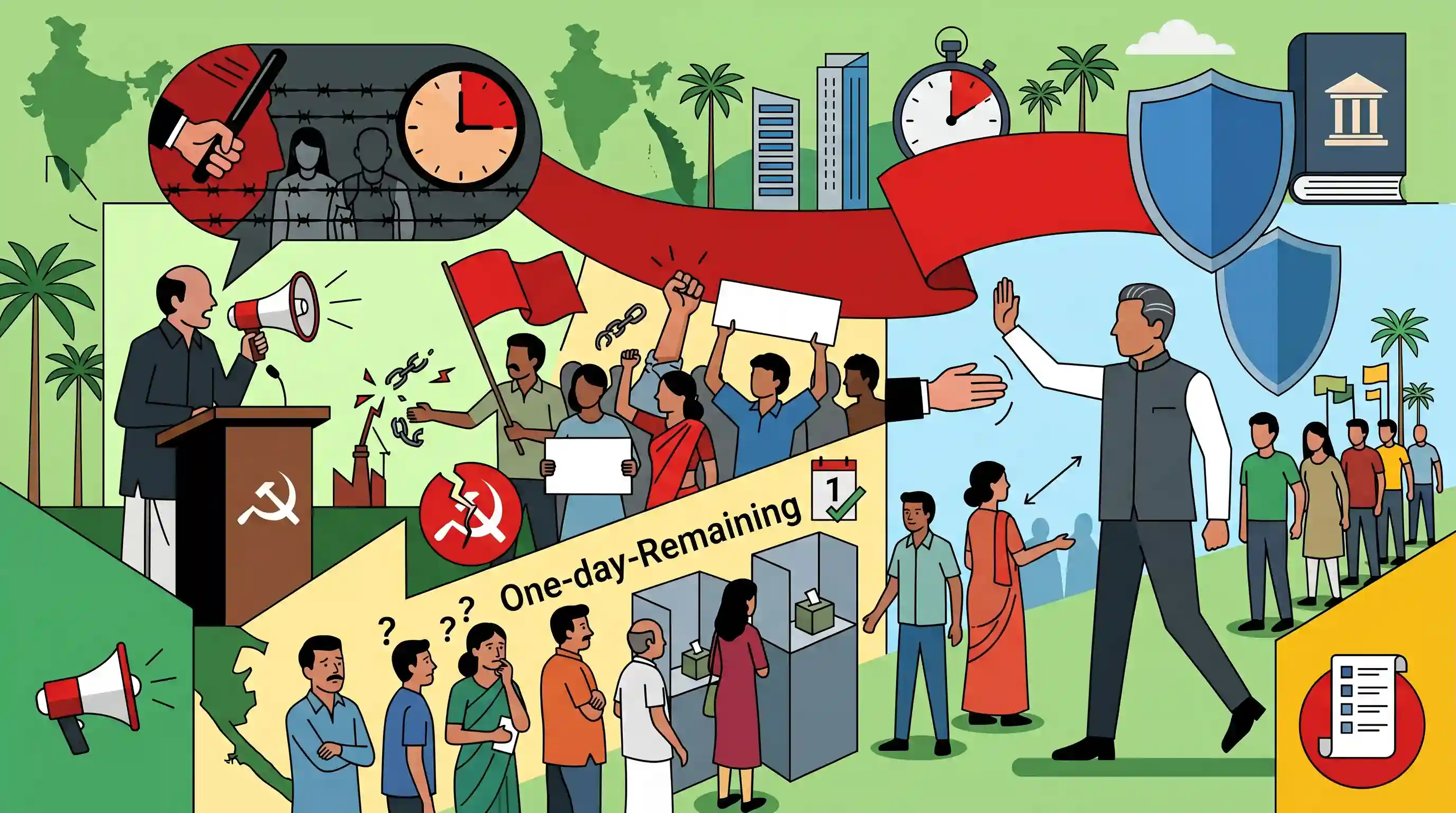
Just a day ahead of the crucial Nilambur bypoll in Kerala, the ruling CPI(M) found itself in an awkward position after a party leader made controversial remarks regarding the National Emergency. The comments, which conflicted with the CPI(M)'s historic opposition to the 1975 Emergency, threatened to damage the party's electoral prospects. Consequently, Kerala Chief Minister Pinarayi Vijayan was compelled to step in and address the situation to mitigate the political damage before the constituency went to vote. The incident highlights the enduring political sensitivity around the Emergency and the immediate impact of political rhetoric on bypoll dynamics.
Key Points
- A controversial remark about the National Emergency by a CPI(M) leader put the ruling party in a difficult position in Kerala.
- The statement was made just a day before the politically significant Nilambur bypoll, risking immediate electoral fallout.
- Kerala Chief Minister Pinarayi Vijayan was forced to publicly address the issue to clarify the party's stance and control the damage.
- The incident underscores the CPI(M)'s historical opposition to the 1975 Emergency and the enduring sensitivity of the issue in Indian politics.
Important Terms
National Emergency (1975)

A period (1975–1977) when the President, citing "internal disturbance," suspended fundamental rights and democratic processes under Article 352. It remains a watershed moment in India's constitutional and political history.
UPSC context
GS Paper II (Polity) and Modern History; tests understanding of emergency provisions, federalism, and judicial review.
Representation of the People Act, 1951
The primary legislation governing the actual conduct of elections in India, including the registration of political parties, candidate qualifications, disqualifications, and the adjudication of election disputes.
UPSC context
GS Paper II (Elections); a core topic regarding electoral reforms and the legal framework of Indian democracy.
Bye-election (Bypoll)
An election conducted to fill a single legislative seat that becomes vacant between general elections due to a member's death, resignation, or disqualification.
UPSC context
GS Paper II (Electoral Process); tests knowledge of mid-term vacancies and the Election Commission's mandate.
CPI(M)
A National political party formed in 1964 following a split from the CPI. Ideologically Marxist-Leninist, it historically opposed the 1975 Emergency and remains a major force in Kerala politics.
UPSC context
GS Paper II (Political Parties); relevant for understanding the evolution of the party system and ideological shifts.
Article 352
The specific provision in the Indian Constitution that empowers the President to declare a National Emergency when the security of India is threatened by war, external aggression, or armed rebellion.
UPSC context
GS Paper II (Polity); central to questions on executive powers and constitutional safeguards during crises.
Prelims Trap
A bypoll must be held within six months of a vacancy regardless of the remainder of the member's term.
Section 151A of the RPA 1951 mandates bypolls within six months only if the remainder of the term is at least one year. If less remains, it is not required.
Static Concepts Connected
How did the 44th Amendment alter the constitutional provisions for a National Emergency?
- Grounds for declaration: Replaced the vague ground of 'internal disturbance' with the more specific 'armed rebellion' under Article 352.
- Cabinet approval: Mandated that the President can proclaim an emergency only after receiving a written recommendation from the Union Cabinet.
- Fundamental Rights: Prohibited the suspension of Fundamental Rights guaranteed by Articles 20 and 21, even during a National Emergency.
What are the statutory rules governing the 'silence period' during Indian elections?
- Legal backing: It is mandated under Section 126 of the Representation of the People Act, 1951.
- Duration: It lasts for 48 hours ending with the specific hour fixed for the conclusion of the poll.
- Restrictions: Strictly prohibits public meetings and the display of election matter via television, cinematograph, or similar apparatus.
Cross-Topic Patterns
Emergency safeguards + Election Commission powers
The historical misuse of Emergency powers directly inspired the 44th Amendment safeguards, which are often tested alongside the Election Commission's statutory tools to ensure uninfluenced voting.
Article 19 vs. RPA Silence Period
The 48-hour election silence period limits politicians' free speech (Article 19) just before voting, creating a recurring UPSC theme balancing fundamental rights against statutory election laws.

Expect a statement-based question linking the 44th Amendment's Emergency safeguards with the ECI's statutory powers under the RPA 1951.
Linked PYQs · 4
Linked PYQs · 4
- 2024PrelimsGS1
Which of the following statements are correct about the Constitution of India? 1. Powers of the Municipalities are given in Part IX A of the Constitution. 2. Emergency provisions are given in Part XVIII of the Constitution. 3. Provisions related to the amendment of the Constitution are given in Part XX of the Constitution. Select the answer using the code given below :
- 2022MainsGS2
Discuss the procedures to decide the disputes arising out of the election of a Member of the Parliament or State Legislature under The Representation of the People Act, 1951. What are the grounds on which the election of any returned candidate may be declared void ? What remedy is available to the aggrieved party against the decision ? Refer to the case laws.
- 2020MainsGS2
There is a need for simplification of procedure for disqualification of persons found guilty of corrupt practices under the Representation of Peoples Act". Comment.
- 2025MainsGS2
Discuss the 'corrupt practices' for the purpose of the Representation of the People Act, 1951. Analyze whether the increase in the assets of the legislators and/or their associates, disproportionate to their known sources of income, would constitute 'undue influence' and consequently a corrupt practice.
